

We ranked the best proposal software for consulting firms in 2027 on two things: the editor, and whether the price becomes the project budget.
A consulting proposal has two jobs. It has to win the client, and the price inside it becomes the budget your team delivers against. Most PSAs only do the second job well. They build the price from a quote or template, then leave you to write the proposal in Word, so the document your client signs and the budget your team works from drift apart. Standalone proposal software for consultants has the opposite problem, with a good editor and no link to delivery.
We compared 12 tools on both jobs to find the best proposal software for consulting firms in 2027, using vendor documentation and G2 reviews.
What is proposal software, and what are the three types?
Proposal software, also called proposal writing or proposal management software, helps a firm write, price and send the document that wins the work. RFP teams also use “proposal management” for tools that answer long questionnaires from a library of approved responses, which this list doesn’t cover.
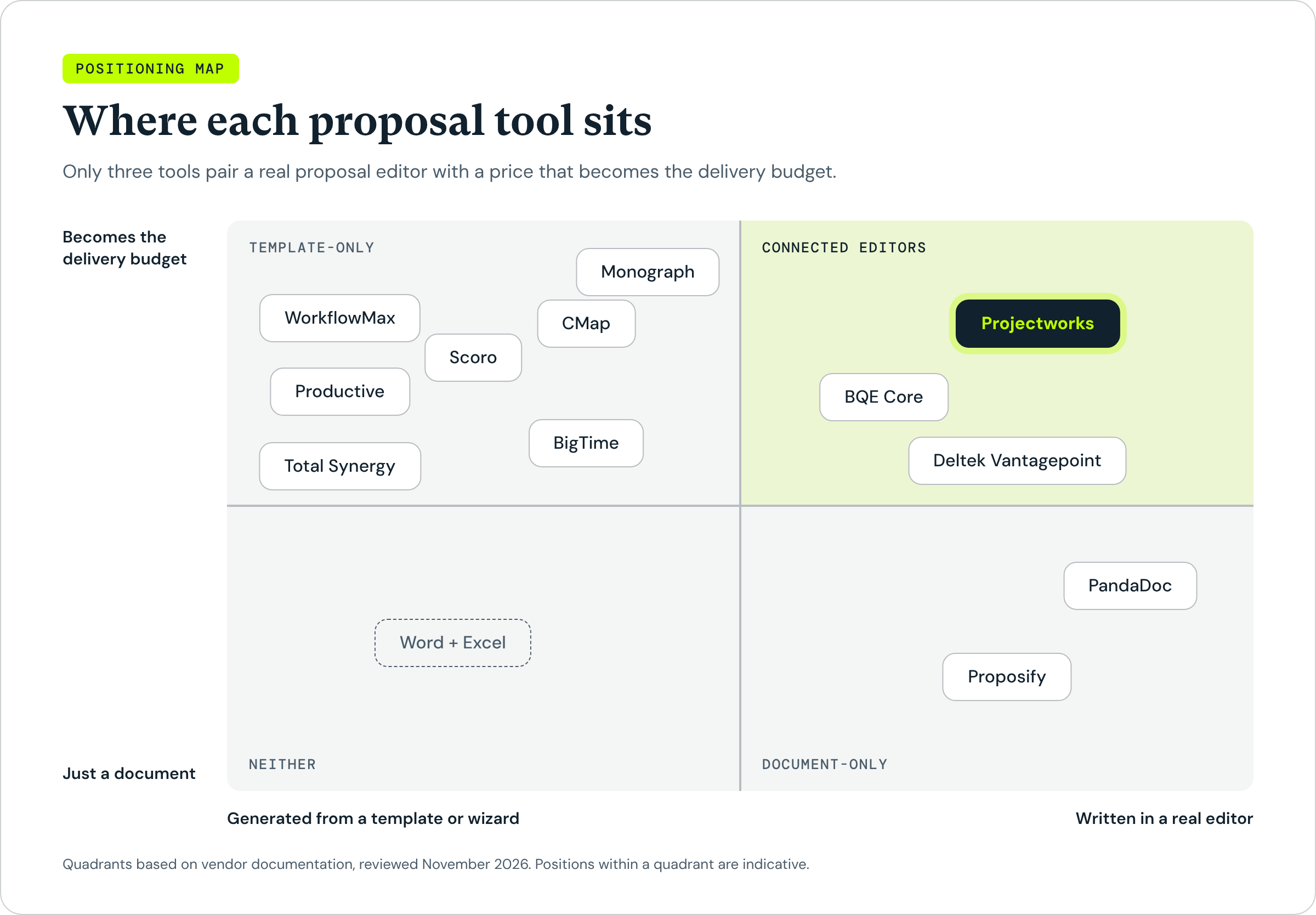
Document-only tools such as PandaDoc and Proposify are a different kind of product from everything else on this list. They’re proposal builders made for sales teams rather than PSAs, and their job is to get a document written and signed. They don’t hold projects, budgets or timesheets, so once the client signs, someone retypes the price into a separate delivery system.
Template-only tools work the other way around, and most PSAs fall into this group. Their proposal automation software carries the price into the project, but an automated proposal generator merges it into a template instead of giving you somewhere to write.
Connected editors do both. Projectworks, BQE Core and Deltek Vantagepoint pair an in-app proposal editor with the system that runs delivery, although how far the price carries into the project still differs between them. It's the same choice as a PSA with built-in CRM versus two systems joined by an integration.
Comparison of best proposal software tools for consulting firms
Top 12 Proposal Editors [Compared for 2027]
1. Projectworks

What it is
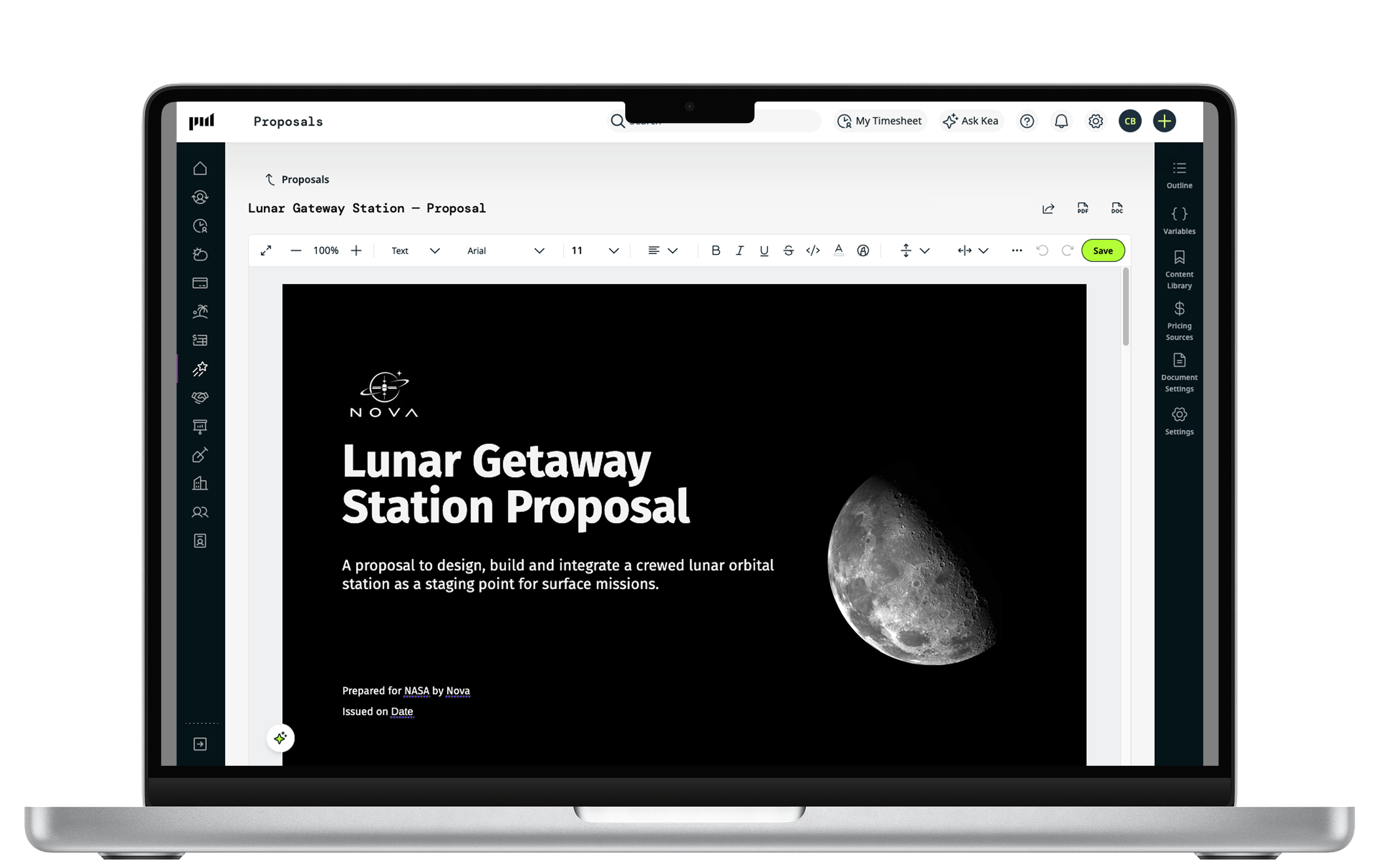
Projectworks is a PSA with a consulting CRM built in, made for consulting firms of 20 to 200 people. With proposals in Projectworks, a proposal is created, priced and signed on the deal, in the same platform that runs delivery from first call to final invoice.
Where it wins
- A rich-text editor where AI tailors drafts from your RFPs, project briefs, client requirements, call transcripts or emails
- AI controls that adjust, simplify, expand or refine the writing
- A content library of reusable blocks for methodologies, case studies, pricing models and team bios, plus your best proposals as templates
- Repeated snippets, such as the client's name, controlled everywhere they appear
- Each deal keeps its proposals, notes and budget in one place
- Won work becomes a project in one step, seeded with the budget the client agreed to
- Clients sign in the document through a secure link with optional password and expiry, and the signed version locks with an audit trail
- G2 reviewers single out its budget visibility and project margin reporting
What it's not designed for
Projectworks is built to be the one system where a consulting firm sells, prices and delivers its work. It isn't designed for:
- Marketing automation. It's a sales pipeline for delivery firms, not a marketing CRM, so firms running outbound campaigns keep a marketing tool beside it.
- Qualified electronic signatures. Most consulting engagements are standard commercial agreements that don't call for one. A qualified signature is an EU standard that usually only comes up when the law requires a handwritten-equivalent signature, such as some public-sector contracts. If your clients need one, or insist on signing through their own DocuSign account, check the fit first.
The verdict
For a consulting firm that writes real proposals and wants the price to become the budget without a second tool, this is the closest fit here. Proposals come with a consulting CRM and are included on select Projectworks plans.
2. BQE Core
What it is
BQE Core is practice management software for architecture and engineering firms, and its in-app Proposal Builder is part of CORE CRM.
Where it wins
- A quote inserted into the Proposal Builder sets the proposal amount
- When a won opportunity becomes a project, the linked quote can become the budget
- Signing through CORE's DocuSign integration
- G2 reviewers praise its time tracking and invoicing
Where it falls short
- The link to delivery runs through the opportunity, not the document
- The Proposal Builder needs CORE CRM added to the account
- G2 reviewers mention slow page loads and a learning curve
The verdict
A good fit for an A&E firm whose clients expect DocuSign. A management or IT consultancy will be working around A&E assumptions, the main trade-off in how BQE Core compares with Projectworks.
3. Monograph
What it is
Monograph is firm management software built only for architecture and engineering practices, and its proposals start from .docx templates that you upload and tag.
Where it wins
- AI writes a first draft from the lead context
- Pipeline connects leads and proposals to the projects your team delivers
- Built-in e-signature with no client account needed, plus automatic reminders
- G2 reviewers like having costs and revenue in one place
Where it falls short
- Templates must be Word (.docx) files, with editing done in the document
- Pipeline is an add-on for Grow subscribers
- G2 reviewers mention a learning curve and limited invoice customization, from a small sample of 37 reviews
The verdict
A fit for A&E practices that already write their proposals in Word. Consultancies outside A&E can see how Monograph compares with Projectworks.
4. BigTime
What it is
BigTime is time, billing and project software for professional services firms, and it builds proposals as a priced statement of work.
Where it wins
- A quote setup wizard builds the price
- Document templates turn the quote into an editable SOW
- Create New Project carries the quote's key fields into a project
- Scores above the G2 PSA category average for ease of setup and use
Where it falls short
- Its own help center warns that document edits don't sync back to the quote data
- Approved quotes are locked unless an admin recalls them
- Quotes are downloaded as a PDF to send, and we found no client e-signature
The verdict
Suits firms whose proposal is mostly a price with a scope attached. Firms that also need a written argument can weigh BigTime against Projectworks.
5. Productive
What it is
Productive is agency management software that generates proposals from the deal using a document template.
Where it wins
- Flags a proposal as out of sync when the deal pricing changes
- Clients sign through a secure public link, and the team can track status
- G2 reviewers praise its ease of use
Where it falls short
- Public links need the Professional or Ultimate plan, and engagement analytics need Ultimate
- Bespoke narrative is uploaded as a PDF that no longer draws on Productive data
- One G2 reviewer found the built-in builder too basic for designed proposals
The verdict
A fit for agencies selling scoped packages, while consultancies that write longer proposals can check how Productive compares with Projectworks.
6. PandaDoc
What it is
PandaDoc is document software for sales teams selling products and packaged services.
Where it wins
- Drag-and-drop editor and templates
- Quote builder with pricing tables, plus CPQ on the Enterprise plan
- Approval workflows, e-signature, payment collection and document analytics
- G2 reviewers rate it highly for ease of use and time-saving templates
Where it falls short
- Its own materials describe a workflow that ends at signature and payment, with no project budget
- The content library and approval workflows start on the Business plan, a gate G2 reviewers also mention
The verdict
Suits sales teams that need documents out and signed quickly, though a consulting firm still carries the signed price into delivery by hand.
7. Proposify
What it is
Proposify is proposal software for sales teams.
Where it wins
- Drag-and-drop editor and reusable templates
- Content library and pricing tables with interactive quoting
- Approval workflows, proposal tracking and e-signature
Where it falls short
- Its own materials describe a process that ends at the client's signature, with no delivery budget or project handoff
- When a consulting firm compares Proposify alternatives, the real question is what happens to the price after the client signs
The verdict
Suits sales teams that hand delivery to someone else.
8. Scoro
What it is
Scoro is a PSA for agencies and consultancies that sell from a priced quote.
Where it wins
- A quote estimation matrix (Performance and Enterprise plans) breaks deliverables down by role and person, with internal cost and margin
- A quote converts to a project, with quoted versus actual reportable
- Clients can comment on a shared link
Where it falls short
- Works in quotes rather than proposals
- The client document is a configured PDF template, so a narrative proposal is written in another tool
The verdict
A fit for firms that sell from a detailed estimate. If your proposals carry more argument than arithmetic, see how Scoro compares with Projectworks.
9. Deltek Vantagepoint
What it is
Deltek Vantagepoint is a project-based ERP for architecture, engineering and consulting firms.
Where it wins
- Custom Proposals pulls project sheets and employee resumes straight from Vantagepoint records
- Proposals export to PDF or Word
Where it falls short
- Custom Proposals requires the CRM Plus module
- Deltek's documentation describes exporting proposals to send, not signing them in the product
- G2 reviewers report about six months to implement, plus complaints about reporting and the learning curve
The verdict
Built for large AEC bid teams, and a lot of system for a 40-person consultancy, as our Deltek Vantagepoint comparison shows.
10. Total Synergy
What it is
Total Synergy is Australian-built project management software for architecture and engineering firms.
Where it wins
- Proposals are generated as Word documents from templates with Synergy bookmarks
- A stage-level fee breakdown that is then tracked through invoicing
- G2 reviewers praise its customer support
Where it falls short
- Edits happen in the Word document, not in the product
- Proposals are shared by email or transmittal
- A few G2 reviewers raise cost and accounting sync
The verdict
A fit for A&E practices that price by stage, while other consultancies can see how Total Synergy compares with Projectworks.
11. WorkflowMax
What it is
WorkflowMax is job management software for small firms that send quotes.
Where it wins
- An accepted quote moves to Pending Quotes, ready to become a job
- eQuote (Advanced plan) lets clients accept or decline on a secure page with an audit trail
- G2 reviewers like its central time tracking
Where it falls short
- The quote document comes from a custom template, not an in-app editor
- Its own FAQ notes that a formal signature workflow may still need a separate e-signature tool
- Some G2 reviewers report bugs and limited functionality
The verdict
Suits small firms that quote rather than propose, and WorkflowMax vs Projectworks covers what changes as a firm grows.
12. CMap
What it is
CMap is PSA software for UK consultancies and architecture and engineering firms.
Where it wins
- A Fee Estimator that builds estimates bottom-up, top-down or a mix, with AI analysis of comparable past projects
- Proposals auto-populated from custom templates with client names and costing tables
- Real-time margin tracking alongside
Where it falls short
- The proposal document is generated from a custom template, closer to the template-only tools above than to a writing surface
- G2 reviewers find the report builder complex and report about four months to implement
The verdict
A fit for UK firms that lead with the fee estimate.
Choosing the best proposal software for your firm
Here's where we'd start, including firms Projectworks isn't built for.
What to look for in the best proposal software: a 5-point checklist
Proposal software for consultants gets heavy use, so the editor matters as much as the connection. In Projectworks research, firms submit an average of 91 proposals a year and spend an average of 24 hours on each. Senior staff contribute 47% of that time, roughly 11 hours per proposal, so every hour a tool saves comes out of the most expensive calendars in the firm.
When we asked professional services experts what they most wanted to improve, content generation came first at 46%. The second answer was the half that most proposal tools leave out.
1. A real authoring surface
- Can you write the approach and assumptions in the tool, or does the narrative go back to Word?
- Does the proposal creation software handle long text, tables and images without fighting the layout?
- Can AI draft from the client's own material, such as an RFP or a call transcript?
2. Pricing that becomes the delivery budget
- Does the fee in the proposal become the project budget, or does someone retype it after the client signs?
- Is the budget locked to the version the client signed, so the team delivers against what was agreed?
- Does an accepted proposal create the project with its phases and fees intact?
3. Sharing, tracking and signing
- Does it send a secure link the client can read on any device, as the best software for creating and sharing sales proposals does?
- Can you see when the client opened it, which is the job proposal tracking software and good online proposal software both do?
- Can the client sign inside the document, so the tool also does the work of proposal and contract software?
4. Content reuse
- Can you save your best past proposals as templates?
- Can you find and reuse the write-ups and team bios that won past bids, which usually sit buried in old files?
5. Fit for a 20 to 200 person firm
- Can you set it up without a dedicated systems admin or a six-month implementation?
- Is it built for your region and your type of consulting work, rather than an enterprise bid team or a quote-only shop?
Why choose Projectworks for proposals
Projectworks is built for consulting firms of 20 to 200 people in management consulting, IT and software services, engineering and architecture that win work with proposals, quotes or statements of work and then deliver against the number they quoted. It replaces the spreadsheet, the Word file and the second round of data entry with one record that becomes the project and carries through to the invoice.
See our CRM and Proposals in action for yourself
Book a demo and we'll show you around, or start a free trial and try it yourself.
Or start building your proposals now using our free template!
Free template [Word & PDF]
Consulting Proposal Template for Professional Services
Eleven pages that walk your client from “here’s our problem” to “where do I sign.” Instant download.
Download the free template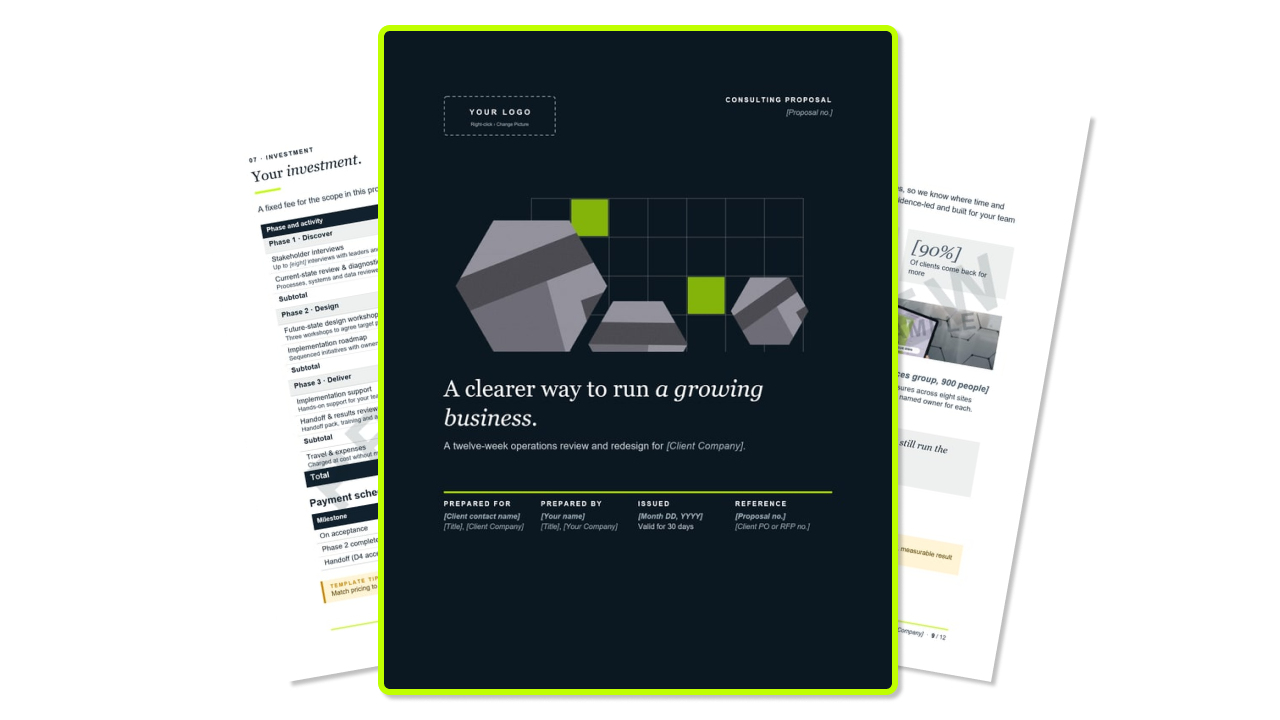
FAQs

Read similar resources from Projectworks
Five client and cash questions firm leaders can answer before their next client or board meeting, by asking Claude, ChatGPT or Copilot connected to Projectworks through MCP. MCP is a common way for AI assistants to link to other software so they can look things up and make changes.
If Claude, ChatGPT or Copilot is already open somewhere in your working day, connect it to Projectworks and it can check delivery against the budget and draft changes for you to approve. The connection runs on MCP, a common way for AI assistants to link up with other software so they can look things up and make changes there.
Thinking of switching from Harvest after the price increase? What to decide first, what data you can export, and how a migration actually works.