


What is a statement of work? A plain definition, the sections every SOW needs, and three annotated examples from consulting, engineering and IT projects.
For a consulting firm, the statement of work is what the delivery team gets held to and what finance invoices from. When a client asks whether an extra workshop is included, or finance needs to know whether a milestone can be billed, a good SOW answers the question without anyone going back to the proposal.
What is a statement of work?
A statement of work (SOW) is a signed document that sets out the work a firm will do on one engagement. It covers the deliverables and how each is accepted, the timeline, who does the work, and the price and payment terms.
Most consulting firms sign a master services agreement (MSA) once with each client to cover legal terms like liability and confidentiality. Each new engagement then gets its own SOW, which holds the scope and price for that piece of work. People often treat "statement of work" and "scope of work" as the same thing, but a scope of work is only one section of an SOW.
What a statement of work does for a consulting firm
For your delivery team, the SOW is the list of what you owe the client. Anything that isn't in it is either a favor or a change request. For your finance team, it sets when each invoice can go out and what has to happen first, such as a deliverable being signed off. And when a client asks for something new, the change process in the SOW decides whether that work gets billed.
Vague SOWs cost money.
Scope disputes and invoicing errors are among the causes it lists. The figure spans all industries rather than consulting specifically.
What's in a statement of work
Each section takes some care to draft well, and our step-by-step guide to writing an SOW walks through them in order.
Types of statement of work
There are three main types of SOW, and the right one depends on how clearly the client can define the work up front.
A design/detail SOW spells out exactly what you'll produce and how. It suits work with a clear spec, like an engineering package built to an existing standard.
A level-of-effort SOW pays for your team's time, usually on time and materials. It suits discovery work, ongoing advisory and phased design, where later work depends on what you find early on.
A performance-based SOW describes the result the client needs and leaves the method to you. (US federal rules tell agencies to write these around required results rather than methods or hours - FAR 37.602. You get more freedom in how you deliver, but more risk if success is hard to measure. Firms in government contracting see this type most often.)
Statement of work examples
The three SOW examples below are illustrative composites, not real client documents. Each uses a different way of charging, and each table shows four lines a delivery lead should check before signing.
Fixed-fee strategy engagement (management consulting)
A 25-person consultancy is running a 10-week operating model review for a healthcare group, for a fixed fee. The client wants a recommendation its board can vote on.
On a fixed fee, a clear acceptance test protects your margin, because an open-ended deliverable is where unpaid work creeps in.
Phased design engagement on time and materials (engineering)
An engineering firm is doing concept and preliminary design for a stormwater upgrade, billed on time and materials. The first phase is a site investigation.
Even on time and materials, clients tend to treat the estimate as a budget, so the SOW still needs a clear scope.
Milestone-billed software implementation (IT services)
An IT services firm is setting up a cloud finance system for a manufacturer, paid in milestones. The biggest payment depends on the client finishing user acceptance testing, and firms using this model often start from an IT and software SOW template.
With milestone billing, the acceptance clause controls your cash flow, because a client that's slow to test is also slow to pay.
When does a consulting firm need a statement of work?
You need one before any billable work starts, including a second phase with an existing client whose MSA is already signed. Smaller firms sometimes let a signed proposal act as the SOW. That works until there's a disagreement and the only record of the scope is a sales document.
A consulting proposal is written to persuade the client, while the SOW records what the client actually bought. The consultancy proposal format in Projectworks' How To Win More Work ebook keeps Scope & Deliverables, Pricing & Investment, and Assumptions/Exclusions as separate sections. The SOW turns each of those into a commitment. For example, a deliverable gets an acceptance test, and a price gets the event that triggers its invoice.
Start from an SOW that matches how your team works
Plenty of scope arguments start with an SOW rushed out the night before kickoff. Starting from one that already reflects how your team delivers means the hard questions are settled before the work begins.
Free template
Statement of work template for professional services firms
Start your next engagement from a structured SOW instead of a blank page.
Download the free template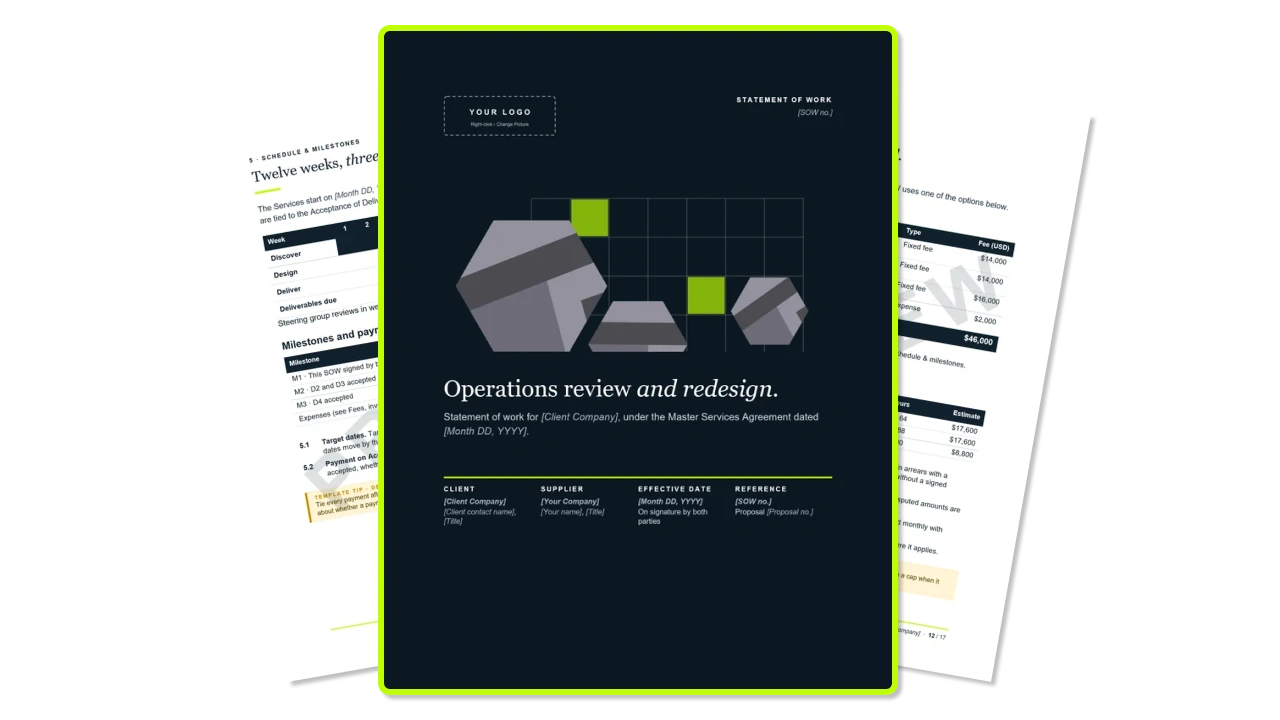


Read similar resources from Projectworks

This month is a special one - the Projectworks Consulting CRM and Proposals are now available for anyone to use or try out. A big thank you again to all of our design partners and early access firms, whose extensive feedback has shaped these features. There’s also lots more planned, so you’ll see them both in upcoming product updates! More tooling also landed in expenses and resourcing this month, so keep reading to find out more 👇

It's the end of September and expenses got a lot of love this month, with a couple of big changes you can start using today and more on the way! We've also made updates across financial reporting, resourcing, HubSpot, and invoicing, dive in to see what's new.

Most pipeline coverage advice is written for SaaS. Here's how a consulting firm sets coverage by deal stage and plans for the clients it will lose.