


Most pipeline coverage advice is written for SaaS. Here's how a consulting firm sets coverage by deal stage and plans for the clients it will lose.
In a recent Projectworks podcast episode, CEO Mark Orttung and CCO Dominique Rennell talked through what to do when your biggest client stops spending, and how much pipeline a firm needs so that one lost client doesn’t wreck its growth plan. This post takes that second question further. Most pipeline coverage advice is written for SaaS sales teams chasing new logos against a quarterly quota. Across 700+ consulting firms in Projectworks customer data, the largest client brings in 36% of revenue on average, so losing an existing client is usually the biggest risk to a firm’s year.
What is pipeline coverage?
Pipeline coverage is the ratio of your open pipeline to your revenue target for the same period.
Metabase sets out the pipeline coverage formula as open pipeline value ÷ quota, and a consulting firm's quota is its revenue target. So $2M of open deals against a $1M quarterly target is a pipeline coverage ratio of 2x. Weighted pipeline adjusts for risk by multiplying each deal's value by its odds of closing. Count only deals that can close inside the period, since a big consulting deal that won't sign until next year flatters this quarter's number without adding to it.
Why the 3x rule doesn't fit a consulting firm
The usual benchmark is 3x pipeline coverage. HubSpot puts most successful sales organizations between 3-to-1 and 5-to-1, and 3x is one divided by a win rate of about 33%. The math holds up for the business it was designed for, which is new-logo sales, where existing revenue belongs to someone else and is expected to renew. In Projectworks research, 55% of proposals are for existing clients or repeat work, so the revenue a quota model treats as safe is where a consulting firm has the most to lose.
Consulting has its own older heuristic that gets closer, the 2-4-8 rule often attributed to McKinsey. Per director, it calls for two projects in progress, four in proposal and eight prospects in active conversation, which at least accepts that deals carry different odds by stage. A flat 3x ratio treats a deal in discovery the same as one in negotiation.
How much pipeline coverage do you need?
Coverage works better when it's set by deal stage. Take a 50-person firm doing $10M a year that wants to grow 20%. That's $500K of new bookings a quarter, assuming the firm keeps every dollar of existing revenue. The pipeline it takes to produce those bookings depends on where each deal sits, because each stage's coverage multiple is roughly one divided by its win rate.
Projectworks CEO Mark Orttung puts typical stage win rates like this:
At proposal stage, $500K a quarter means carrying $1M to $1.25M in live proposals.
Plan for the clients you'll lose
Stage multiples size the pipeline for growth, and they say nothing about the clients who'll leave during the year. Mark's guidance is that if you expect around a quarter of your clients to churn, coverage needs to go "a little bit higher" than those multiples alone suggest. At Nexient, the consulting firm he ran before Projectworks, client loss was a planning input rather than a surprise.

We had effectively assumed that we were gonna lose one client per region. We had five regions… we had about 40 or 50 clients. So we figured about five of them would just disappear randomly. And so we just tried to build our pipe to be big enough.
Nobody could have named those five clients in advance, which is exactly why planning for the total works. When a loss comes, it lands as a gap the pipeline already has room for rather than an emergency that sends everyone back to prospecting from a standing start.
Read your pipeline in three layers
A ratio can't show how much of the year's revenue is already secure, so Mark reads coverage alongside a revenue bridge, a simple version of a revenue forecast. It splits the annual number into contracted backlog, weighted pipeline and what Mark calls go-get, revenue you're confident you'll sell but can't yet tie to a client or project.
For example, in Nexient's February 2021 estimate for the year, go-get came to about 7% of the total.
How to increase pipeline coverage at each stage
One business development person builds the pipeline and two account leads build solutions and pitch. A bigger pipeline stretches all three, so each stage starts with getting more from the people you have.
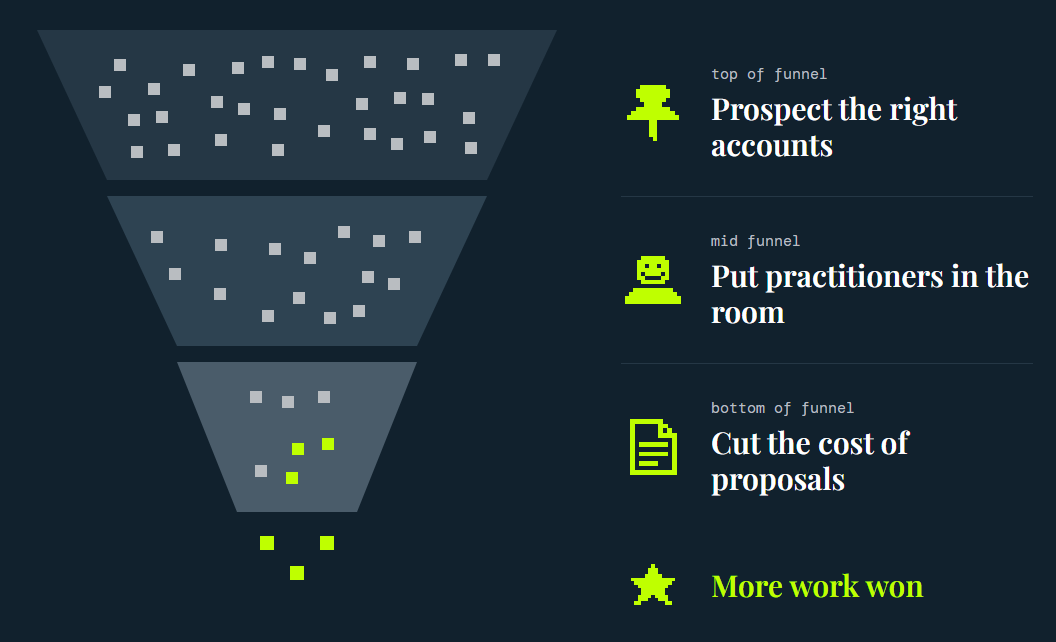
Top of funnel: more prospecting, pointed at the right people
Before hiring more business development people, use AI workflows to take research and list-building off the one you have. Then point that effort at better targets. A defined list of accounts you work consistently (account-based marketing, or ABM) gets further than volume, and the best names on it share a mindset as well as a profile. Nexient looked for what it called "dissatisfied optimists," people "unhappy enough with the way things are, but optimistic enough that they think they can make a change happen."
Start early. In Mark's experience, an enterprise-grade account takes 6 to 18 months to crack and usually opens with a pilot. If sales isn't your background, resist measuring a salesperson only on closed business, and reward the prospecting activity too, or the long early stretch will look like failure.
Mid funnel: put practitioners in the room
Buyers want to meet someone who has done the work early in a sale, so a consulting firm's strongest sellers are often practitioners who want to sell. They pitch with more conviction because they're describing their own work. A dedicated salesperson still needs a clear ideal client profile behind them.
Without one, in the words of Dominique Rennell, CCO of Projectworks,
Until you can hire a practitioner who sells, carve out part of an expert's week for selling, for example 30%.
Bottom of funnel: cut the cost of each proposal
More prospects means more proposals. Mark's illustrative firm spends around 25 hours on each one, which is close to the 24-hour average in Projectworks community data and won't hold once volume climbs. Cut the low-value sections, since not every proposal deserves the same effort, and turn content you rewrite every time, such as client brag sheets (short summaries of past client work), into material you can reuse.
Size your coverage before you need it
Pipeline coverage only protects you if it's there before the bad news. The deals that would replace a big client need to be in proposal before it cuts back, and getting them there takes months.
If the call from your biggest client has already come, start with this 90-day plan.


Read similar resources from Projectworks

Let’s say a consulting firm signs a $30,000 engagement in July and invoices the full fee upfront. The client pays quickly and the cash lands, but the work runs from July through September. By the end of July the firm has completed about one-third of the engagement - the project’s on track but the finance team have some work to do to match revenue with the costs incurred (the “matching principle” of having costs and revenue in the same period is a key accounting concept). Only a third of the project’s fee has been earned (because only a third of the work has been done), and the remaining $20k of revenue is deferred to a future period.
It's the end of September and expenses got a lot of love this month, with a couple of big changes you can start using today and more on the way! We've also made updates across financial reporting, resourcing, HubSpot, and invoicing, dive in to see what's new.
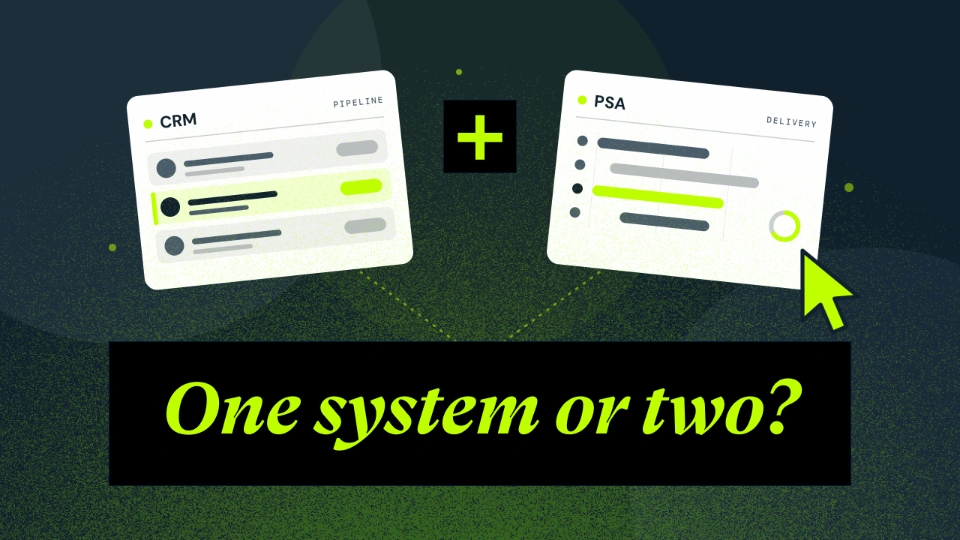
PSA software with built-in CRM, or a separate CRM? For consulting firms, one system usually wins. Here's why.