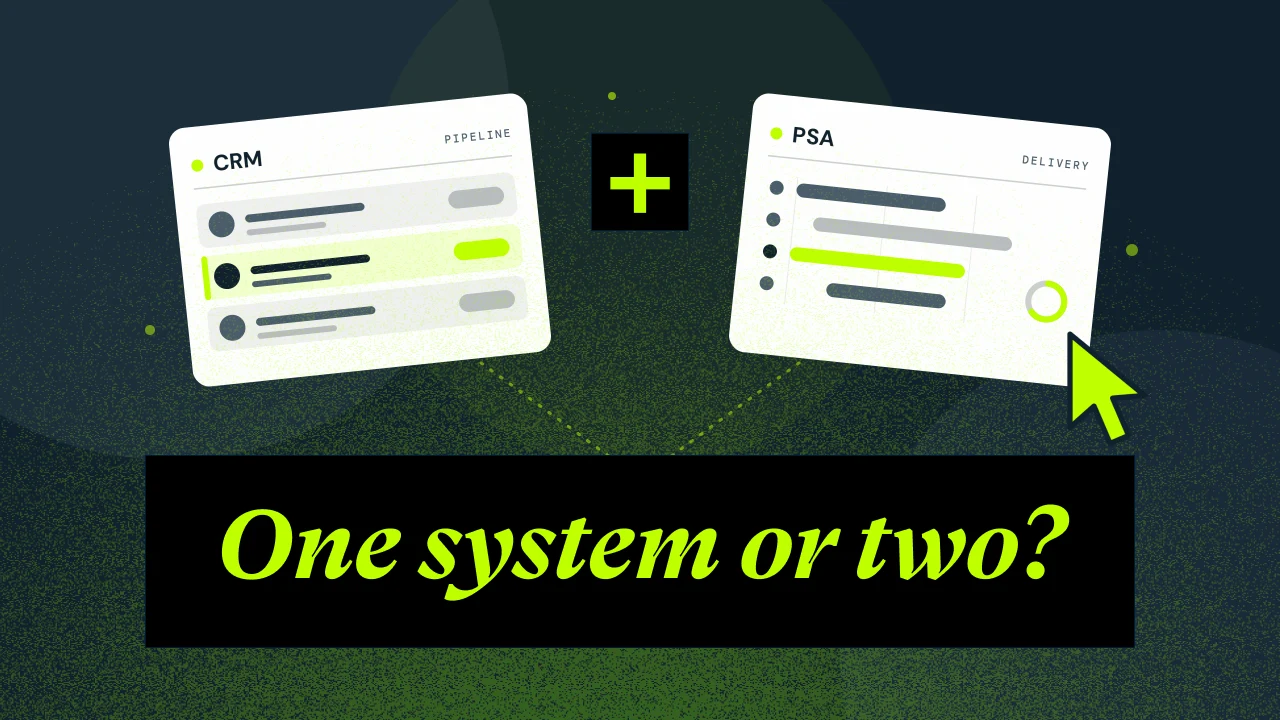


PSA software with built-in CRM, or a separate CRM? For consulting firms, one system usually wins. Here's why.
What happens to a proposal in the days after the client signs it? In many consulting firms, somebody in operations opens it in one window and rebuilds it as a project in another, typing the phases and hours into the system that will run delivery. Whether that retyping happens at all is what separates PSA software with built-in CRM from a separate CRM wired to your PSA.
Our advice for a consulting firm of 20 to 200 people is to pick one system. Some firms are better served by two, though they tend not to sell the way consulting firms do.
Built-in CRM vs best-of-breed: where the handoff lives
There are two ways to set this up. The first is an all-in-one PSA CRM, a professional services automation (PSA) platform with the CRM built in, so pipeline and proposals share a database with delivery. The second is the best-of-breed route, where a standalone CRM such as Salesforce or HubSpot connects to a separate PSA through an integration. Either arrangement can track a pipeline and run projects, so the difference between them comes down to where the seam falls. With two systems it falls at closed-won, the moment a deal passes from the people who sold it to the people who have to deliver it at a margin. Once you've settled whether a consulting firm needs a CRM or a PSA, the practical question becomes how many systems should do those two jobs.
The seam matters more in consulting than in most businesses because of where the work comes from. In Projectworks research, 55% of proposals go to existing clients or repeat work, and for about 60% of firms, repeat work makes up more than half the total. A firm selling that way has little use for a machine built to convert strangers into customers, because the work that decides its margin is turning each proposal won from a familiar client into a project cleanly, then doing it again next quarter.
What "built-in CRM" actually covers in a PSA
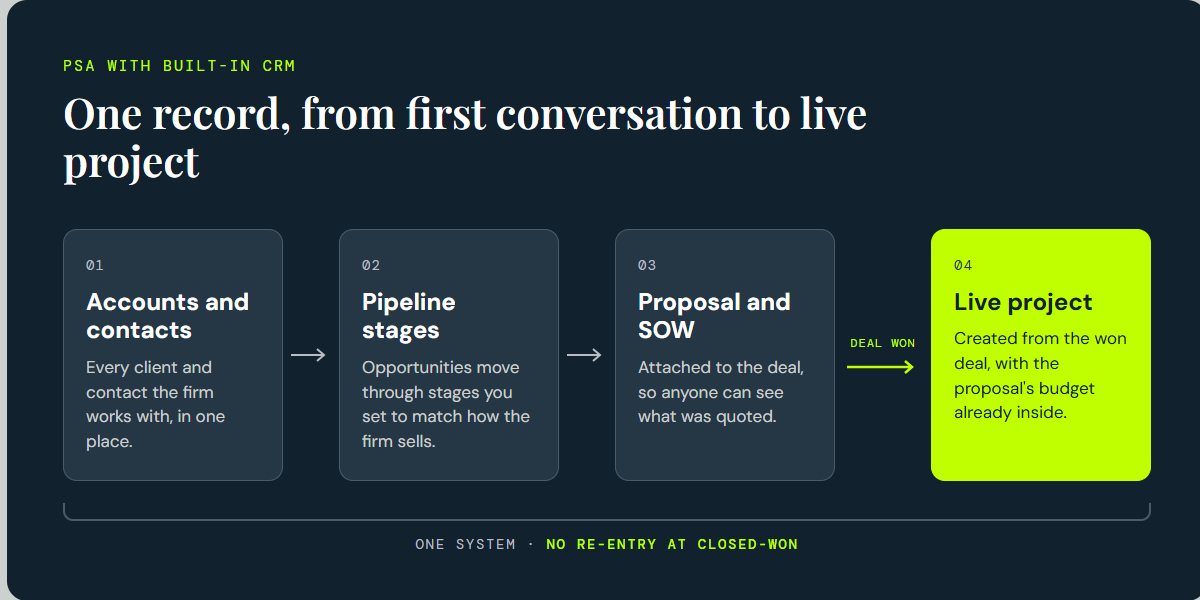
The phrase gets used loosely, so a fair comparison of PSA software with built-in CRM starts by pinning down what the CRM part includes. In a consulting-focused PSA, the CRM side holds your accounts and contacts and moves opportunities through pipeline stages you configure to match how the firm sells. Proposals and statements of work attach to the deal they belong to, which means nobody has to search a shared drive to find out what was actually quoted. The capability that matters most comes at the end of the cycle, when a won deal becomes a project with the proposal's budget already inside it.
A built-in CRM is not a marketing automation platform, so it won't score thousands of inbound leads or run nurture campaigns across email and paid channels. It also isn't designed for a team of sales development reps working high-volume outbound sequences. A firm whose growth plan depends on that machinery will find a built-in CRM thin, because it was scoped for a different way of selling.
The same kind of scoping applies on the delivery side, where a PSA runs projects and billing but isn't an ERP and won't replace your general ledger. Each tool is shaped around a particular job. For most consulting firms, the marketing machinery a built-in CRM omits was never the part of the pipeline doing the work, so the trade costs them very little.
What running two systems really costs
Two licenses are the obvious cost, but most of the expense lands on your operations team.
The closed-won re-entry tax
When a deal closes in a standalone CRM, the PSA doesn't know until someone tells it. Usually an ops manager or project lead opens the signed proposal and rebuilds its phases and hours by hand. An integration can carry the client name and contract value across, but the assumptions the team priced against stay behind in the proposal document.
That gap is where margin leaks. A scope change agreed late in negotiation may never reach the project budget, and nobody notices until the project report turns red.
When Projectworks asked professional services experts what they most wanted to fix in their proposal process, 41.2% chose data integration and accuracy, the second most common answer.
A PSA with built-in CRM removes the step rather than automating it. The won proposal becomes the live project, and the budget the team delivers against is the one the client signed.
The PSA CRM integration you maintain forever
An integration fixes re-entry, but someone has to own it, and in a 50-person firm that's usually whoever set it up. When sales adds a pipeline stage or renames a custom field, the mapping needs updating. If nobody updates it, the sync keeps running on stale rules, and the first sign of trouble is often a won deal that never became a project.
Reporting has the same problem. A question that spans both systems, such as how margins on repeat work compare with new clients, has no single home, so someone exports from each and reconciles them in a spreadsheet. Wellingtone's State of Project Management Report 2026 found that 72% of organizations spend half a day or more every month collating reports. In a consulting firm, that time usually comes out of a senior operations person's week.
For a consulting firm, built-in CRM is the call
Start from how your firm wins work, because that decides the architecture more reliably than any feature comparison. Most firms in Projectworks research win the majority of their work from existing clients and referrals, and a plan to build an outbound engine someday isn't the same as having one today.
Firms that end up with two systems usually get there by accident, at around 30 people. That is roughly when two requests reach the leadership team in the same quarter. Sales wants a pipeline it can forecast from, and the head of delivery wants a system that runs projects and shows margin before month-end does. Buying a sales tool for the first request and a delivery tool for the second feels sensible at the time, and it is how many firms end up owning the seam between them. Solving both in one system where a won deal starts the project avoids building the seam in the first place.
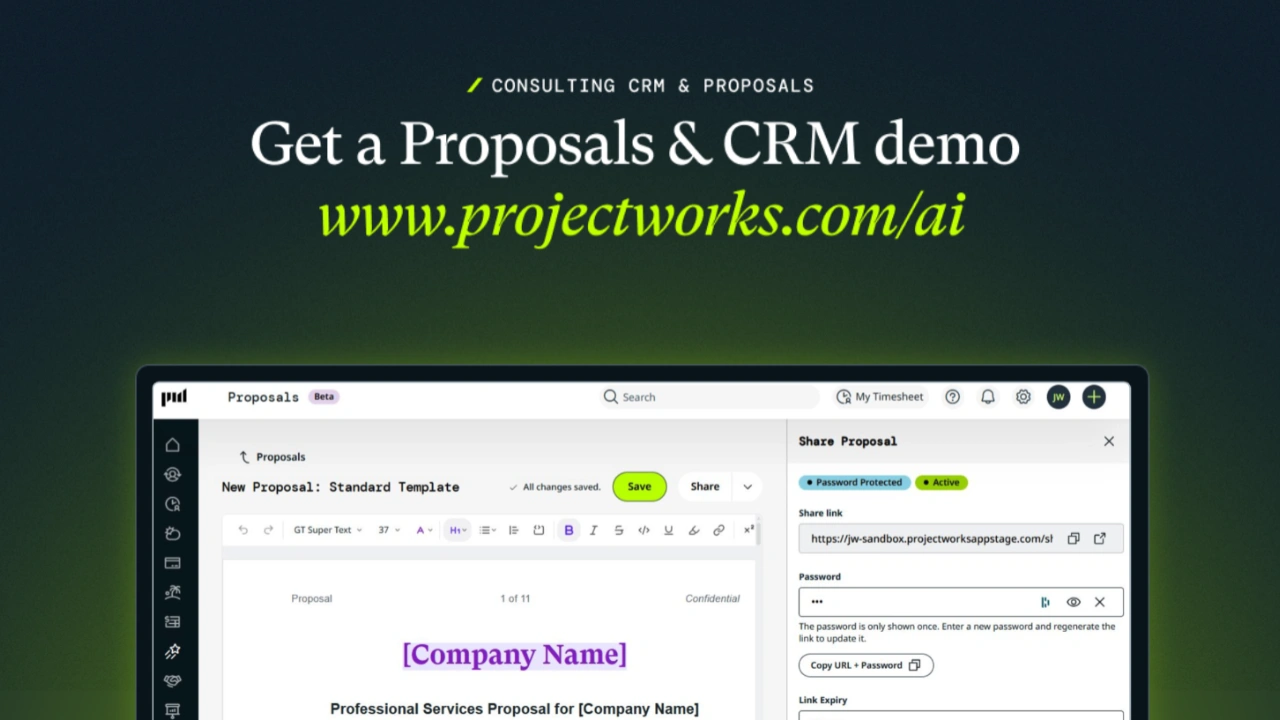
This is the model behind Consulting CRM and proposals in Projectworks. Proposals sit on the deal they belong to, and when the deal is won it becomes a project in one step, with the proposal's budget carried across. The proposals feature is in beta today. More than 600 professional services firms run on Projectworks.
If your pipeline looks like most consulting firms', see how Projectworks connects the proposal you win to the project you deliver.
One system for winning and delivering
Every project a consulting firm wins crosses from sale to delivery once, and in a two-system stack each crossing is another chance for the numbers you priced to slip away from the work you run. Keeping winning and delivering in one system closes that gap for good. Reach for a second system when you are running a real sales engine that needs its own machine, and be clear-eyed about whether that describes the firm you run now or the one you picture in five years. Most firms growing through the clients they already serve will find the answer is one system, and the proposal they sold stays the project they deliver.

Read similar resources from Projectworks
It's the end of September and expenses got a lot of love this month, with a couple of big changes you can start using today and more on the way! We've also made updates across financial reporting, resourcing, HubSpot, and invoicing, dive in to see what's new.
.png)
This is your guide to all the updates across Projectworks in the month of August. There's new and updated integrations, upgraded resourcing and the opportunity to join early access to Kea, our AI Agent - something for everyone!
Most CRM features are built for sales teams that consulting firms don't have. See which CRM features consulting firms actually need, and which ones they’re paying for and never use.