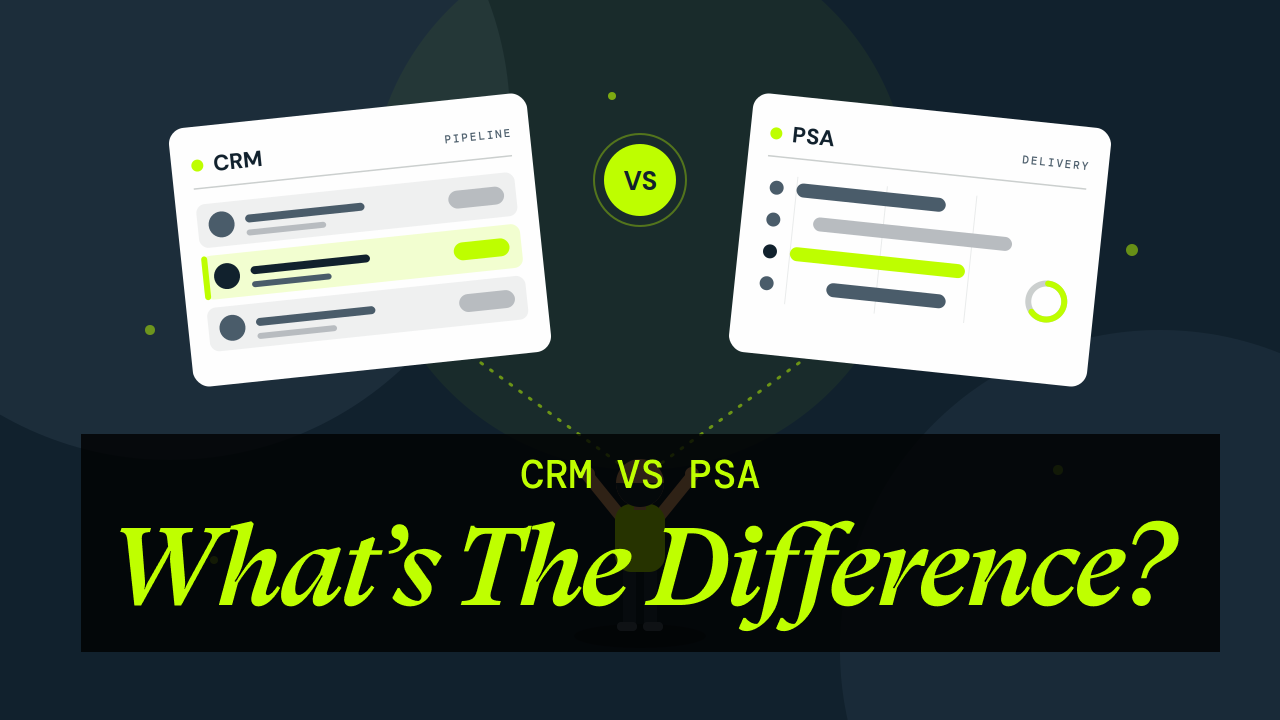


CRM manages the sale, PSA manages the delivery. Here's what actually differs, and whether a consulting firm needs both, or one system built for how you sell.
Somewhere around thirty people, most consulting firms have the same argument. Sales wants a CRM to keep the pipeline honest, delivery wants something that can actually run projects and protect margin, and whoever holds the budget starts searching 'CRM vs PSA', only to hit a wall of vendor pages that all arrive at the same tidy conclusion. You need both.
It's worth slowing down before you take their word for it, because for a lot of SMB consulting firms the reflex to buy two systems answers a problem they don't really have while creating one they will. The better place to start is with what each tool is actually for, where the two collide, and how the answer shifts once you account for the way consulting firms win work in the first place.
PSA vs CRM: What’s the difference?
A CRM manages the relationship before the work exists, from first contact through pipeline and forecasting. It’s there to help you win the work in the first place.
A PSA picks up the moment you have won. It runs the delivery side, everything from resourcing and time to margin and invoicing, so the work you sold actually turns a profit.
Same client, then, but two different jobs, divided by the moment a deal closes. Leave either one out and the gap shows up fast. A CRM with no PSA behind it can tell you what you sold and nothing about whether you delivered it profitably, while a PSA with no relationship data in front of it makes every project start from a blank page. That handoff, from won work to delivered work, is where most firms lose real time and money.
What a CRM actually does
A CRM is built around the sale. It keeps track of who you are talking to, which stage each opportunity has reached, and what might realistically close this quarter, and the better ones capture emails and meetings on their own so the pipeline stays current without anyone maintaining it by hand.
The catch is the assumption sitting underneath it. Most CRMs are designed for a marketing funnel, where leads arrive in volume at the top, move through a set of defined stages, and come out the bottom as closed deals. That shape suits a business chasing large numbers of net-new logos. It suits a lot of consulting firms far less neatly, for reasons worth returning to once the delivery side is in view.
What a PSA actually does
A PSA takes over at the point you win. It turns a signed proposal into a live project, staffs that project against who is genuinely available, tracks time and expenses as the work runs, watches margin before it has a chance to slip, and bills the client at the end.
This is the half a CRM has no vocabulary for. A standard CRM holds no concept of a billable hour, a consultant's capacity, or the margin on a given project, so firms that try to run delivery inside one drift back into spreadsheets and end up reconciling the numbers by hand at month-end. A PSA exists to close exactly that gap, which is why it can show you live margin as the work happens rather than a nasty surprise three weeks after the fact.
Where they overlap, and where firms get stuck
On paper the division looks clean. In practice both systems have to describe the same client, and that is where it breaks down. When a CRM and a PSA don't talk to each other, someone re-enters every won deal into the delivery system by hand, contact details drift out of sync, and the two halves of the business slowly lose sight of one another. Sales can't tell whether projects are healthy. Delivery can't see what is about to land. The firm runs on two versions of the truth and fully trusts neither.
This is not a niche frustration. When we asked 68 professional services firms what they most wanted to fix in how they win and deliver work, data integration and accuracy came out on top at 41%, ahead of speed, pricing, and everything else. What sat near the bottom of the same list, at 10%, was CRM tracking. Put those two numbers next to each other and the message is hard to miss.
Do consulting firms need both?
Here is where the standard advice starts to come apart.
Consulting firms don't sell the way software companies do. Rather than pouring cold leads into the top of a funnel, they win most of their work from clients they already have, on the strength of trust they earned by delivering well the last time around. In our research, 55% of proposals go to existing or repeat clients, and consulting carries one of the highest retention rates of any industry, sitting near 84% (Statista, 2025). For most firms the pipeline is, in large part, people who already know them.
That reality changes what the word CRM should even mean for your firm. A heavy, funnel-shaped system built to marshal an outbound sales team is aimed at a problem you mostly don't have. What you need instead is a way to manage proposals, keep sight of the work you are bidding on, and move a won proposal straight into delivery without keying it in twice. Deal stages matter less than they would at a software company, and the proposals matter a great deal more.
So, do you need both a CRM and a PSA? You need both jobs done, and done well. What you rarely need is two separate, disconnected systems to do them.
How to choose for your firm
Choosing well comes down to being honest about three things.
The first is how you actually win work. If most of it arrives through repeat clients and referrals, a proposal-centric approach will serve you better than a funnel-shaped CRM, whereas if you truly generate high volumes of net-new demand, you may well need both a marketing CRM and a PSA running together.
The second is where your data breaks: follow one client from the first conversation all the way to the final invoice and mark every point where someone has to re-enter information, because each of those breaks is admin tax and another chance to get the numbers wrong.
The third is what you already run and how your team feels about it, since a CRM that is embedded and genuinely used is worth integrating, while one that is half-adopted and resented is telling you something.
The point of the exercise is to match your tools to the way your firm sells and delivers, not to the way a vendor happens to bundle its pricing.
The bottom line
The market is pushing firms toward more projects at smaller sizes. Across the firms we track, the average number of signed projects climbed from 18 in 2023 to 66 in 2025, while the average budget attached to each one fell by 56%. More work broken into smaller pieces means the cost of every handoff, every re-key, and every disconnected report keeps compounding, and that is the real case against a stitched-together stack. Two systems aren't wrong in principle. The trouble is that most SMB consulting firms can't carry the tax of running the sale and the work in two separate worlds. Bring the relationship, the proposal, and the delivery onto one connected system, and you hand your experts back the hours they were losing to admin. That is how a firm grows without drowning in its own complexity.
FAQ
What is the difference between a CRM and a PSA?
A CRM manages the customer relationship before the sale, including leads, pipeline, and forecasting. A PSA, or professional services automation platform, manages the work after the sale, including resourcing, time, margin, and invoicing. Same client, two different jobs.
Do I need a CRM if I have a PSA?
You need what a CRM does. You may not need a separate system to do it. If your firm sells mostly through repeat clients and proposals, a proposal-centric CRM built into your PSA usually covers it. If you run a high-volume marketing engine, keep a dedicated CRM and connect it.
Can a PSA replace a CRM for a consulting firm?
For many SMB consulting firms, yes. A PSA with a built-in, proposal-centric CRM manages pipeline and relationships alongside delivery, so a won proposal becomes a staffed project with no re-entry.
Does Projectworks have a CRM?
Yes. The Projectworks CRM is built around proposals rather than deal stages, and it feeds straight into resourcing and delivery, so the sale and the work share one source of truth.

Read similar resources from Projectworks
Projectworks has spent 25 years inside consulting firms. Here’s why we built a Consulting CRM around the proposal, and where it goes next.
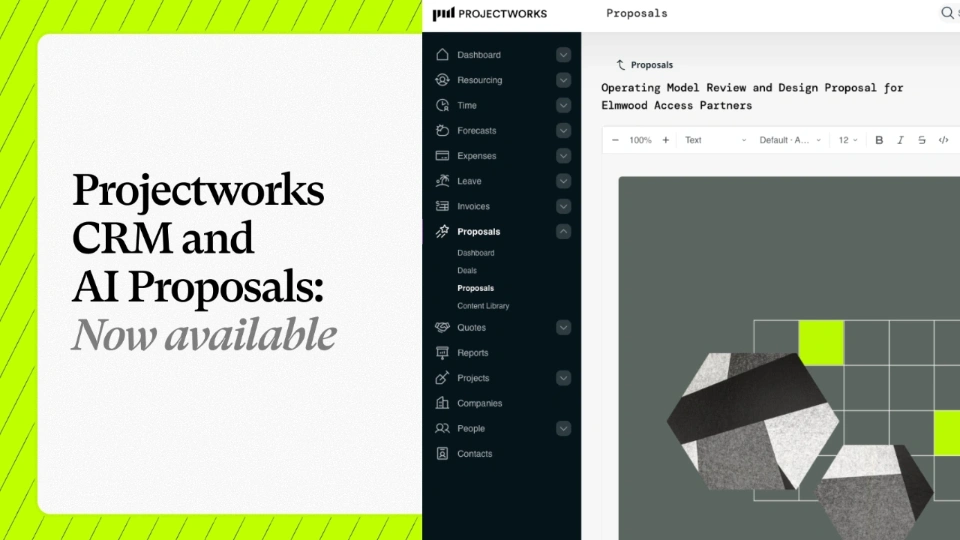
We're excited to announce that our Consulting CRM and Proposals are now available for anyone to use or try out. In just three months, a fast-growing group of firms have been running their pipeline and proposals in Projectworks as part of our early access group, and the results have blown us away.
-card.webp)
Projectworks has been named to the 2026 Inc. 5000, the annual ranking of fastest-growing private companies in the United States, for the second time. Building a global software business is not an easy thing to do. So when our growth shows up on a stage as competitive as the US market, it means a lot.