

Projectworks has spent 25 years inside consulting firms. Here’s why we built a Consulting CRM around the proposal, and where it goes next.
For most of its life, Projectworks met a client's work only after someone else had sold it. A deal would close somewhere outside our software, usually with the proposal saved in a shared drive. Then a project manager would open Projectworks and rebuild the budget by hand, line by line. Our Consulting CRM closes that gap. It starts from the proposal rather than the pipeline, so the work a firm sells and the work it delivers are built from the same numbers.
Projectworks is a PSA for consulting firms with a built-in Consulting CRM. Proposals are written and priced inside the CRM, so a won proposal becomes the project budget.
Why did Projectworks build a consulting CRM?
Projectworks built a consulting CRM because the handoff from sales to delivery kept breaking in the same two places. Proposals took real time and still weren't quite right. And once a deal was won, its numbers were retyped into the project by hand, so the project rarely matched what was sold and revenue stayed out of sight until the project existed.
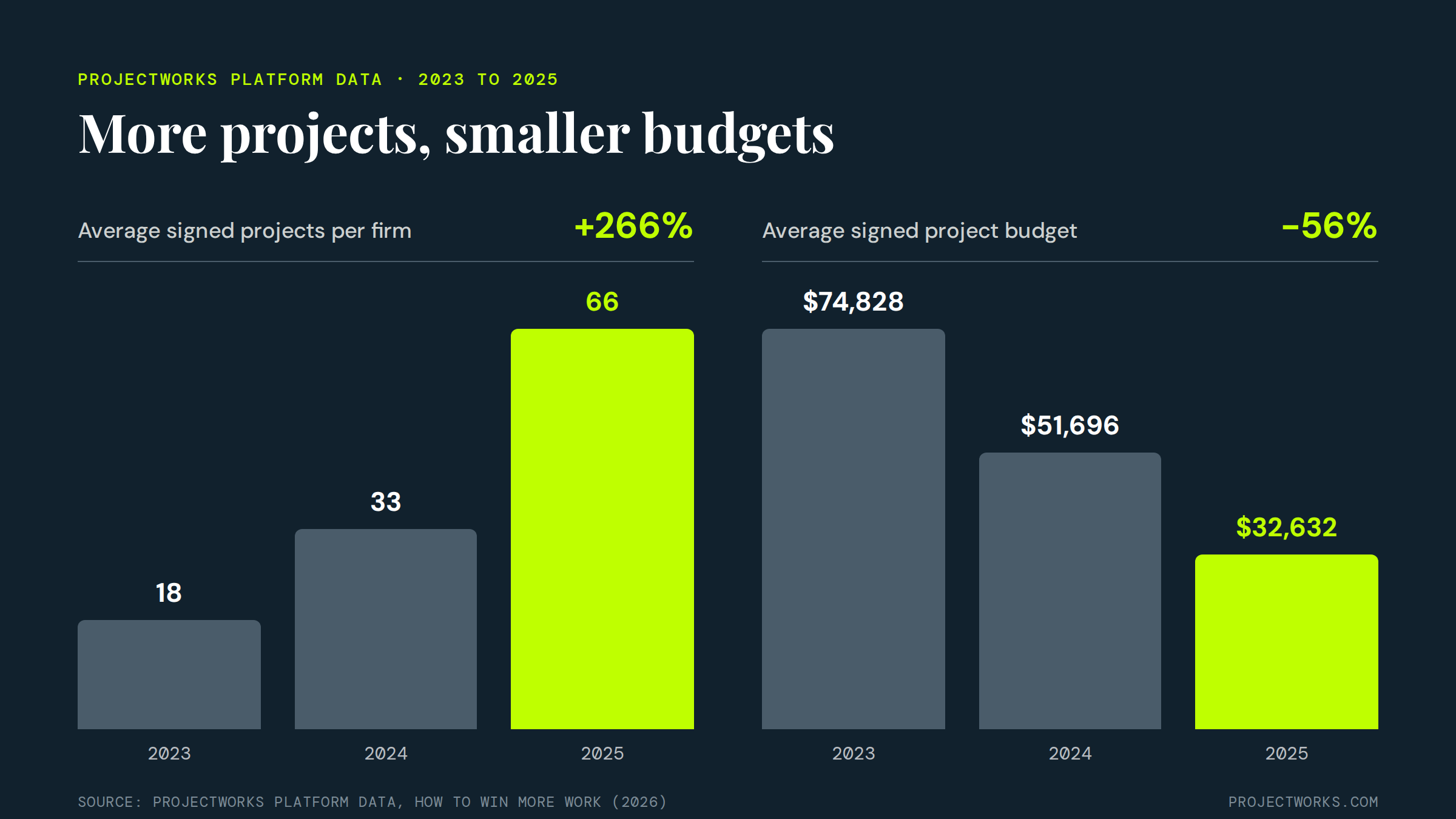
Both problems have grown. Our customers are winning far more projects than they used to, but each one is smaller, so the same people are writing more proposals for less money per win.
Our research showed a proposal takes about 24 hours on average, and 47% of that time comes from senior staff, the people a firm can least afford to pull off client work. Under that pressure, bids get stitched together by whoever happens to be free. Our CEO, Mark Orttung, described the result on the AI-Driven Business Development episode of our podcast, "It feels like 5 people dumped their content in, and nobody created a storyline or an arc."
It isn't only our customers. SPI Research's 2026 Professional Services Maturity Benchmark found CRM adoption among professional services firms at 84% and PSA adoption at 68.9%, and it named streamlining the sales-to-delivery handoff as a lever for 2026.
Built inside a consulting firm
Where Projectworks came from
The Projectworks story starts in 2001 at Provoke, a professional services firm, where co-founder Doug Taylor built an in-house time tracking tool for the firm's own people. In 2016, Projectworks became a business in its own right. Firms that sold through HubSpot or Salesforce connected them to Projectworks with our integrations, and Projectworks took over once the deal was won.
Even so, some customers had started pricing work inside Projectworks with our Quotes feature. It was an early hint that the price of the work belonged closer to its delivery.
What that history brings to a consulting CRM
The people behind Projectworks ran consulting firms before they built software for them. Mark Orttung grew the consultancy Nexient from 200 to 1,100 staff, and he and Doug Taylor wrote The $50M Consulting Firm. Our customers have also invoiced $3B through Projectworks, and that delivery history is what a proposal should be able to draw on when a firm prices similar work again.
Proposals became a research subject for us too, published in the How to Win More Work ebook and built into the Proposal Scorer, which lets any firm test a bid of its own. When AI came up on our own sales calls, owners and founders were the buyers most interested in using it for proposals. That fits, since senior people carry so much of the writing.
We started with the proposal, not the pipeline
Most CRMs start with the deal pipeline, so that was the obvious place to begin. But we started with the proposal instead, because that's where firms told us they wanted help.
Using accurate, connected data in proposals came a close second, and both answers lead to the same place. The proposal is where a firm wins the work, and it's where the client agrees to the budget the firm will then be held to. That's why the Consulting CRM is proposal-centric rather than deal-centric.
Once our early access firms started using it, they told us the same thing. Most of what they asked for next was about the proposal, from more control over how it's written to a cleaner path from a signed proposal to a project. Several of the features coming next, including contacts and team members on each deal, came straight from their requests.
What we chose to leave out
In Projectworks research, 55% of proposals were for existing clients or repeat work. Most of a consulting firm's pipeline comes from people who have already seen it deliver, so the Consulting CRM isn't weighed down by marketing automation, sequences or contact enrichment. Those tools are built for selling to people you've never met, and a firm that wins on relationships rarely needs them.
Leaving those tools out keeps the CRM simple enough for a partner to price work without learning a sales platform first. It's a question of fit, the same one behind the PSA vs CRM decision, and the CRM features consulting firms actually need differ from the ones a campaign-driven sales team relies on.
How it works, from deal to delivered project
Deals in a pipeline that matches how your firm sells
Deals move through stages you configure to match the way your firm sells. Each deal keeps its owner, value, probability and close date together with its proposals and working budget, so everything about an opportunity sits in one place.


"The deal object is a really natural place to track how many hours are going on this proposal. Separate the cost to sell from the cost to deliver."
Proposals: the Consulting CRM's core feature
The editor is built for professional services proposals. Reusable blocks hold a firm's methodology, case studies, pricing and team bios, and any past proposal can be uploaded and turned into a template. Paste in the bid details and AI fills in the variables, then Ask AI can tighten, expand or simplify the wording while the person drafting decides what stays.

From signed proposal to project in one step
Proposals go to clients through a secure link with an optional password and expiry date, and clients sign directly in the document. Once a proposal is accepted, you can create the project in one step with the agreed pricing already in its budget. Each deal also shows how much of its value has become a project and how much is still waiting.

What early access firms are seeing
The early results are encouraging. Within weeks of switching, firms tripled their deal visibility, and they're now managing tens of millions of dollars of pipeline in Projectworks. Users have also generated more than 80% of their client-ready proposals directly from templates.
The product vision: from proposal to payment
The Consulting CRM is the first stage of Proposal to Payment, our vision for one connected system that takes a firm from first pitch to final invoice. Most software in consulting firms today is a system of record that stores what already happened. We're building toward a system of action, and our piece on system of record vs system of action explains the difference.
Today, AI in the proposal editor helps a person write faster while they stay in charge of the result. Where we're heading is AI that drafts from a firm's own delivery history, so a new proposal starts from what similar work actually took. Kea, the AI agent inside Projectworks, recommends and the user decides, and MCP lets firms work with Projectworks through their own AI tools. AI does the heavy lifting, you hold the pen.
Having all of this data together and well-structured really becomes powerful as you start to put a system of action or an AI set of agents on top of it.
Closing the gap between sales and delivery
Consulting firms win work on trust, and they keep it by delivering what they promised. A CRM built around the proposal keeps those two things connected, from the first conversation to the final invoice. That's the job the Consulting CRM was built for, and it's ready to use today.

Read similar resources from Projectworks
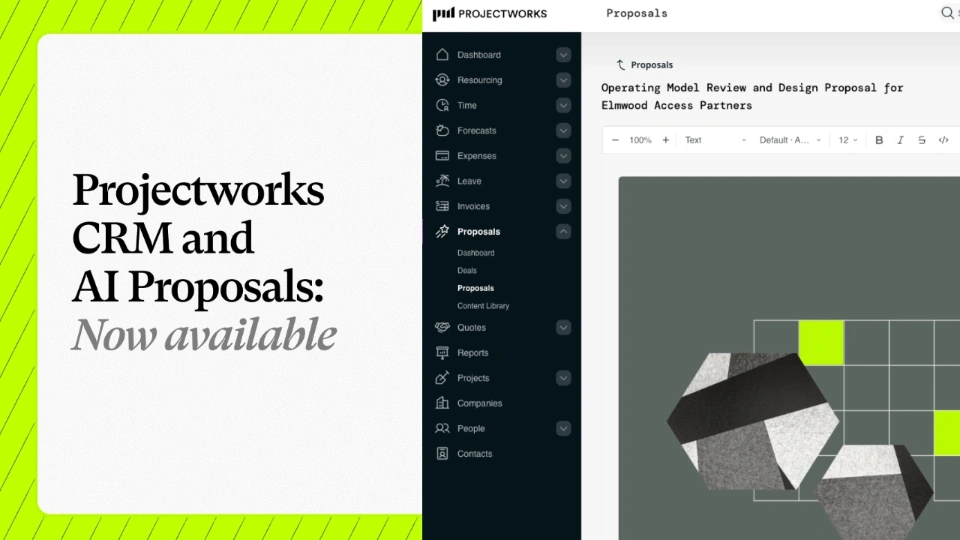
We're excited to announce that our Consulting CRM and Proposals are now available for anyone to use or try out. In just three months, a fast-growing group of firms have been running their pipeline and proposals in Projectworks as part of our early access group, and the results have blown us away.
Projectworks has been named to the 2026 Inc. 5000, the annual ranking of fastest-growing private companies in the United States, for the second time. Building a global software business is not an easy thing to do. So when our growth shows up on a stage as competitive as the US market, it means a lot.
Choosing a CRM for your consulting firm? Here's what actually matters. From tracking the bids you have out to what happens once a job is won.