-card.webp)
Projectworks has been named to the 2026 Inc. 5000, the annual ranking of fastest-growing private companies in the United States, for the second time. Building a global software business is not an easy thing to do. So when our growth shows up on a stage as competitive as the US market, it means a lot.

As a consulting firm owner, knowing your cash flow position is crucial for operations. Typically, you get a clear sense of your cash flow at the end of the month, when all of your invoices are ready to send out. But in the middle of the month, you are operating in the dark. And what about three months from now?

Most consulting firms grow by default. Fewer grow by design. That distinction matters more than many leaders realise, especially if the goal is to build a firm that attracts a strong revenue multiple. In the first episode of Season two of The Projectworks Podcast, Mark Orttung and Dominique Rennell introduced the Growth Maturity Model they are developing to help consulting leaders answer a hard but necessary question: is your firm actually built in a way someone else would want to buy it?
Learn how using PSA software instead of spreadsheets will increase the profitability and efficiency of your consulting business.
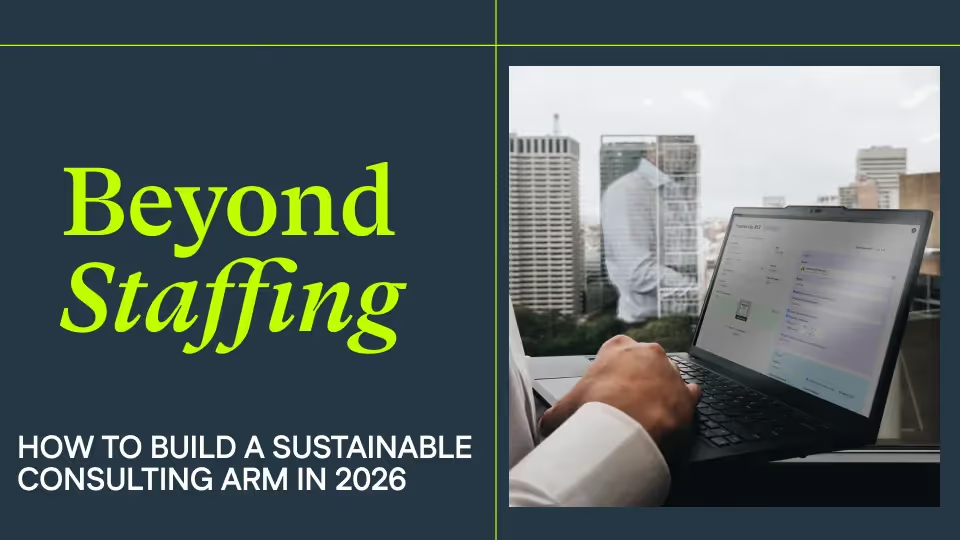
The IT staffing industry is changing fast. Slowing tech hiring, tighter procurement controls, increased MSP involvement, and rapid advances in AI are forcing staffing firms to rethink their business models and their path into IT consulting. The reality is, although most staffing firms want to develop a consulting/ SOW arm, only a small percentage of firms who set out to do it, will find success.
In a year shaped by AI, Software Services Firms and IT Consultancies across the United States are in a widespread reinvention moment. In this guide we break down how firms are navigating the shift, and what strategies are fuelling growth for small and mid sized firms.

Across Australian Architects in 2025, the brief kept getting wider while timelines stayed tight. Clients asked for cooler streets, better shade and movement, water capture and reuse, clear Country pathways, early biodiversity checks and build-ability in view. The studios that grew recognised the pressure early, set clearer scope lines and ran a calmer delivery engine that made decisions weekly instead of monthly.

In 2025 for the Engineering Sector down under, pipeline was the conversation irrespective of what side of the ditch your firm sat on. In Australia the pipeline grew quickly across energy, transport, water and social infrastructure. However, turning that momentum into consistent, profitable delivery was still hard for many firms. In New Zealand the public pipeline only became visible toward the end of the year. It was a tougher run, and leaders had to think differently about growth. The firms that moved ahead in both markets built a high performance delivery engine and ran it with calm discipline, thanks to visibility of all key project and business profitability metrics.

As 2025 nears its conclusion, we’ve taken stock of all we’ve heard in conversation with Engineering Consultancies across the UK – and what made the difference for firms that grew.
Scaling a consulting firm isn’t theory for us - it’s lived experience. We've developed a play-by-play cheat sheet that comes from years of leading and growing firms through every messy, exhilarating stage of the journey. We've made every mistake along the way, which means you don’t have to.

I thought growing a consulting firm would be like stacking bricks. Turns out, it’s more like juggling knives. It’s risky. It’s messy. It’s thrilling. And it can cut you if you’re not careful. In Episode 02 of the Z Suite, Groundline GM Kyle James and I wrestled with the five things growth breaks fastest - and how to growth-proof them.

I thought selling a consulting firm would be like landing a big project. Turns out, it’s nothing like that. It’s emotional. It’s messy. It’s six months of all-consuming work. In Episode 01 of Z Suite Live, I swapped M&A battle stories with Allen Debes, CEO of Koniag Capital. We've pulled together the five things we wish we’d known before our first deal. It’s not a corporate M&A manual. It’s a founder’s cheatsheet you can use tomorrow. Steal it. Use it. Tell me how it goes.