Is Your Consulting Firm Worth Buying?
Most consulting firms grow by default. Fewer grow by design. That distinction matters more than many leaders realise, especially if the goal is to build a firm that attracts a strong revenue multiple. In the first episode of Season two of The Projectworks Podcast, Mark Orttung and Dominique Rennell introduced the Growth Maturity Model they are developing to help consulting leaders answer a hard but necessary question: is your firm actually built in a way someone else would want to buy it?


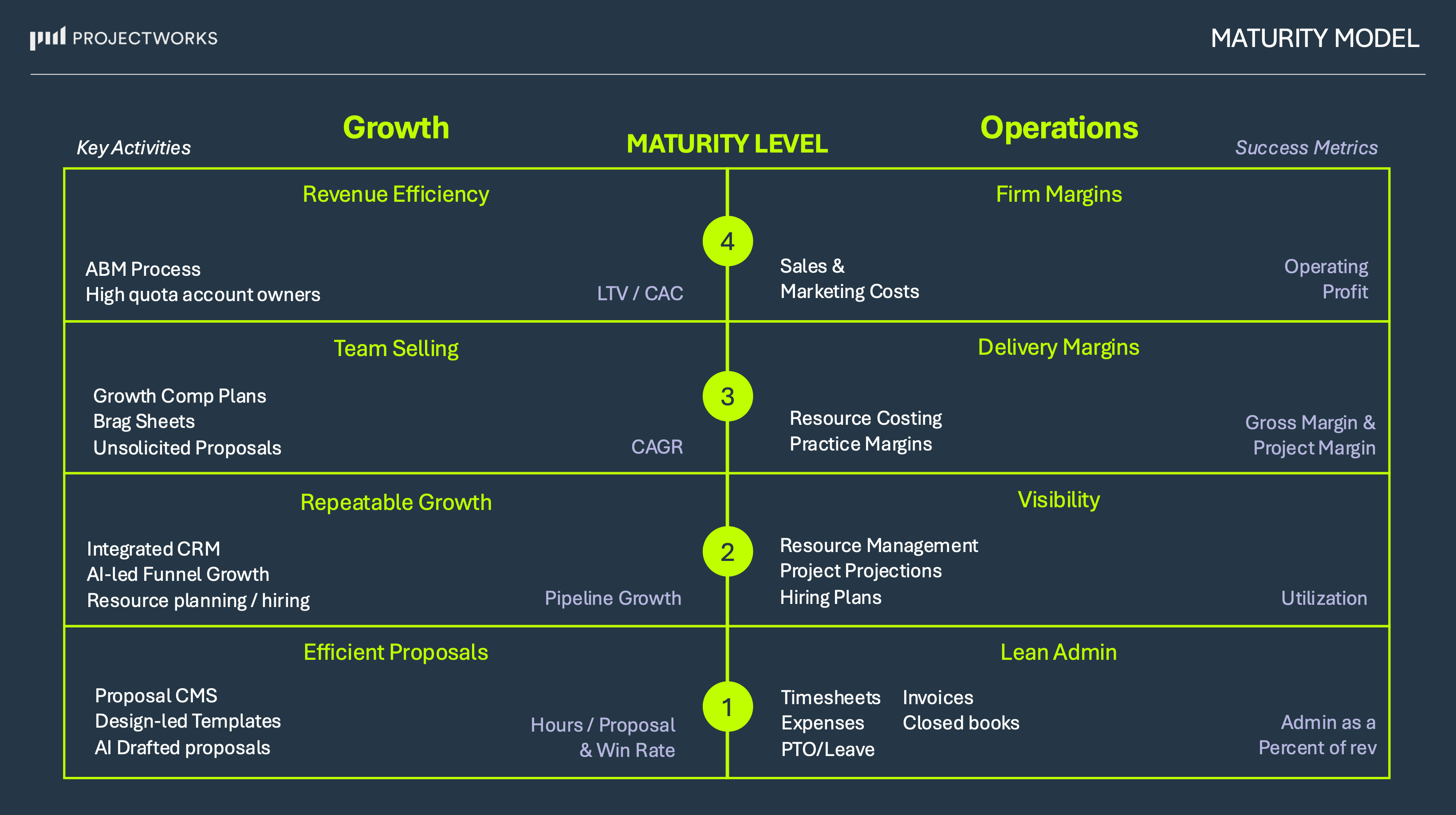
The Growth Maturity Model behind predictable value
Most consulting and professional services firms want to grow. But for leaders building something significant, growth is not the end goal. Options are.
An eventual exit is one option. The freedom that comes with real scale is another. Both depend on the same thing: whether your firm is built in a way someone else would actually want to own.
The difference between consulting firms that attract premium multiples and those that don’t is rarely ambition. It’s maturity.
Looking for the Maturity Model presented in the episode? Get your copy here.
Interested in joining us live for episode two? Reserve your seat today
Consulting firm buyers don’t buy revenue. They buy confidence.
A great multiple is not a reward for working hard. It’s a price paid for certainty.
Buyers pay more when future revenue feels predictable, delivery feels controlled, and performance isn’t tied to a few key people holding everything together. That’s why some professional services firms with impressive top-line growth still struggle to justify their valuation. Growth can increase risk as easily as it increases opportunity.
What buyers want is a growth engine that works without heroics.
Growth maturity is the ability to scale without breaking
A consulting firm can be growing and still be fragile.
Growth maturity means you can increase revenue without losing control of delivery, margins, or leadership capacity. It means the firm can keep performing as the complexity increases, not just when the team is small and everyone can “keep it in their head”.
This is where leaders often overestimate how mature their firm really is. Internally, things can feel manageable. Externally, it can look like a business held together by a few key people and a lot of effort.
The Growth Maturity Model is a mirror
Get your copy of our Maturity Model here.
The purpose of the Growth Maturity Model is not to grade firms or hand out scores.
It’s designed to help consulting leaders see their firm the way a buyer would: through the lens of repeatable performance, risk, and scalability.
Most professional services firms are not immature across the board. They’re uneven. Strong in one area, exposed in another. That unevenness is often invisible until the firm hits a growth ceiling, margins collapse, or the leadership team becomes the bottleneck.
From a valuation perspective, those weak links matter.
The best consulting firms make growth controlled
The consulting firms that attract premium multiples tend to feel different inside.
They don’t rely on last-minute saves, constant firefighting, or a handful of people holding the business together through sheer force. They’ve built the systems, visibility, and discipline to scale cleanly.
That doesn’t mean they are slow or conservative. It means their performance is stable. Their numbers are believable. Their leaders have headspace. And the business doesn’t get riskier as it gets bigger.
That’s what creates enterprise value.
Value is built years before exit is on the table
The biggest mistake consulting leaders make is treating “being worth buying” as something to solve later.
Firms that attract strong multiples build toward it early. They put commercial discipline in place while they still have the flexibility to change. They remove hidden dependencies. They invest in systems like Projectworks that make performance visible.
Because when the opportunity for an exit appears, the firms that win are the ones that are already ready.
Interested in joining us live for episode two? Reserve your seat today
Where Projectworks PSA Software fits into your consulting firm's growth strategy
Projectworks is PSA software built specifically for consulting and professional services firms. It connects project delivery, resourcing, financials, and forecasting in one platform, so leaders can run the business with real visibility and control.
If your goal is to build a firm that scales cleanly and attracts a premium multiple, the work starts with operational maturity. Projectworks helps you get there, by giving every team the same source of truth across every project, person, and dollar.


Listen to moments from similar podcasts

For many consulting firms, the one-project client is the norm and the long-term partnership is the exception, which is backwards given how much cheaper repeat work is to win. This episode is about making that step deliberate rather than accidental. We'll share the play-by-play breakdown of how fast growing firms identify the right client accounts it invest in, how they grow them, who's involved in the relationship, and where AI makes it all easier.

In a small firm, delivery quality holds because everyone works side by side and the founder touches every project. Then the firm grows, the founder runs out of hours, and work gets delivered by people who never learned your delivery method firsthand. Project margins turn inconsistent, and it's rarely the same reason twice. Most AI you've used so far waits for you to ask it something. Agents are different: they work in the background and tell you what needs attention before you'd have caught it yourself. This episode is about what that shift means for delivery, and we'll introduce Kea, the AI agent we're building inside Projectworks, and where we're taking it.

Timesheet chasing, invoicing, month-end, reporting, and the non-billable hours that go with them... its all necessary work in a consulting firm. Without it, clients don't pay you. It's costly though – for most firms, admin as a % of revenue sits at about 15%. Its a whole lot of cost that otherwise could be sitting in your EBITDA. In the AI era, the best consulting firms will bring this figure into the single digits. Learn how in this episode of the podcast.