.avif)


The IT staffing industry is changing fast. Slowing tech hiring, tighter procurement controls, increased MSP involvement, and rapid advances in AI are forcing staffing firms to rethink their business models and their path into IT consulting. The reality is, although most staffing firms want to develop a consulting/ SOW arm, only a small percentage of firms who set out to do it, will find success.
But for firms that think strategically—and zoom out before building a consulting arm—the benefits are significant. Long term, your firm will experience higher margins and more sustained revenue growth from revenue diversification and differentiation, as well as a higher likelihood to exit via M&A. If you are looking for more stability in an era of uncertainty… making the pivot will not be easy in the beginning, but will reap benefits long term.
Recently, Projectworks CEO Mark Orttung broke down what actually differentiates firms who successfully move into consulting, and those who don’t, during a TechServe Alliance webinar. You can catch the entire replay here
👉 Download the whitepaper: Beyond Staffing: The AI-Era Playbook for IT Staffing Firms Transitioning to Consulting to learn:
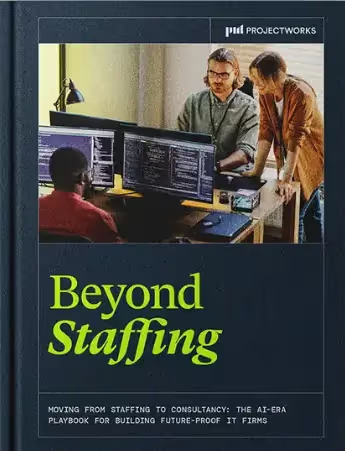
- The market forces reshaping IT staffing and consulting
- How valuation multiples increase as firms shift to project revenue
- The leadership and operational changes required to scale consulting services
If you prefer to skim, below are the key takeaways from the webinar:
The IT Staffing Industry Is Under Pressure
Pure IT staffing firms are facing structural challenges:
- Tech employment growth has stalled, limiting seat-based revenue growth
- Buyers are shifting spend from headcount to outcomes and Statements of Work (SOWs)
- MSPs and procurement teams are enforcing stricter rate discipline
- AI is automating sourcing and screening, accelerating commoditization
The result is margin compression, longer sales cycles, and declining differentiation for staffing-only firms.
From IT Staffing to IT Consulting: The 3 Critical Leaps
We outlined the common progression firms follow as they move from staffing to project-based consulting.
Generic Staffing → Specialized Staffing
Specialization is the first step away from commodity pricing. By focusing on a defined niche (such as cloud, ERP, or cybersecurity) firms can build credibility, raise billable rates, and strengthen their brand. However, specialization alone does not create long-term resilience.
Specialized Staffing → Consulting Start-Up
This the most challenging transition. Firms stop selling individual contractors and begin delivering defined consulting services and project outcomes. This requires more ownership and risk overall. Project revenue emerges, and slowly, client perception begins to shift. Many firms should resort to rebuilding their book of business, as many clients will continue to see you as a specialized staffing firm.
Consulting Start-Up → Scalable IT Consulting Firm
To scale, firms must move beyond founder-led delivery. This requires operational discipline, leadership leverage, standardized proposals and SOWs, and clear visibility into project margin, utilization, and forecasting.
Each step toward consulting unlocks higher billable rates, more predictable revenue, and significantly stronger valuation multiples.
👉 Building a new client base starts with how you sell. Strong proposals signal expertise, process maturity, and delivery confidence. Check out our free proposal grader to see where yours stands.
Why Founder-Led Growth Becomes a Bottleneck
A consistent theme during scale, is that founders eventually become the constraint.
In staffing, early success is driven by relationships and founder expertise. However, until you build repeatable offerings, consistent scoping ,and reliable project data… growth will usually stall. Signs of stalling look like - underpriced work, delivery risk, and limited forecasting accuracy.
Sustainable IT consulting growth depends on:
- Repeatable service offerings
- Clear project scoping and outcome-based pricing
- Visibility into utilization, margin, and delivery risk
- Leadership capacity beyond the founder
Why Project-Based Firms Need Better Systems
As firms move from staffing into consulting, spreadsheets and ATS tools fall short. Managing teams, projects, and outcomes requires systems purpose-built for professional services, and that you can measure the metrics that create sustainable growth
Project intelligence platforms like Projectworks help consulting firms unify resourcing, delivery, and financials—providing the visibility leaders need to scale profitably.
👉 Sign up for a free walkthrough of Projectworks to see how project intelligence supports firms transitioning from staffing to consulting.
The shift from IT staffing to consulting is already underway. Firms that adapt now can protect margins, deepen client relationships, and build durable, scalable businesses.
We’re here to help you navigate the process. Thanks for reading along!


Read similar resources from Projectworks

Most pipeline coverage advice is written for SaaS. Here's how a consulting firm sets coverage by deal stage and plans for the clients it will lose.
Let’s say a consulting firm signs a $30,000 engagement in July and invoices the full fee upfront. The client pays quickly and the cash lands, but the work runs from July through September. By the end of July the firm has completed about one-third of the engagement - the project’s on track but the finance team have some work to do to match revenue with the costs incurred (the “matching principle” of having costs and revenue in the same period is a key accounting concept). Only a third of the project’s fee has been earned (because only a third of the work has been done), and the remaining $20k of revenue is deferred to a future period.

It's the end of September and expenses got a lot of love this month, with a couple of big changes you can start using today and more on the way! We've also made updates across financial reporting, resourcing, HubSpot, and invoicing, dive in to see what's new.