


How to scale a GovCon firm toward $50M: the three growth stages, what to check before you bid, and how to mobilize after a major contract award.
In government contracting, the contract award is often where growth breaks a firm. A major award can lift staffing requirements, financial commitments and operational complexity before any of its revenue arrives, and an unprepared firm pays for it in delayed delivery, thinner margins or compliance problems.
The advice here on how to scale a GovCon firm toward $50M draws on a recent discussion in Washington, D.C. between Mark Orttung, co-author of The $50 Million Consulting Firm and CEO of Projectworks, and Pasquale Scalise, co-founder of the GovCon consulting firm PSJ Consulting.
What are the growth stages of a commercial consulting firm, and how do they apply to GovCon?
Commercial consulting firms typically grow, and hit roadblocks at three distinct stages. Between $0 and $5M, founders establish the foundation. The $5–25M stage is about building a leadership team and repeatable processes, and above $25M the firm needs scalable governance to hold the whole operation together.
The revenue bands for these GovCon growth stages are reference points, as in any general scaling framework, and a firm's contracts and structure can bring a stage's challenges on earlier or later.
$0–5M: establishing the foundation
Founders at this stage typically handle business development, delivery and client relationships themselves, and the priorities are winning initial contracts, building case studies, securing anchor clients and creating a growth model the firm can sustain. Centralized decision-making eventually caps capacity, so founders need to start documenting processes, delegating and setting consistent operating practices. The bottlenecks to look for before they restrict performance are excessive founder dependency, unclear management responsibilities and inconsistent processes.
$5–25M: leadership and repeatable processes
Somewhere in this band, the founder can no longer oversee every decision. The firm needs a leadership team with defined responsibilities across business development, delivery and account management, along with repeatable methodologies, sharper differentiation and visibility into project performance across the portfolio. In GovCon, a single sizable award may also require rapid recruitment, onboarding and program mobilization, and without standard project controls and reliable forecasting, delivery quality varies from one contract to the next.
$25–50M+: scalable governance
The largest stage calls for decentralized management supported by executive leadership, general managers and structured governance, which matters most when a firm moves from subcontractor roles to managing larger prime contracts and its own subcontractor network. Leadership keeps reporting, financial oversight and accountability consistent while business units operate on their own, so growth stays predictable without losing service quality or operational control.
Why winning the contract isn't the same as delivering it profitably
A contract win doesn't guarantee profitable execution, which is why firms that scale well treat the proposal as the first draft of the delivery plan. Before submitting, leadership needs to confirm that the proposed pricing, the required staffing and the people actually available line up with what the work demands. A mismatch doesn't disappear at award. It arrives with the contract, after the firm has committed to a price and a schedule.
How to prepare for a contract award before you bid
Timing is the reason to do this work before submission. A capacity constraint or pricing weakness found during proposal development can be fixed by changing the staffing mix or the price, while the same problem found after award has to be absorbed. That means building resource capacity, labor costs and financial forecasting into proposal development from the start instead of leaving them for after the award.
Take a bid that assumes a project manager at ten hours per week. Modeling that assignment before submission shows its effect on cost and margin, and comparing the bid's staffing needs with existing commitments shows whether those ten hours exist without pulling the manager off another contract. If they don't, the firm finds out while the bid is still a draft.
What to do after a contract award
Award brings a different problem. Without the staffing reserves of larger organizations, growing GovCon firms often mobilize with a mix of existing employees, contingent hires, incumbent personnel and subcontractors, and the hard part is coordinating them while meeting contract requirements and protecting profitability.
Start with a delivery baseline immediately after award. Confirm scope, funding, schedules, staffing and milestones against the original proposal's assumptions, so the plan the team executes is the plan the price was built on. Timekeeping, expense reporting, labor-category mapping and approval workflows need to be in place from the first week too, and where applicable they must support DCAA timekeeping requirements and the contract's accounting obligations.
The numbers to watch once work starts
Once work starts, project managers need visibility into actual costs, remaining work, resource utilization and forecast margins. A change to one employee's start date can reveal a resource shortage before it reaches the schedule, and an updated labor cost can expose margin pressure before it becomes hard to address.
Standardize mobilization so the next award is easier
Standardized workflows for mobilization, staffing, timekeeping and financial reporting mean the next award switches on a delivery plan that already exists, instead of forcing the team to rebuild operations through disconnected spreadsheets and manual processes. Running each mobilization the same way also builds the documentation trail that audit readiness depends on.
How the SBA's size-standard proposal raises the stakes
For anyone trying to scale a government contracting business, operational readiness also shapes which opportunities are realistically in reach. A proposed rule published by the SBA on August 20, 2026 would sharply raise size standards across many professional services industries, potentially putting smaller firms up against much larger organizations.
Operational efficiency counts for more when the competition gets bigger, but the rule is still only a proposal. SBA extended the comment period to November 20, 2026, and has not announced a date for a final rule. Current size standards remain in effect until one is issued.
Where technology helps, and where it doesn't
Integrated platforms can bring project financials, resource planning, time tracking, expenses, invoicing and forecasting into one place, and automation and AI-enabled capabilities may help smaller firms strengthen reporting and operational visibility without a large administrative staff.
Technology alone doesn't establish compliance or good governance. Any system has to sit on top of documented procedures, appropriate accounting controls and each contract's specific requirements, and software for government contracting firms can support those procedures without standing in for them. For firms taking on more prime responsibilities, that combination is the foundation for financial discipline and coordinated subcontractor management.
Getting to $50M starts before the next award
The habit that holds the rest together is comparing forecasts against actual project results on a regular schedule, which shows leadership teams staffing gaps, schedule changes and margin pressure early enough to correct course. Reaching $50M in government contracting takes more than a strong pipeline. It takes processes, governance and systems that are already running when the major awards arrive.
If you're building that foundation now, see how Projectworks approaches software for government contracting firms.

Read similar resources from Projectworks

Projectworks has spent 25 years inside consulting firms. Here’s why we built a Consulting CRM around the proposal, and where it goes next.
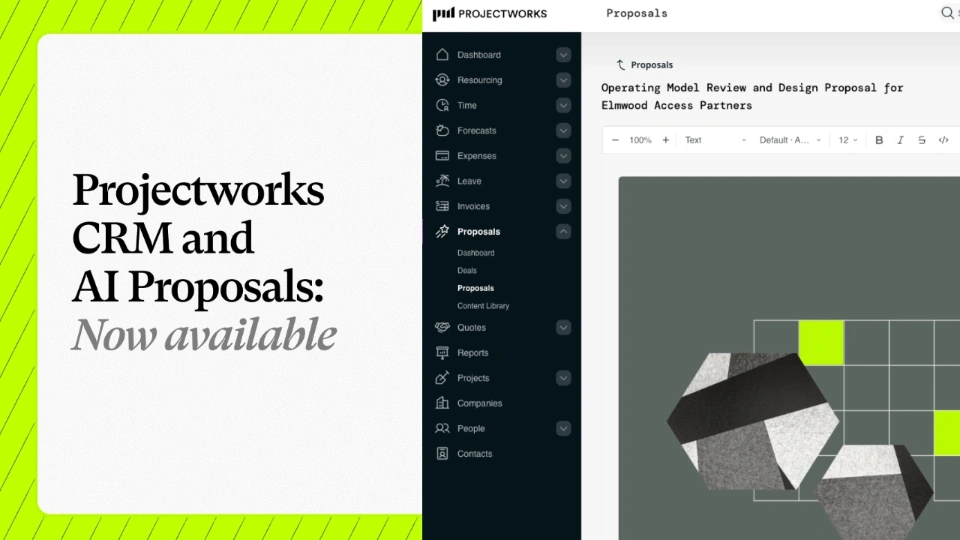
We're excited to announce that our Consulting CRM and Proposals are now available for anyone to use or try out. In just three months, a fast-growing group of firms have been running their pipeline and proposals in Projectworks as part of our early access group, and the results have blown us away.
What is MCP? A plain-English guide to the Model Context Protocol for consulting firms, and what to check before you connect your data to your AI.