

DCAA timekeeping compliance fails for predictable reasons. Here's what auditors actually check, and how to build a system that holds up.
Most firms that fail a DCAA timekeeping audit are not dishonest. Their system just makes honesty inconvenient.
DCAA timekeeping compliance comes down to whether your firm can prove, on any given day, that the hours billed to the government match the work actually done. Materials come with invoices an auditor can verify independently, but labor comes with nothing except your timesheets, which is why the Defense Contract Audit Agency puts so much weight on timekeeping controls. In FY2024, DCAA examined nearly $600 billion in contract costs, according to its Report to Congress.
The encouraging part is that compliance is not complicated. It is a small set of habits, done daily, backed by a system that records everything. Here is what that looks like in practice.
What Does DCAA Timekeeping Compliance Actually Require?
There is no single regulation called "timekeeping compliance." The requirements come from the Federal Acquisition Regulation, DCAA's audit guidance, and decades of audit practice, and they add up to six expectations:
1. Time is recorded daily
Daily entry is the control auditors care about most, because a timesheet reconstructed on Friday afternoon from memory and calendar entries is an estimate rather than a record, and the government does not reimburse estimates.
2. Employees enter their own time
The person who did the work records the work. An admin filling in timesheets for the team, or a manager entering hours for someone on leave, breaks the chain of evidence connecting a labor charge to the individual who performed it.
3. Every charge maps to a contract or task
Charge codes should tie cleanly to contracts, task orders, and indirect cost categories. If a consultant cannot explain a code on their own timesheet to an auditor, the code is a problem regardless of whether the hours were legitimate.
4. Corrections leave a trail
Any change to a timesheet needs a documented reason, a date, and the identity of the person who made it. Verbal corrections and silently overwritten entries are audit findings in waiting, even when the correction itself was honest.
5. Supervisors approve
A second set of eyes reviews and approves time before it flows into billing.
6. The record is complete
All hours worked get recorded, including unbillable time and uncompensated overtime. This principle, known as total time accounting, matters because leaving hours off the timesheet distorts the labor rates the government pays.
None of this is exotic. Each requirement exists because labor is the largest cost most contractors bill, and the timesheet is the only evidence behind it.
Where Timekeeping Compliance Actually Breaks Down
Firms rarely fail because someone set out to defraud the government. They fail because the day-to-day operation quietly drifts away from the written policy.
The most common gap is end-of-week reconstruction. The policy says daily entry, but consultants are busy, the timesheet tool is a chore, and Friday becomes catch-up day without anyone deciding it should. The drift stays invisible until an auditor runs a DCAA floor check, interviews an employee mid-week, and finds a timesheet three days behind. At that point the policy binder says one thing, the system of record says another, and the auditor believes the system of record every time.
Verbal corrections are the second pattern. A project manager notices hours charged to the wrong code, mentions it to the consultant, and the entry gets changed with no note attached. Nothing improper happened, but the missing documentation is itself the finding, because an auditor cannot tell an undocumented honest correction from a manipulated one.
Shared logins, delegated entry, and unrecorded overtime round out the list. Each one looks harmless in the moment, and each one is exactly what an auditor is trained to find.
The pattern worth noticing is that every failure above is a process failure rather than a fraud, which means every one is preventable.
What Happens If Your Timekeeping Fails an Audit?
The consequences scale with severity. Questioned costs come first, meaning hours the auditor cannot verify get challenged and the firm either defends them with evidence or absorbs them. Payment withholds can follow on the affected contracts.
The serious outcome is a determination that your accounting system is inadequate. That finding puts cost-reimbursable work at risk, because the government will not award cost-type contracts to a firm whose system cannot support them. For a growing GovCon firm this is less a compliance problem than a pipeline problem, since contract types you cannot bid on represent revenue you cannot win.
Most firms never get there. The ones that do usually saw the warning signs earlier and treated them as paperwork issues rather than operating issues.
How To Build a Timekeeping System That Holds Up
Compliance is a byproduct of good operations, and the firms that get this right do the following things consistently.
Make daily entry the path of least resistance
If entering time takes ten minutes and three logins, people will batch it no matter what the policy says. If it takes thirty seconds from wherever they already work, they will do it daily. Timesheet software with built-in audit trails removes the friction and produces the documentation automatically, so nobody has to assemble evidence when the auditor calls.
Train people to answer an auditor's questions cold
In a floor check, DCAA interviews employees directly, and every person on your team should be able to say what they are working on, which code it charges to, and how corrections work at your firm. Fifteen minutes of training per quarter covers it.
Run your own floor checks
Pick a random day each quarter and check whether timesheets are current, codes make sense, and corrections carry documentation. Finding your own gaps costs nothing. Letting DCAA find them costs plenty.
Let the system carry the audit trail
Approval workflows, change logs, and charge code structures should live inside your timekeeping platform rather than in a shared drive of PDFs. When the record is generated as a side effect of daily work, audit readiness stops being a project and becomes the default.
This is where software choice matters. A spreadsheet can technically hold timesheet data, but it cannot enforce daily entry, restrict who edits what, or produce a change history an auditor will accept. Purpose-built resourcing and timekeeping software for government contractors does all three, and Projectworks backs it with SOC 2 and DCAA-ready timekeeping.
Compliance is a habit, not a policy binder
The firms that pass audits without breaking a sweat are not the ones with the thickest policy documents. They are the ones where daily time entry is simply how the firm works, where corrections leave a trail because the system will not accept them otherwise, and where any employee can answer an auditor's questions without rehearsal.
Build the habit. Pick tools that enforce it. The audit takes care of itself.


Read similar resources from Projectworks
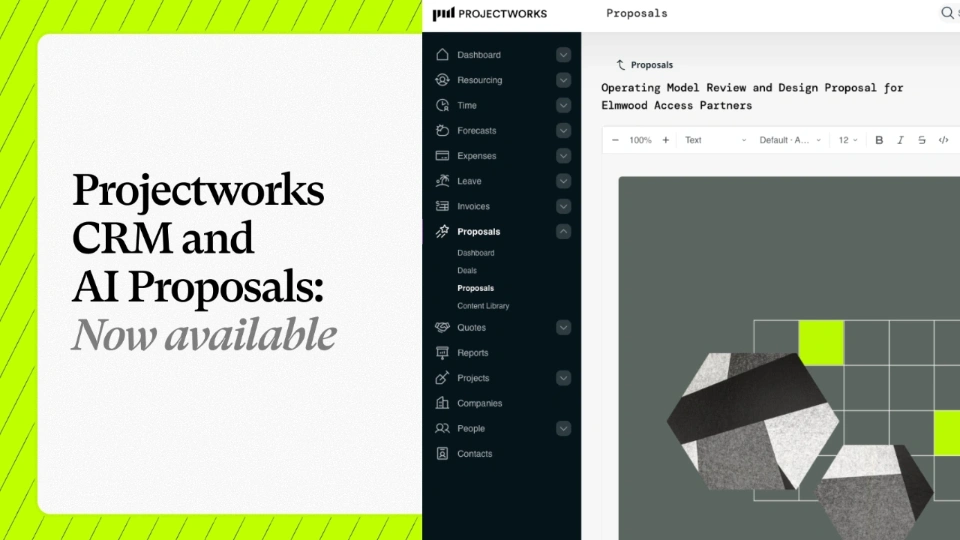
We're excited to announce that our Consulting CRM and Proposals are now available for anyone to use or try out. In just three months, a fast-growing group of firms have been running their pipeline and proposals in Projectworks as part of our early access group, and the results have blown us away.

E-invoicing sends invoices straight into your client's finance system via Peppol. Here's what NZ and Australian firms need to know and fix first.

Most pipeline coverage advice is written for SaaS. Here's how a consulting firm sets coverage by deal stage and plans for the clients it will lose.