

In a consulting firm, the answer to what is a scope of work has a commercial edge, because the scope is the document your price, staffing plan and invoices all come from. The firms that get it right write it from the edges in and have the person who'll run the work test it before it's priced.
What is a scope of work?
A scope of work is the part of a consulting engagement that sets the boundary of the work. It lists the deliverables and how each is accepted, the assumptions the price depends on, what the client must provide, and what's excluded. Those lines mark where the firm's paid work ends.
In most firms the scope sits inside a statement of work as one section, and the statement of work vs scope of work distinction mostly comes down to which document carries which promise.
Why scope decides margin in a consulting firm
Every deliverable in a scope turns into hours on an estimate. If the scope says twelve stakeholder interviews, someone has priced twelve interviews plus the scheduling and write-up each one drags along with it. If it says "change management support," the estimate still assumed a number, but the client never saw it, and the gap between their number and yours becomes work your team does with no line to bill it against.
Over time, those gaps all add up without getting billed.
The survey covers managed IT service providers rather than consultancies, and it counts firms naming scope creep as a challenge rather than projects affected. Wider professional services data isn't more reassuring. SPI Research's 2026 Professional Services Maturity Benchmark put on-time project delivery at 73.8% for 2025, about level with the year before and below the 80.2% high it recorded in 2021. The benchmark doesn't blame late delivery on scope, and projects slip for plenty of other reasons. A late project is still where every soft line in a scope gets tested, though, because the client is asking for more while the budget runs down.
When a request does land outside the scope, a change process for scope creep prices it, but that process only works if the scope makes it obvious the request is new.
What goes into a scope of work
Projectworks research on How To Win More Work found that professional services experts focus 65–75% of their proposal attention on the executive summary, the scope and deliverables, and the pricing. In practice the deliverables list is the part of the scope that gets argued over and rewritten, while the assumptions and exclusions underneath it get copied from the last proposal. It should be the other way around, since the assumptions and exclusions are what protect your price.
Deliverables and acceptance criteria
Write each deliverable as a noun, something the client receives rather than an activity your team performs. "Support the finance transformation" describes effort with no natural end, while "a current-state process map for accounts payable, covering the five processes in Appendix A" is something you can hand over.
Each deliverable also needs an acceptance test someone can apply without asking how the client feels. "Accepted when the client is satisfied" hands the end date of the engagement to the person with the least reason to call it finished.
Assumptions and client responsibilities
Assumptions are the estimate's inputs, written down where the client can see them. They cover volume (how many sites, systems or users), access to data and people, and how quickly the client reviews drafts. When the client's finance system turns out to run as three instances instead of one, a written assumption means both sides saw the price change coming.
Client responsibilities are the assumptions the client controls, such as an IT contact who supplies system access.
Exclusions
The exclusions that cost money sit one step past the deliverable, like implementing the recommendations, training staff on a system you configured, or cleaning data before you can analyze it. Clients assume that work is included because it's the logical next step, and firms leave it out of the estimate for the same reason.
A catch-all line like "anything not listed is out of scope" wins the argument on paper but not three months in, when the client is asking about training they never saw excluded. A named exclusion holds up because the client read it before signing.
How to write a scope of work
Order matters here. If you write the deliverables first, they grow to fill any space the rest of the scope leaves open.
Step 5 is the one that gets skipped when the proposal is due tomorrow, but it catches what the person who sold the work can't see. Sellers write the scope from what the client asked for. The person who'll run the work reads it as a plan and goes through it week by week, asking where each hour will go. That's when the missing work shows up, like two weeks waiting for client feedback, data prep nobody mentioned, and the internal reviews and project management that sit behind every deliverable.
Scope of work example
The example below is an illustrative composite, not a client document.
A 40-person cybersecurity consultancy is scoping a four-week external network and web application security assessment for a regional lender, whose board wants independent assurance ahead of an audit.
The two exclusions do most of the protecting here, since remediation and retesting are the work clients most often assume comes with a security assessment. The scope of work template for professional services lays out a section for each of these elements.
When the scope needs a full SOW around it
Once the boundary is tested, the rest of the paperwork builds on it. The timeline, billing triggers, governance and sign-off all go into the statement of work around the scope, and none of them should need the scope rewritten to fit. Our step-by-step guide on how to write a statement of work takes each of those sections in order. If there's a proposal on your desk this week, start it with the exclusions.
Free template
Statement of work template for professional services firms
Start your next engagement from a structured SOW instead of a blank page.
Download the free template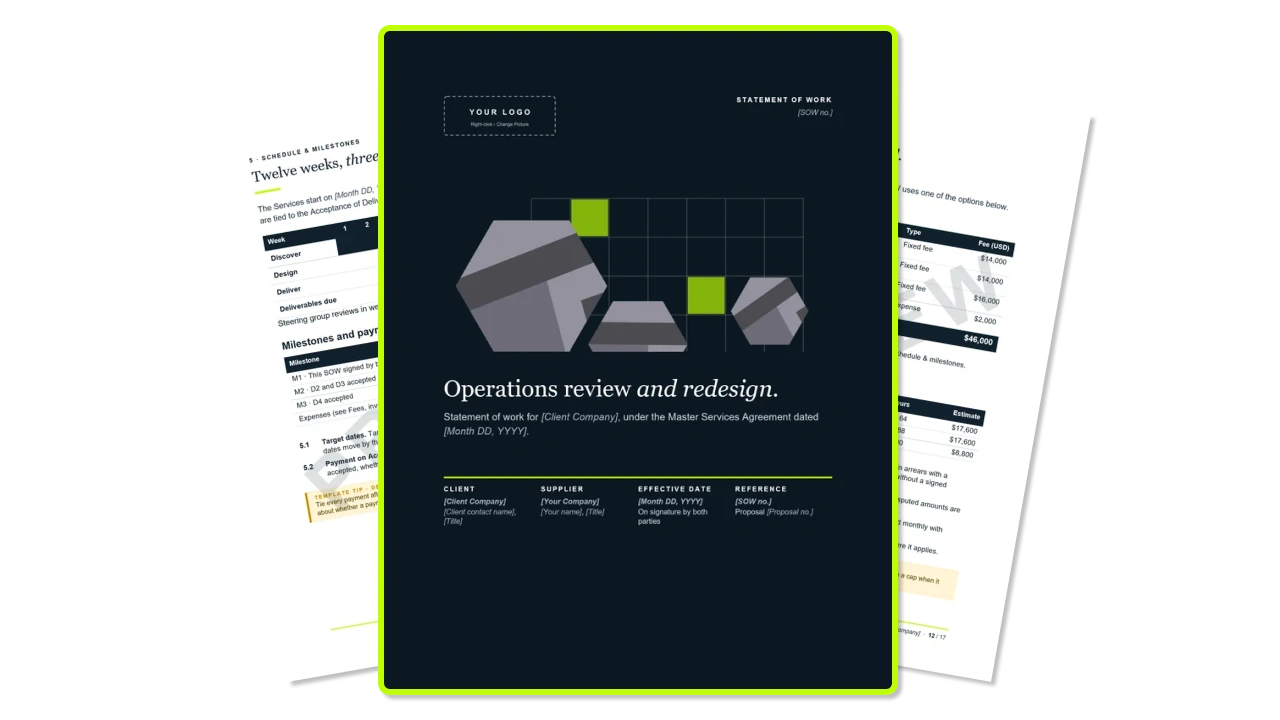


Read similar resources from Projectworks

Thinking of switching from Harvest after the price increase? What to decide first, what data you can export, and how a migration actually works.
Statements of work and scopes of work both get shortened to “SOW,” and because the scope usually sits inside the statement, teams end up treating them as one document. This post settles the statement of work vs scope of work question and shows where each one fits, so you know which one you’re signing.
Dominique here, Chief Customer Officer at Projectworks. I'm really excited to be kicking off a brand new live series called Projectworks Sessions. Session #01 is all about Proposals and CRM: how to manage your pipeline, send proposals and hand won work over to delivery without leaving Projectworks. We’d love you to join us live. RSVP to save your spot.