2027 Planning Bootcamp Part 1: Revenue
This is part one of a three-part bootcamp for consulting leaders, covering revenue, delivery, and your back office. Join us as we share the templates and advice you can use as your firm plans out 2027. In part one, Madeline, Mark and Dominique start with revenue: what worked for your firm in 2026, where the market opportunity lies in 2027, and how to carve out a slice of it that you can realistically win.


Revenue planning for consulting firms comes down to two questions for 2027. How much work can you realistically win, and where will it come from?
This is Part 1 of the 2027 Planning Bootcamp, a three-part Projectworks podcast series that moves from revenue to delivery to the back office, hosted by CEO Mark Orttung and CCO Dominique Rennell with Projectworks CRO Madeline Bakewell as this part's guest.
What goes into a consulting firm's revenue plan?
Top-down vs bottom-up revenue planning
A top-down plan starts from how big you want to be, usually set by the board, an exit plan or a margin target, and is split by month for seasonality.
A bottom-up plan starts from what you can realistically deliver, built from signed work, then weighted pipeline, then each new motion by segment, region or channel, with every line tied to a specific bet.
Build the two separately so neither sways the other, and be conservative with anything new. The plan is the reconciliation. Turn the dials on a couple of lines first. If the numbers still don't meet, adjust the top-down with your board.
The revenue bridge, weighted pipeline and go-get
A revenue bridge stacks your goal in three blocks:
- Contracted work is already signed.
- Weighted pipeline is each open deal's value multiplied by its chance of winning.
- The go-get is everything left over.
When Mark sold Nexient, the bankers built this chart for the sale, and the team wished they'd had it years earlier.

We called it the go-get… you can't name a client. You can't name anything about this yet.
The go-get as a share of the goal is a fast confidence test. Mark's rule of thumb is that under 10% deserves real confidence, 10 to 20% is a medium range, and more than 20% should worry you. Through the year the go-get should shrink, and Dominique looks for roughly half of it filled by mid-year.
Work to win, and why late-year wins lag
Work to win is the new work you need to sign to close the gap between signed work and the goal. It's almost always bigger than the revenue gap, because work signed late in the year delivers mostly the following year. A big project that starts in November might put two months of its revenue into this year, so firms with longer projects feel this more. The upside is that the spillover becomes next year's contracted base.
Farming vs hunting
Farming means growing existing clients and hunting means winning new ones. Have a view on the mix before you set targets, since the two need different effort and convert at different rates. In Mark's view, "70-30 is a pretty healthy ratio" of farming to hunting.
A firm that stops hunting ends up leaning on a few large clients, the client concentration risk that drags down valuations.
TAM, SAM and SOM for consulting firms
- Total addressable market (TAM) is everyone you could ever serve, which is mostly theoretical.
- Serviceable addressable market (SAM) is the part your services and regions can reach.
- Serviceable obtainable market (SOM) is the share you can realistically win.
Meet Fieldstone, our example firm

The rest of this article builds Fieldstone's 2027 plan.
Building a 2027 revenue plan, step by step
Set a floor and a ceiling
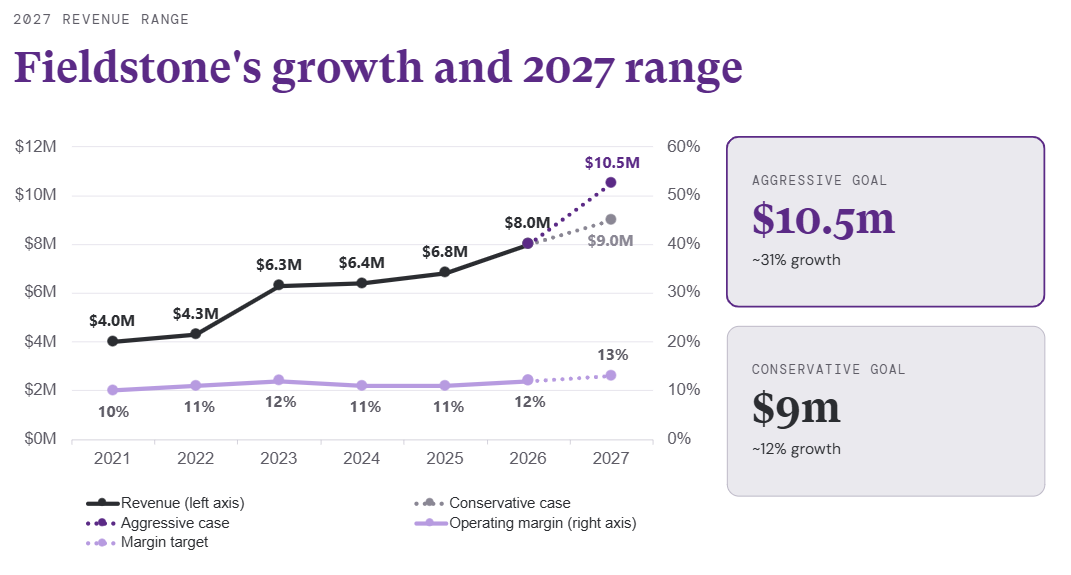
In the Fieldstone example, the plan has two numbers and spends against the lower one.
- $9M bottom-up floor, about 12% growth
- $10.5M top-down ceiling, about 31% growth
- Spending planned on the $9M, with extra spend released only as the quarters track toward $10.5M
If you really only have confidence in the bottom line, then that should be your spending plan.
Choose the segments to back
The 2026 audit points Fieldstone to three priority segments.
- Grid and data center, with a 39% margin and 55% growth
- University and hospital campuses, with a 37% margin and 33% growth
- City and county water, with only 7% growth but 100% repeat clients
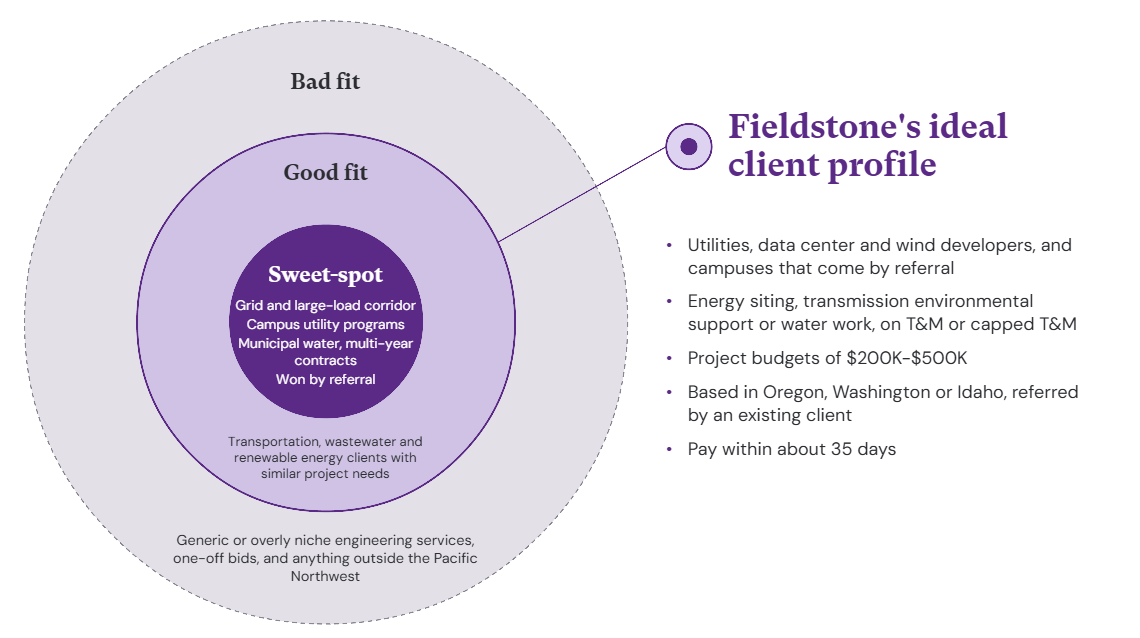
Three is deliberate, since plans that push nine segments up at once rarely play out. Fieldstone's example client profile, specific enough to brief a first sales hire, targets $200K to $500K projects in its three states from clients who pay within about 35 days.
Check the market has room
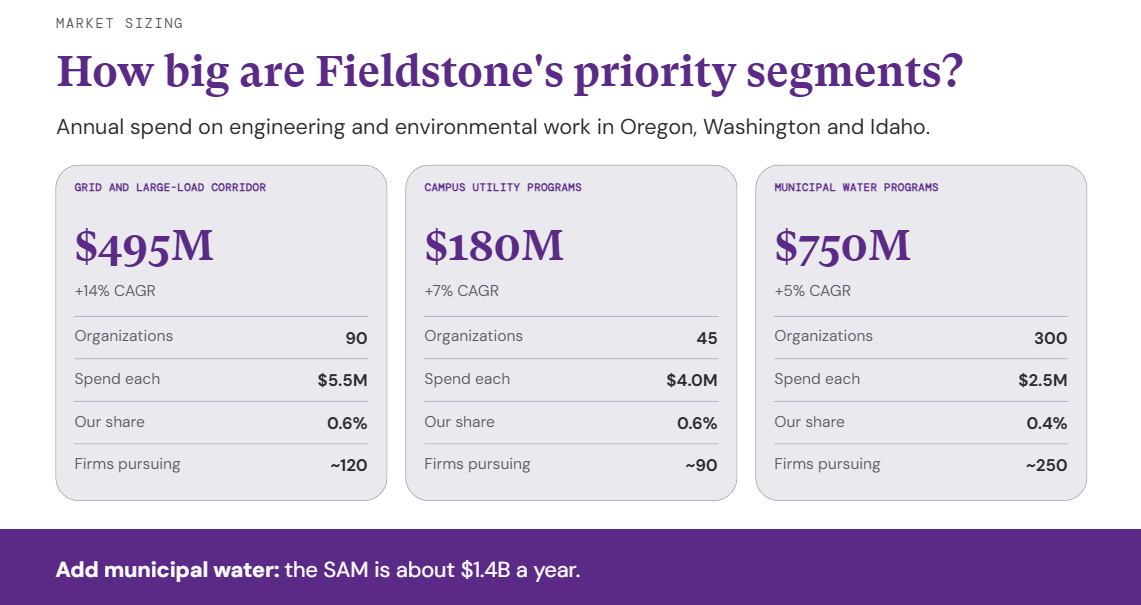
Across its three segments, Fieldstone's illustrative market is about $1.4B a year from roughly 435 organizations, plenty of headroom for a handful of new clients.
- Expect low conversion. Back-of-envelope math can turn 100 firms contacted into five replies, two sales cycles and one signed client.
- Start the next region now with a small share of effort, because new markets are slow to enter.
- Find the hub buyer. At Mark's previous company, one or two utilities visited PG&E (Pacific Gas and Electric) every week, so getting close to PG&E opened doors across the segment.
Test confidence with the revenue bridge
Fieldstone's bridge to its $10.5M goal has three blocks.
- $5.7M contracted
- $2.2M weighted pipeline
- $2.6M go-get, about 25% of the goal
That go-get puts the plan in the low-confidence band, which is why spending sits on the floor. The plan also expects 68% of its revenue goal from farming, close to the 70-30 mix.
Work back to pipeline targets
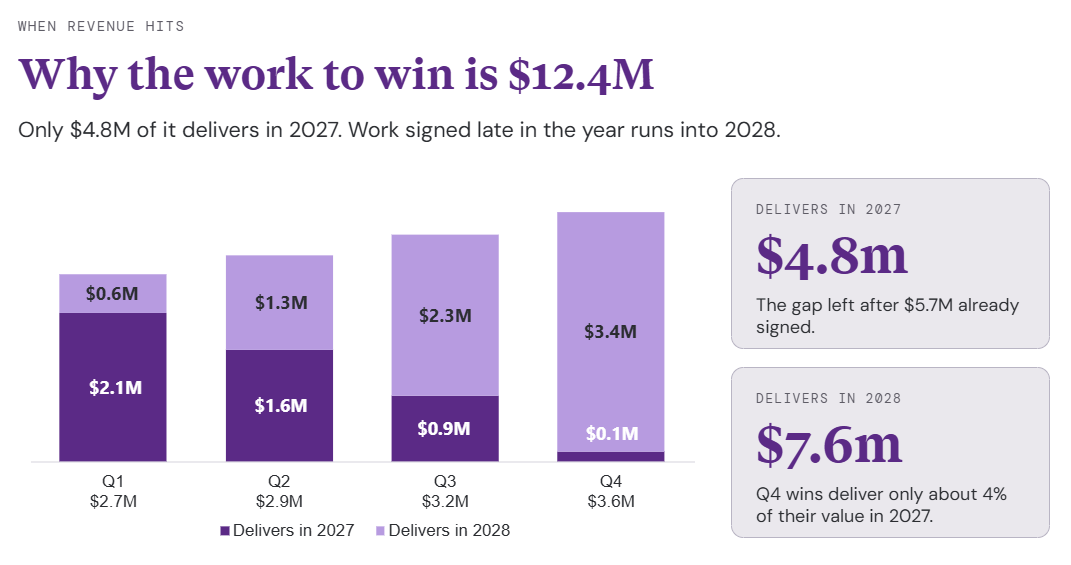
To hit $10.5M, the plan works back from $12.4M of work to win.
- 50 deals at about $250K each
- 113 proposals at a 44% win rate (matching the average for engineering firms in Projectworks research)
- Roughly 235 open opportunities
- Pipeline coverage of about 2.3 times the work to win
Only $4.8M of the $12.4M delivers in 2027, because $7.6M runs into 2028. Quarterly targets build about 10% a quarter, from $2.7M in Q1 to $3.6M in Q4. Set upper-funnel targets too, so an opportunity shortfall shows up months before revenue does.
Split targets by channel and owner
Break the number down by segment, channel and owner before checking it against quotas.
- Cover every channel, including inbound, outbound, partners and founder network
- Give a quota to anyone who brings in work, not only salespeople
- Roll quotas up to 10 to 15% above the goal as a rule of thumb, because the whole team rarely hits target
Your 2027 planning toolkit
- 2027 revenue plan template sets your floor and ceiling, then shows the gap month by month (steps 5 and 6).
- Ideal client finder skill ranks last year's clients from your export and drafts your ideal client profile (steps 1 to 3).
- Pipeline target calculator skill turns your goal into quarterly targets for deals, proposals and pipeline (steps 7 and 8).
Can you deliver the plan you just built?
Balancing new sales with having the right people available at the right moment is probably the hardest problem of running a firm, because a revenue plan only holds if people are free when the work lands.
Projectworks Founder and CPO Matt Hayter joins Part 2 of the bootcamp to pick that up. It covers scaling delivery, what AI can take off your team's plate, when to hire and which roles first, holding margin, and tracking delivery monthly. Fieldstone hands over a $10.5M goal, about 52 people at $200K of revenue each, a 13% operating margin target, and $7.6M of 2027 wins that deliver in 2028.
Download the revenue plan template to start your 2027 plan.
Excel Workbook
Free Revenue Plan Template for Consulting Firms
A free revenue plan template that sets your target against what your pipeline can actually deliver, then shows the gap in total and month by month. One Excel workbook, four tabs, seven steps.
Download the free template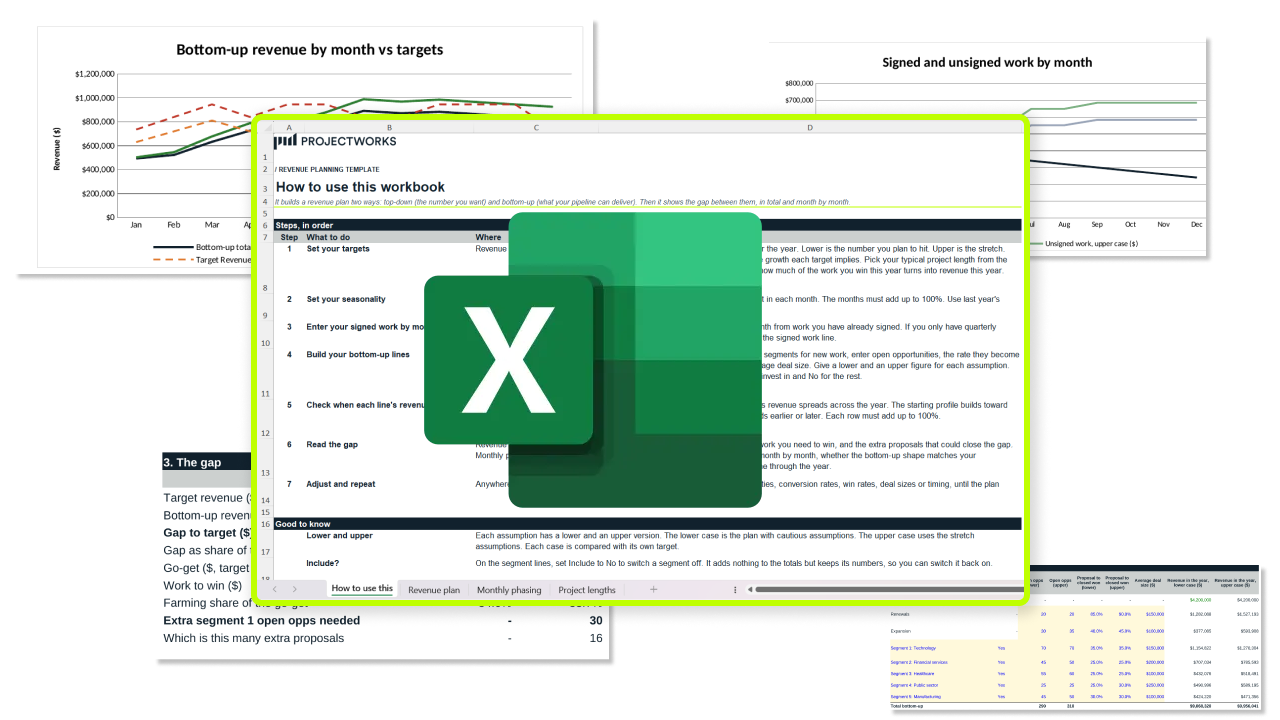


Listen to moments from similar podcasts
The thing is, most founders have never actually broken down what selling means at their firm, so when it's time to hire, they struggle to know who to hire, let alone what to pay them. In this episode, Mark and Dominique lay out the three components of successful sales in a growing firm, and turn that into a framework for making both calls.

Losing your biggest client is one of the few things every founder worries about and almost nobody prepares for. In this episode, Mark and Dominique will walk through what actually happens in the 90 days after it hits, then zoom out to the harder question: how you avoid ending up there again. That means carrying enough pipeline to hit your growth number even without your biggest account, and treating client concentration as something you manage on purpose instead of something a crisis forces on you.
For many consulting firms, the one-project client is the norm and the long-term partnership is the exception, which is backwards given how much cheaper repeat work is to win. This episode is about making that step deliberate rather than accidental. We'll share the play-by-play breakdown of how fast growing firms identify the right client accounts it invest in, how they grow them, who's involved in the relationship, and where AI makes it all easier.