Sales Compensation For Consulting Firms
The thing is, most founders have never actually broken down what selling means at their firm, so when it's time to hire, they struggle to know who to hire, let alone what to pay them. In this episode, Mark and Dominique lay out the three components of successful sales in a growing firm, and turn that into a framework for making both calls.


When does founder-led sales stop working?
Consulting founders are usually experts first and salespeople a distant second. They sell anyway and cover every part of it themselves, which works until the firm gets busy. Then one of the jobs slips, usually the slow relationship work that never feels urgent, and by the time anyone looks up, the pipeline isn't there. A firm that runs out of founder time without planning for it plateaus and often starts to slide. It's the founder-bandwidth wall most firms meet first.
The three roles behind every consulting sales job
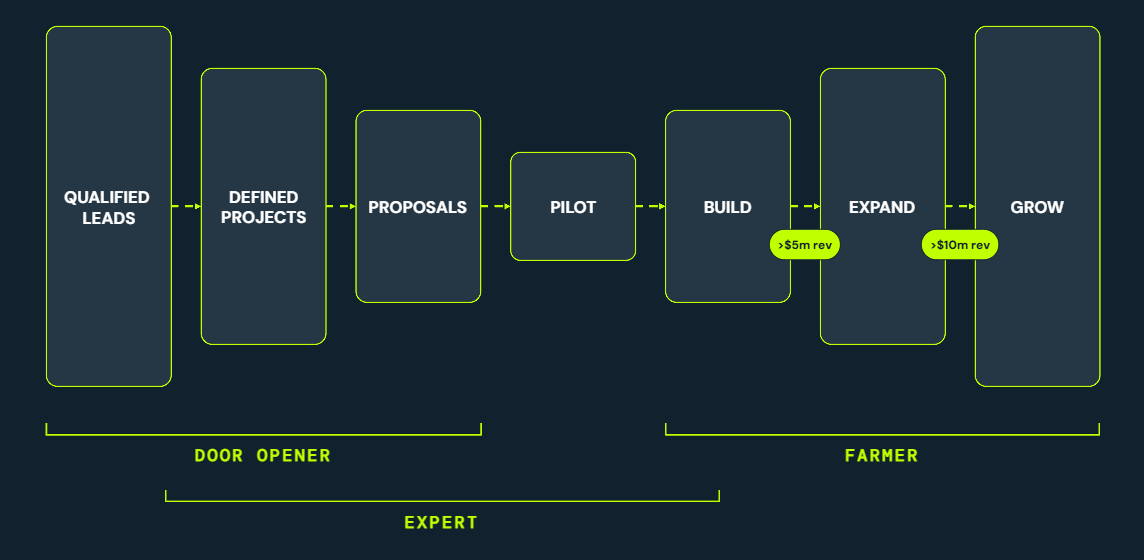
A product sale usually ends with one rep closing the deal and handing the customer to an account manager. In consulting, the relationship starts with the first project, so all three roles stay in play long after the contract is signed.
1. The 'door opener' wins new clients
The door opener (sometimes called the hunter) finds the clients you don't have yet.
- Builds relationships before there's a project to bid on.
- Turns a loose problem a prospect mentions into a second meeting with your expert.
- Plays a long game, following up well past the point where most people would give up.
- Needs real standing in your market, which is a different thing from an SDR's call volume.
- Often starts out as the founder's own network, which makes this the hardest role to hand over.
2. The ‘expert’ builds trust and runs the pilot
The expert turns the door opener's conversation into the first piece of paid work.
- Is a practitioner with years in your core offering, which is what makes them credible to a client.
- Is still selling, because at this stage winning the work depends on them as much as on the door opener.
- Shapes the pilot or first engagement so the client can see what the firm does.
3. The ‘farmer’ expands the relationship
The farmer grows the client once the first project is underway.
- Knows the client's organization, people and plans.
- Sells as part of delivering the work rather than as a separate activity.
- Knows they've earned full trust when the client shares next year's budget and the projects they're considering.
Who should your first sales hire be?
Resist the urge to replace the founder with three people at once. Pick the one role that makes most sense to start with in your situation, which means working out how much of it you want to hand over and who would complement you. Usually that's the role you're weakest at.
Then be explicit about where you're pointing the hire and how you'll judge their success. A plain revenue target lets a new salesperson make their number from clients you already have without winning a single new one. That's where the easy money sits, since 55% of consulting proposals are for existing clients or repeat work, according to Projectworks research for How To Win More Work. Give a door opener goals about new relationships instead, such as an illustrative 40 new contacts who know the firm within six months.
How should you pay a consulting salesperson?
Once the role is clear, the pay plan follows from it. The template here is the plan Mark ran for Nexient's client partners, which he first outlined in our episode on AI-driven business development. It was built for firms up to about $30M in revenue with client partners reporting to the CEO.

"Go-to-market teams are very coin-operated. And by that I mean they are going to look at the comp plan you put in front of them, and they are going to optimize their commission payment based on what you've put in front of them."
So the plan has to spell out exactly what you want. Nexient budgeted about 4% of revenue for sales and account management, then paid each client partner a share of their accounts' revenue that rose or fell with two measures. One was year-on-year account growth against a 25% target, and the other was gross margin against a target of 35%, later raised to 37.5%. A client partner who hit both earned 2% of their accounts' revenue.
"If you only had one, I'd do gross margin, because it demonstrates that you're running a healthy engagement with that client."
Mark credits the plan with Nexient averaging 40% growth a year for five years, his read on his own firm rather than a controlled result.
Door openers need something simpler, because their job is to keep finding new clients rather than to run accounts. Nexient paid them 2% of a new client's revenue in year one, 1% in year two and nothing in year three.
Growth is a system, not a single hire
That's also why a consulting sales plan pays on account growth and gross margin, since both are decided as much in delivery as in the sale. Running a plan like that means knowing each account's revenue, growth and margin, which is far easier when deals, proposals and project financials sit in the same system. That's why we built CRM & Proposals into Projectworks, so that the sales side lives alongside that delivery data.
Start with one well-chosen hire and a plan that pays for the growth you want at a margin you can live with. Want to see what your own numbers look like using Nexient's model?



Listen to moments from similar podcasts

This is part one of a three-part bootcamp for consulting leaders, covering revenue, delivery, and your back office. Join us as we share the templates and advice you can use as your firm plans out 2027. In part one, Madeline, Mark and Dominique start with revenue: what worked for your firm in 2026, where the market opportunity lies in 2027, and how to carve out a slice of it that you can realistically win.

Losing your biggest client is one of the few things every founder worries about and almost nobody prepares for. In this episode, Mark and Dominique will walk through what actually happens in the 90 days after it hits, then zoom out to the harder question: how you avoid ending up there again. That means carrying enough pipeline to hit your growth number even without your biggest account, and treating client concentration as something you manage on purpose instead of something a crisis forces on you.

For many consulting firms, the one-project client is the norm and the long-term partnership is the exception, which is backwards given how much cheaper repeat work is to win. This episode is about making that step deliberate rather than accidental. We'll share the play-by-play breakdown of how fast growing firms identify the right client accounts it invest in, how they grow them, who's involved in the relationship, and where AI makes it all easier.