

The best consulting sales people win new clients and grow the ones you already have, at a margin worth keeping. Build a sales incentive plan that pays them for both. Answer five questions about your firm and the role, and the sales incentive plan calculator gives you a one-page plan with your numbers in it, ready to download. Built for consulting and professional services firms of 10 to 200 people.
What you'll need before you start
- On-target earnings (OTE). What you'd expect to pay your sales person for a year on target.
- Base vs variable split. How much of OTE is fixed salary and how much rides on results.
- New vs existing client mix. The share of their work you expect to come from new clients.
- Account growth target. How much you want existing client accounts to grow in a year.
- Account margin target. What you want left from each client's revenue after every cost assigned to it.
No targets yet? Use your current figures.
Why does a consulting sales person need to hunt and farm?
In a lot of industries, closing the deal is the whole job. A hunter wins the account, hands it to customer success or an account manager, and goes looking for the next one. Alexander Group, the sales consultancy, says that split works best for offerings the market already understands, where most of the selling happens before the first sale.
Consulting runs the other way. The first project is where the client relationship starts, and the follow-on work (the second phase, or next year's bigger engagement) depends on how that project went and on who stayed close to the client during delivery. Alexander Group says complex offerings with ongoing services suit a generalist who wins the account and then grows it from the inside.
Our research for How To Win More Work found the same pattern in where consulting proposals go.
So pipeline and proposals have to work for repeat business as well as new logos. That's how we built consulting CRM and proposals in Projectworks, with configurable deal stages, AI-drafted proposals that pull from a shared content library, and deal budgets that carry into the project when you win.
It's also why the calculator asks how your sales person's time splits between new and existing clients. The default is 30% new, but your own estimate matters more. Someone who spends most of their week on existing accounts is still selling, and a plan that only rewards new logos will teach them to stop.
Why the plan rewards growth and profitability together
This sales incentive plan pays on two measures, account growth and account margin, and weights them equally. Each one on its own rewards a different way of hurting a consulting firm.
Pay a sales person on growth alone and they'll find growth, some of it by trimming rates to win the next phase and some by letting the delivery team over-service the account so the client keeps buying. Revenue goes up while the firm makes less on every hour it sells.
Pay on margin alone and you get the opposite problem. The easiest way to protect margin is to avoid new commitments, pass on the stretch project and keep the client exactly where it is. Margin looks healthy while the book gets smaller.
Paying half on each means the only way to earn the full variable pay is to grow accounts at a margin the firm is happy with. Equal weighting is also easy to explain, which matters more than it sounds when someone's income depends on it. There is a trade-off. A strong result on one measure can partly make up for a weak result on the other, so a sales person who doubles an account at a thin margin still earns something. We think that's a fair price for a plan people can understand without a spreadsheet.
The plan is adapted from one Projectworks CEO Mark Orttung ran at Nexient, the software services firm he led, where client partners earned a share of revenue that moved up or down with account margin and year-on-year account growth. He has written up how that compensation plan was built.
The logic carries over to any consulting firm because it matches how firms are valued. A buyer prices a consulting firm as a multiple of its earnings, and how durable its growth looks helps set that multiple (how valuation multiples work). Your sales person should be paid for the same profitable growth a buyer would pay for.
How this sales incentive plan works
How base pay and variable pay are set
Base pay and variable pay both cover the sales person's whole book, new clients and existing ones. Salary doesn't pay for hunting while commission pays for farming, because the same person does both and a new client becomes an existing one within a year.
You set on-target earnings and the split between base and variable. The variable part is then measured against your firm's own targets for account growth and account margin. Hit both targets and the sales person earns their full variable pay. Beat them and the payment grows, while a miss on either measure reduces it.
Why the variable pay has no cap
A cap in a sales commission structure usually exists to stop anyone earning an awkward amount in a good year. Mark's view from Nexient is blunt: "I've never understood caps on commission plans." If every extra dollar of profitable growth is good for the firm, there's no reason to stop paying for it at a ceiling. The sales person's own time and capacity is the practical limit.
Cliffs cause a similar problem from the other side. Harikesh Nair and Sanjog Misra at Stanford GSB studied the sales force of a Fortune 500 contact lens maker and found that quota-based pay gave reps who had already made quota a reason to push further sales into the next period, and gave reps who couldn't make it a reason to ease off. After the company redesigned its sales compensation plan without the quota, revenue rose 9%, about $12 million a year (Stanford GSB).
What the plan costs your firm
On target, the plan costs the firm about 2% of the revenue the sales person manages. The calculator also shows the cost as a share of gross profit, which is often a useful view, since 2% of revenue is a much bigger slice of gross profit at a 30% gross margin than at 50%.
How to choose your inputs
What is OTE in sales?
OTE, or on-target earnings, is what a sales person earns in a year if they hit 100% of target, which is their base salary plus their full variable pay.
To set OTE, start with what you'd expect to pay a good sales person in your market for a year of solid results, then check what the calculator says the role costs as a share of revenue. If that looks wrong, either the OTE or the revenue you expect the person to manage needs another look.
How much should be base salary and how much variable?
Common pay mixes keep fixed salary above half of total pay, and the base share tends to rise when sales cycles are long or the job includes work beyond closing deals. Account managers with a broad set of customer duties usually carry a high base, while new-business sellers on short cycles carry more variable. A consulting sales person who hunts and farms sits closer to the account manager end, and in our experience a base below about 40% of OTE is rare for a senior consulting sales role.
Whatever split you choose, the base still has to satisfy minimum pay law where the person works, and the rules differ by market. Be sure to check local employment law before you finalize your plan.
How to set growth and account margin targets
For account growth, use the target you've already set for existing clients. If you don't have one, use your current growth rate, so the plan pays for keeping pace and rewards anything above it.
Account margin in this plan is what's left from a client's revenue after every cost assigned to that client, including the delivery team and the sales person's own cost. That's broader than the definition in our account margin calculator, which counts the direct costs of delivering the work, so expect the figure here to come out lower for the same client. If you don't have a target, use your current margin on this broader definition.
Turning your calculator results into a working plan
The calculator works on annual averages so you can see the shape of a plan in a few minutes. Use the one-page plan as your starting template. It already covers the role, objectives, incentive calculation, what beating target pays and payment rules. Then add the clauses that fit how your firm runs, such as how you credit a client two people worked on, what happens when someone leaves mid-period and how a brand new client counts toward growth in its first year.
Running the plan takes per-client numbers every six months
To pay someone on account growth and account margin, you need revenue, growth and margin for every client they manage, twice a year, and everyone has to trust the figures because pay depends on them. Most firms we talk to struggle to get that reliably. The data is spread across systems and a spreadsheet someone in finance rebuilds each period, and the argument about which costs belong to which client starts again every time.
Projectworks shows current and projected margin by client, project or person, with custom reports for the cuts your plan needs. Our customers grow an average of 20% in their first year. Build your plan with the calculator, then see how it runs when the numbers it pays on are already in one place.

The cost of delaying is huge.
Try Projectworks free, now.
Explore similar resources from Projectworks
A step-by-step cheat sheet showing consulting firms how to build a Skill in Claude or ChatGPT that turns project data into a client status deck.
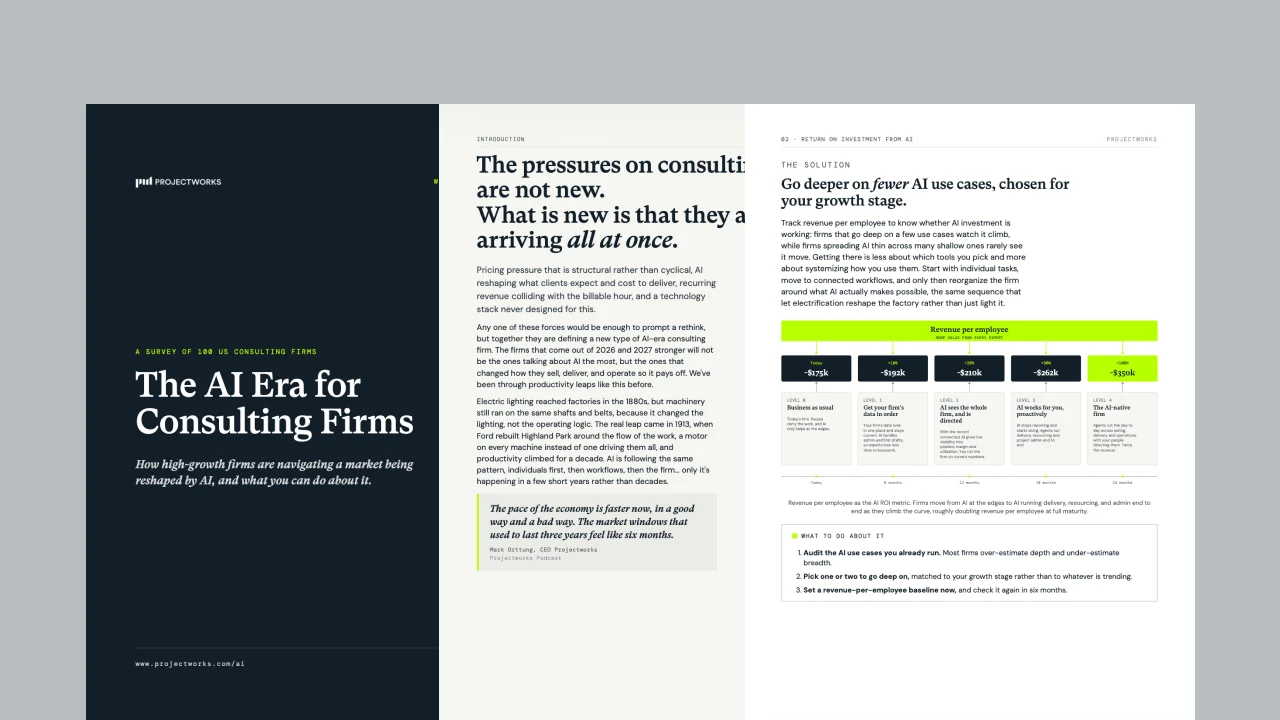
Based on a survey of 100 high-growth US consulting firms, this whitepaper breaks down how firms responding to the pricing, AI, and tech-stack pressures reshaping the industry right now. It covers the five places every firm needs to act, and what the firms pulling ahead are doing differently.

This guide explains how to work out what AI is actually returning at your engineering firm. Plus, five free AI Cheats Sheets to start winning back time and tighten project delivery using AI.