Client Concentration Risk: What It Is, Why It Tanks Your Valuation & How to Fix It


Client concentration risk can compress your valuation and put your firm at risk. Learn what it is, how to calculate it, and how to reduce it.
If you tuned into our discussion around how buyers actually value consulting firms, you’ll already know that EBITDA (Earnings Before Interest, Taxes, Depreciation, and Amortization) is what really drives the valuation, and not revenue. And if you’ve dug into how valuation multiples actually work, you’ll know that the multiple applied to that EBITDA isn’t fixed. It moves based on how risky your business looks to a buyer.
Client concentration risk is one of the most reliable ways to make your business look risky to potential buyers. It’s one of the fastest ways to see a multiple compress at the negotiating table. And yet, many professional services firms don’t realize they have a problem until it’s too late.
What is Client Concentration Risk?
Client concentration risk (also called customer concentration risk) is the danger that arises when a disproportionate share of your firm’s revenue comes from a small number of clients. In other words: if one or two clients walked out the door tomorrow, would your business survive?
For consulting firms, agencies, and other professional services businesses, this is an especially acute concern. Your revenue is relational. It lives inside ongoing engagements, retainers, and trust-based partnerships. This can give you a false sense of security, when everything feels so stable.
What does client concentration look like?
It’s not always obvious, but some of the tell-tale signs include:
- a single client representing 30%, 40%, or even 60% of your total revenue
- your top three clients collectively accounting for more than half of your revenue
- a handful of clients on large, long-term retainers that feel locked in
- a client or contact that has introduced most of your other clients, creating a fragile network.
You may feel as if you have a close partnership with a client, but no one client should be an existential dependency for your business.
Most firms don't set out to be over-concentrated. It happens gradually, and for understandable reasons.
A large client brings in significant revenue, pays reliably, and is enjoyable to work with. The natural response is to say yes to more of their work. Over time, they become a bigger and bigger share of the pie, not because you neglected other clients, but because serving them well was simply easier and more profitable in the short term.
Meanwhile, business development takes a back seat. Why chase new logos when you have a full team already billing to your best client?
The result is a firm that feels successful but is structurally fragile. Over time, you get so comfortable with business-as-usual that the risk no longer feels real. Sometimes even to the extent that resourcing, processes, even culture, start to orient around your top client. By the time they cut their budget, bring work in-house, or simply move on, it's often too late to course-correct quickly.
How To Calculate Client Concentration Risk
Measuring client concentration is straightforward, but it can be eye-opening. Some firms would rather just avoid confronting the uncomfortable realization that they are putting themselves at risk, especially when everything else feels like it’s in a really good place.
Be brave. Let’s go through this step-by-step.
1. Pull your revenue data for the past 12 months.
Calculate total revenue across all clients and each client’s revenue for that period (including projects, retainers, one-off work, etc).
Accurate financial reporting software like Projectworks should make this step a breeze.
2. Apply the formula to get each client’s concentration percentage.
The most common method for calculating each client's revenue concentration percentage:
Client Concentration (%) = (Revenue from Client ÷ Total Revenue) × 100
3. Rank your clients from highest to lowest concentration.
Once you’ve run the calculation for every client, rank each one from highest to lowest concentration.
4. Calculate cumulative concentration.
Add up the percentages for your top 1, top 3, and top 5 clients.
5. Identify the red flags.
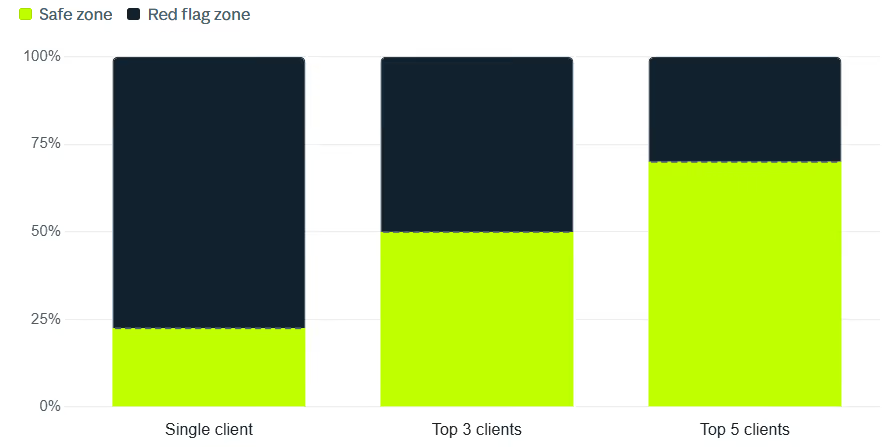
What you’re looking for is:
- any single client above 20-25% of total revenue
- your top 3 clients collectively above 50%
- your top 5 clients collectively above 70%
That first one in particular is a common threshold that buyers will be looking for.
And if you want to get really accurate, repeat the analysis with slight variations.
For example, you could repeat the analysis by headcount or leveraging your utilization reporting, in addition to just revenue. Sometimes a client who represents 20% of revenue is absorbing 40% of your senior team’s time, which is its own kind of concentration problem.
Or what happens if you include projected pipeline, and not just historical data? If one client accounts for 25% of closed revenue and 40% of your active pipeline, the actual risk is higher than the historical number suggests.
Impact of Client Concentration on Agency Valuation
Here’s where concentration risk goes from being an operational concern to a financial one.
When a buyer evaluates a professional services firm, they’re not just buying your current earnings. They’re buying the predictability of those earnings into the future. Client concentration is one of the most direct threats to that predictability.
The red flags we listed in step 5 of how to calculate client concentration risk might be applied as an informal rule of thumb for acquirers, but they can significantly reduce your multiple or even kill a deal entirely.
Think of it from the position of the buyer. If your firm’s EBITDA is $1M, but $400K of that is attributable to one client who could leave, the buyer isn’t really buying $1M of earnings. They’re buying $600K of earnings and a lottery ticket.
Of course, these figures might look a little different across different services firms.
- Management consultancies tend to have more project-based diversity, but senior partner relationships can create informal concentration. Buyers will look at relationship dependency as much as revenue dependency.
- Creative and marketing agencies are particularly vulnerable. A large retained client is often a badge of honor, but it creates the exact conditions for concentration risk.
- IT software and cybersecurity services face concentration risk that compounds with key-person risk. If your biggest client relationship is managed by one senior consultant or account director, their departure could trigger the client’s departure too.
Reducing Client Concentration Risk
The good news is that client concentration is fixable. The bad news is that it takes time, and the best moment to start was two years ago.
The obvious solution is to diversify your client base. But it does require decided effort to put strategies into place. In reality, most firms under-invest in business development precisely because they’re busy serving the clients they already have. Which is how you get into this position in the first place.
In order to reduce client concentration risk, business development time needs to be treated the same way that you treat client delivery time. It needs to be scheduled, protected, and tracked.
Your BD team should also be targeting clients in different industries. Sector diversification reduces the risk that an economic downturn in one industry hits multiple clients simultaneously. And, while it can be tempting to just focus energy on large retainers, intentionally developing smaller clients to build a more diverse client portfolio is far more resilient than one large anchor client. Improving your proposals process is a practical step to winning more work faster and more efficiently, to help you get there.
Firms should be setting a formal revenue cap per client. Decide in advance that no single client will exceed 20% of revenue (or whatever threshold makes sense for your firm). That way, when a client starts to approach that ceiling, sure, celebrate the growth, but also treat it as a signal to accelerate new business activity.
Build Systems to Track and Monitor Concentration
You can't manage what you don't measure. One of the most underused levers for managing concentration risk is having clear, real-time visibility into your revenue distribution.
This is where PSA software like Projectworks becomes genuinely useful. Rather than running a manual spreadsheet analysis once a year, Projectworks gives you ongoing visibility into how revenue is distributed across your client portfolio. You can see, at a glance, which clients are growing as a proportion of total revenue, and catch concentration creeping up before it becomes a structural problem.
Beyond identification, the same data that surfaces concentration risk can inform your resourcing and growth decisions. If you can see that 40% of your senior consultant hours are going to one client, you can make deliberate decisions about how to rebalance, rather than discovering the problem when that client reduces scope.
Practical steps with Projectworks
- Use revenue reporting to run a regular (at minimum, quarterly) client concentration analysis.
- Set internal alerts or review triggers when any client crosses a threshold percentage of revenue.
- Use pipeline and project forecasting to assess forward-looking concentration, not just historical. (Our data shows that firms with stronger resource planning practices grow at twice the rate of those without.)
- Align resourcing decisions with diversification goals. Track utilization by client so you can see where your human capital is concentrated, not just your revenue.
For professional services firms thinking about growth, exit, or simply building something more resilient, addressing customer concentration is one of the highest-leverage moves available. Measure it regularly, set clear thresholds, invest in new business, and use your operational data to stay ahead of the problem.
The firms that do this well don't just get better valuations. They build businesses that can genuinely weather the unexpected, and that's valuable whether or not you ever sell.


Read similar resources from Projectworks

E-invoicing sends invoices straight into your client's finance system via Peppol. Here's what NZ and Australian firms need to know and fix first.

Most pipeline coverage advice is written for SaaS. Here's how a consulting firm sets coverage by deal stage and plans for the clients it will lose.

Let’s say a consulting firm signs a $30,000 engagement in July and invoices the full fee upfront. The client pays quickly and the cash lands, but the work runs from July through September. By the end of July the firm has completed about one-third of the engagement - the project’s on track but the finance team have some work to do to match revenue with the costs incurred (the “matching principle” of having costs and revenue in the same period is a key accounting concept). Only a third of the project’s fee has been earned (because only a third of the work has been done), and the remaining $20k of revenue is deferred to a future period.