Using AI to Grow Project Margin
In a small firm, delivery quality holds because everyone works side by side and the founder touches every project. Then the firm grows, the founder runs out of hours, and work gets delivered by people who never learned your delivery method firsthand. Project margins turn inconsistent, and it's rarely the same reason twice. Most AI you've used so far waits for you to ask it something. Agents are different: they work in the background and tell you what needs attention before you'd have caught it yourself. This episode is about what that shift means for delivery, and we'll introduce Kea, the AI agent we're building inside Projectworks, and where we're taking it.
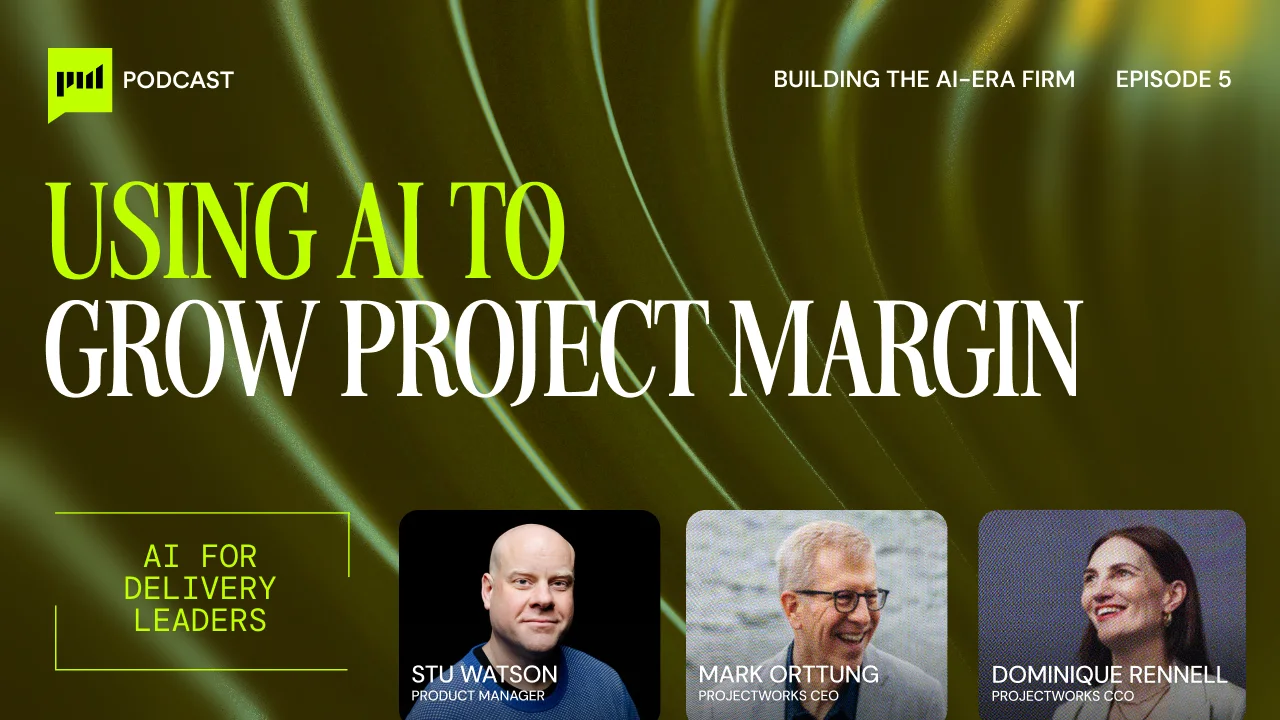


When a consulting firm is small, the founder is in every project, pricing the work and quietly keeping it profitable. Growth can break that. As the firm gets bigger, no single person can stay across every job, and project margin starts to slip in ways that are hard to see coming. In this episode, our CEO Mark Orttung, CCO Dominique Rennell and Kea's product manager Stu Watson get into how agentic AI can help hold project margin as you scale.
Why project margin gets harder to hold as you scale
Early on, problems are easy to catch because someone senior is close to every project. As you grow, delivery spreads to people who never learned the founder's playbook firsthand, and the discipline that used to come from personal oversight starts to thin out. Margin slips for a different reason each time, scope creep on one project, a late invoice on the next.
In our maturity model, this is an operations problem, not a sales one. Once you're reliably winning work, profitability comes down to how well that work gets delivered, and that shows up in your delivery margins, gross margin and project margin, project by project.
As Mark points out, selling, delivering and staying profitable aren't three separate jobs. They're one chain.
"They're right in the core of every firm... whether you do all the work to sell it, you've gotta deliver it well. It's gotta be profitable, and hopefully lead to more work."
Mark Orttung, CEO
What actually is Agentic AI in professional services?
Not every AI tool is an agent, and the difference matters here. A reactive tool waits for you to ask a question, then hands back an answer. An agentic one takes the goal behind the question and does the work to get there.
"The way to think about it: chatbot, it can only answer, it's very manual. Agentic AI is about workflows and automation, the idea is it's saving you effort and time."
Stu Watson, Product Manager
For someone running delivery, that's the whole point. A reactive tool can tell you which projects are over budget when you think to ask. An agentic one watches for it, flags the projects that need you, and starts sorting out the fix before you have to chase it.
Meet Kea, agentic AI that's built into Projectworks
Kea is our agentic AI. Instead of sitting off to the side, it works on top of everything already in Projectworks, and today it shows up as a chat interface. The aim is for it to work right across the services value chain, from how work gets resourced to how it's tracked and closed out.
Fun fact: Kea is named after an alpine parrot native to New Zealand, where we started. They're famously clever, curious and adaptable, and they've been known to take apart car wipers for fun. We were going for the clever and adaptable part.
You can see early looks at Kea in action in the recording above.
Inside Kea's learning loop, four agents on one system of record
Kea's value comes from where it sits. All the work a firm does, from winning it to resourcing, delivering and invoicing, already lives in one place in Projectworks, and Kea works across the lot. Because every agent draws on the same data, what one picks up feeds the next, so a resourcing change today shapes the margin picture tomorrow.
"Having all of this data together and well-structured really becomes powerful as you start to put a system of action or an AI set of agents on top of it."
Mark Orttung, CEO
Resourcing is the clearest place to feel it. Covering a sudden bit of leave, finding the best-fit people for a project, rebalancing a plan that's drifted, that's the kind of legwork Kea takes on for you, so it's minutes instead of a lost afternoon.
Keeping that admin lean has a direct effect on the bottom line, as Mark explains.
"The more you can automate and keep admin lean, that generally goes straight to your operating profit. All the other margin you're getting, it doesn't whittle away at it."
Mark Orttung, CEO
For Stu, the real job is pointing you at the handful of things that actually need you.
"What you want is those outliers, those outliers where there's trouble. And what Kea does is it helps with that."
Stu Watson, Product Manager
The payoff: higher margins, less admin, more revenue per employee
For anyone running delivery, the value is in getting answers without having to go digging for them. Dominique put it well when she described what she actually wants on a Monday morning.
"What I really want to know first thing on Monday morning is: where is my margin slipping? What projects are trending over budget? What should I do to rebalance the team?"
Dominique Rennell, CCO
Answering those questions early is how you stop margin leaking away one project at a time. When the tracking and the flagging happen on their own, your team spends less of the week piecing the picture together and more of it acting on what matters. Across a whole firm, that adds up to leaner admin and more work out the door from the same people. That's where higher revenue per employee comes from: less time lost to overhead, not more asked of anyone.
Where agentic AI takes delivery work next
For all the talk of agents and automation, Stu keeps coming back to the same point.
"It's not about the tech, it's about helping people."
Stu Watson, Product Manager
Kea is in private beta today, with a public beta opening soon, and we're starting where it helps most: resourcing, time and the admin around them. There's plenty more to come.
Want to see what it could do for your margins? Book a demo of Kea and our MCP today.


Listen to moments from similar podcasts

Timesheet chasing, invoicing, month-end, reporting, and the non-billable hours that go with them... its all necessary work in a consulting firm. Without it, clients don't pay you. It's costly though – for most firms, admin as a % of revenue sits at about 15%. Its a whole lot of cost that otherwise could be sitting in your EBITDA. In the AI era, the best consulting firms will bring this figure into the single digits. Learn how in this episode of the podcast.

Client acquisition cost is the number no one measures but everyone should. Most firm leaders can quote utilization and margin, then go quiet when you ask what it costs to win a client. We'll work through how to measure it, what healthy looks like, and the leadership question underneath it: who you hire, and what an AI-forward exec team needs to be.

Every proposal, pitch, and scoping call is overhead you carry before a client says yes, and the faster you grow the more it stacks up. In the AI era that's changing, with cost per proposal dropping by as much as 75% at firms using the right tools and workflows. We'll dig into what those leading firms are running, and how to keep this cost from blowing out as you scale.