Turning an Operational Discipline Into a Growth Engine
Novigi has an impressive story. Since launching in 2016, they’ve scaled to 550 staff across six offices and two countries, while becoming the fastest-growing professional services firm on the AFR Fast 100 - their story is worth studying.




Growing safely isn't a constraint on ambition, it's the engine
In conversation with Novigi COO David Short, he used the phrase "growing safely" almost in passing, but arguably, it reveals a key insight into Novigi’s success. The reason they could move faster, win long-term client relationships, and sustain margins across so many people was because they never sacrificed operational integrity or cultural foundations for short-term speed. Decisions to value being a great place to work, sharing risk, ‘banter’ alongside collaboration and innovation had direct operational and commercial consequences. The intentional combination of safety and speed, turned out to be a winning one.
Four key lessons from Novigi's story that belong in every operations playbook:
Ops lesson 1: Treat culture as an operational responsibility, not just an HR one
Actively protect and scale the conditions that support people to perform well. Operationally, this means building people metrics like happiness indices and utilization heat maps directly into your governance framework.
This wasn’t incidental for Novigi, as they reached 550 people across multiple offices and countries, it was evidenced in consistently low staff churn and Great Place to Work accreditations in both Australia and Sri Lanka.
David notes they look at “getting that right balance that allows…[people] to be able to deliver at good margins, but at the same time, we want to be really clear on, giving people space to develop and explore other things."
Ops lesson 2: Actively build the business you're becoming, not just manage the one you have
Operations should be running slightly ahead of the current state, think designing target operating models, org structures, and tooling for the next phase of scale before you arrive there. Ask and plan through this question, “What do we need to look like at the end of that next phase to be fit for purpose, able to cope with that?”
David was clear: Novigi has been “very, very deliberate,” when transitioning between growth phases.
They ran deliberate TOM exercises ahead of each major transition. When they hit the 20-30-40 phase in 18 months instead of the planned 3-4 years, the infrastructure held up.
Ops lesson 3: Don’t be afraid of friction
Creating a balance of enough structure to maintain visibility and control, without stifling agility and entrepreneurialism that drive growth can be tricky.
David described his secret sauce as, “helping try and bring the right degree of rigor and support…without losing the flexibility and agility that had made Novigi get to the point that it got to.”
Removing friction can sometimes be helpful, but David emphasized Operations has an important role to play in “putting the right friction in the system…Don't stifle the innovation, don't stifle the ability to be entrepreneurial and creative around the way we do deals, but also make sure that we can safely scale.
Understanding and calibrating that balance between operational rigor and entrepreneurial agility is one of the most underappreciated Operations skills!
Ops lesson 4: As an operational capability, integration must be systematized
Bringing new teams into your business, whether through acquisition or client team absorption needs to be treated as a repeatable operational process with a clear playbook, not handled entirely ad hoc each time.
Novigi executed this type of integration six times, and it became one of their most distinctive growth levers. Their success came from treating rapid cultural integration as a core operational discipline and it evolved into a genuine repeatable operational capability.
What operational capability actually looks like in practice
The thread running through all of Novigi's lessons is that operational capability is a discipline. But discipline requires visibility. You can't plan for the next phase if you don't have a clear picture of the current one. Projectworks exists for firms at exactly this inflection point, where the ambition is clear, and the operational foundations are growing to match it.
We’ve developed a cheat sheet which distills what really matters at each stage of growth: the inflection points, the pitfalls, and the moves that separate firms that stall out from those that scale into world-class businesses.
Download the cheat sheet, pin it up, and use it as your north star, then let Projectworks take care of the rest.


Listen to moments from similar podcasts
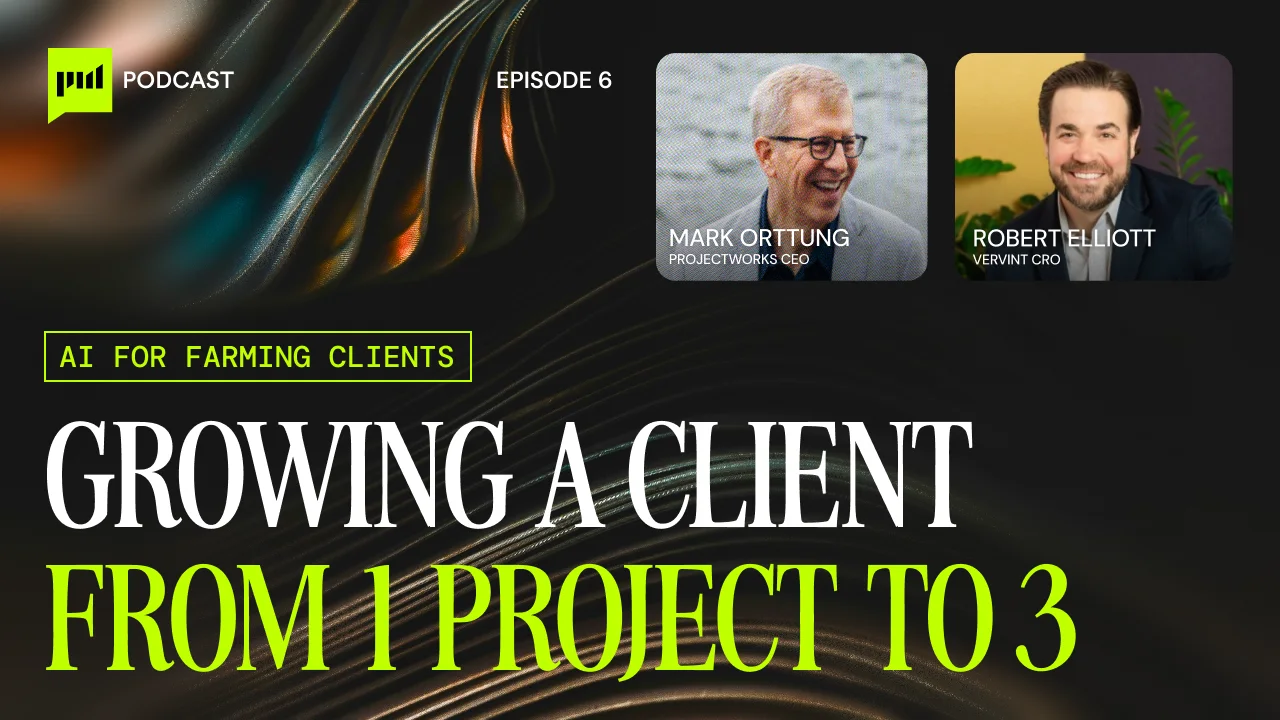
For many consulting firms, the one-project client is the norm and the long-term partnership is the exception, which is backwards given how much cheaper repeat work is to win. This episode is about making that step deliberate rather than accidental. We'll share the play-by-play breakdown of how fast growing firms identify the right client accounts it invest in, how they grow them, who's involved in the relationship, and where AI makes it all easier.
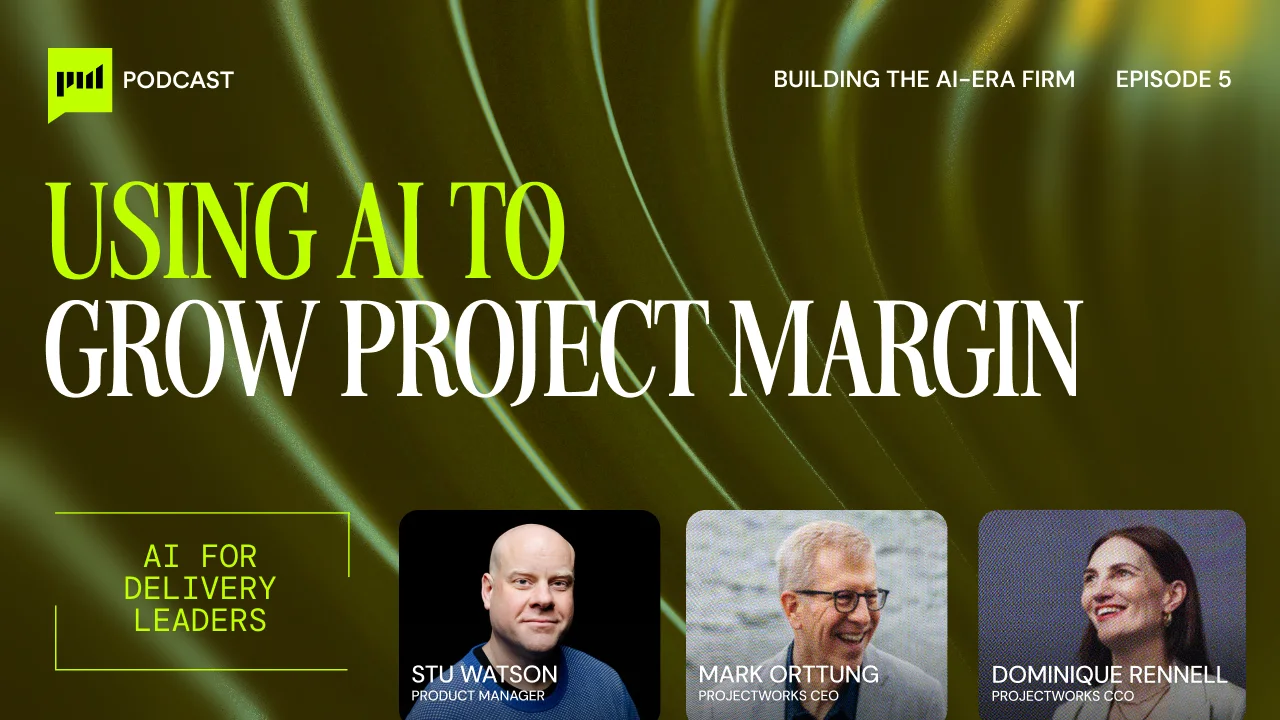
In a small firm, delivery quality holds because everyone works side by side and the founder touches every project. Then the firm grows, the founder runs out of hours, and work gets delivered by people who never learned your delivery method firsthand. Project margins turn inconsistent, and it's rarely the same reason twice. Most AI you've used so far waits for you to ask it something. Agents are different: they work in the background and tell you what needs attention before you'd have caught it yourself. This episode is about what that shift means for delivery, and we'll introduce Kea, the AI agent we're building inside Projectworks, and where we're taking it.
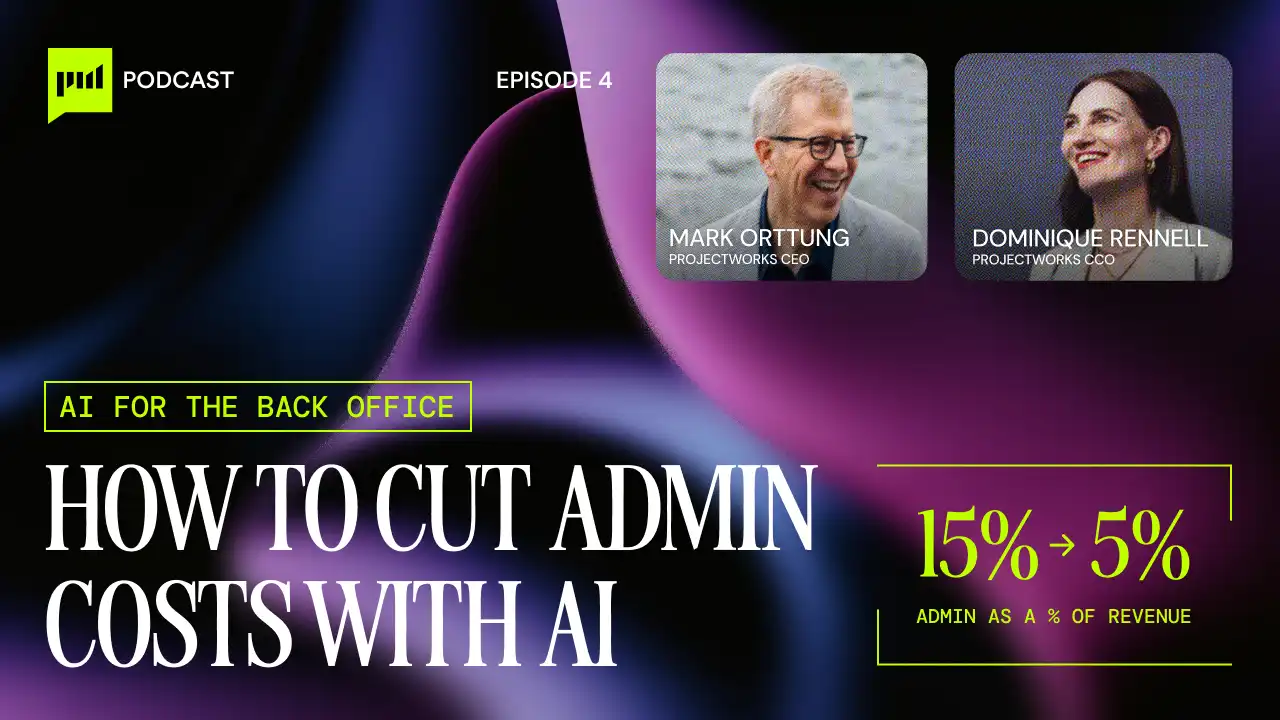
Timesheet chasing, invoicing, month-end, reporting, and the non-billable hours that go with them... its all necessary work in a consulting firm. Without it, clients don't pay you. It's costly though – for most firms, admin as a % of revenue sits at about 15%. Its a whole lot of cost that otherwise could be sitting in your EBITDA. In the AI era, the best consulting firms will bring this figure into the single digits. Learn how in this episode of the podcast.