5 Lessons on Scaling a Consulting Firm, from the Founder of Provoke
In a recent Projectworks Podcast episode, Doug Taylor (who co-founded Provoke and scaled it to 150 staff) sat down with Mark Orttung (who took Nexient from $30m to $130m). Together, they co-wrote The $50 Million Consulting Firm, and in this episode they shared a collection of lessons they wish they'd had earlier when scaling their software consulting firms.


1. Consulting Founders Have To Do Everything... Until Suddenly They Can't
In the early days, founders should do everything. Clients are buying from them. The relationships are theirs. The firm exists because of them.
But one day, the founders become the bottleneck. Growth stalls, and not because demand dried up, but because every decision still routes through the same few people.
The way through isn't hiring layers of management. It's bringing in hands-on leaders who can sell and deliver alongside the founders. People who share the load at the coalface, not above it.
Doug's first attempt at this didn't go smoothly – the GFC hit, the team wasn't quite right, and Provoke went backwards for a few years before it got the people part figured out. Hear how it played out in the full episode above.
2. The Second Growth Wall Is Quieter And It Hits Harder
Once you've brought in that first wave of leaders, you'll get a run of growth. Then a second wall arrives, and it doesn't announce itself.
The signals arrive as surprises. A major client cancels with no warning. A project goes sideways six months early. Suddenly dozens of people are coming to the bench.
As Mark puts it: "Nobody comes to you and says you've hit a growth wall."
The fix isn't more people. It's the systems that should have been built earlier, such as expectation management with clients, quality checks, resourcing visibility, early warnings on delivery health. The firms that scale through this wall are the ones who stop tolerating the gaps, and are willing to reinvent themselves and their structure again.
3. Growth And Profit Have To Be Carefully Balanced
Revenue growth is addictive. It's what everyone celebrates, what clients notice, what the outside world uses to judge you. But growth without margin discipline is one of the most dangerous phases a firm can go through, because it looks like success while the fundamentals can be getting worse.
Doug knows this one firsthand. Provoke had years where revenue was climbing fast and, from the outside, everyone thought they were killing it. Internally, margins were shrinking. Costs weren't being managed with the same energy as growth. Payroll got harder, not easier. By the time the problem was visible in the P&L, it had been baked in for months, and took just as long to unwind.
Celebrate revenue, but manage margin with equal discipline. The two have to move together.
4. Financial Literacy Isn't Optional, And Many Leaders Lack It
In many consulting firms, the people closest to the work such as practice leads, project managers and client partners are the ones making the decisions that most affect profitability. But too often they don't fully see or understand the financial impact of those decisions.
Should we put three people on this pitch for free to win the larger engagement?
Is this client actually profitable once you account for the senior time we're over-investing?
Is our newest non-billable hire paying for themselves yet?
These questions get answered months later at a leadership level, by which point the damage is already baked in.
The firms that scale well push financial visibility down, not just up. Practice leaders see their own margins. Project managers see how resourcing choices move the numbers. Everyone making commitments understands what those commitments cost.
That's exactly what Projectworks is built to do. Our PSA software democratizes financial visibility across your firm, so the people making the decisions have the information they need to make them well.
5. The Walls Arrive Faster Now
At Nexient, Mark bet on a 3-year technology adoption window and timed it beautifully – getting acquired near the peak of the curve. Today, that same kind of window might be 6 months. AI is reshaping service categories monthly. Growth curves are steeper and shorter.
For consulting founders today, growth walls arrive faster than they used to. The cost of not having your systems, your financial literacy, and your leadership team ready can hit your bottom line much faster than you think.
These five lessons are a fraction of what Doug and Mark cover in the full conversation, including Manila office battle scars, the co-founder dynamics Doug would write a whole book about, and the moment the team realised they needed to redo the entire structure of The $50 Million Consulting Firm days before it was meant to be finished.
Watch the full episode above, and be sure to grab a copy of the book.


Listen to moments from similar podcasts

For many consulting firms, the one-project client is the norm and the long-term partnership is the exception, which is backwards given how much cheaper repeat work is to win. This episode is about making that step deliberate rather than accidental. We'll share the play-by-play breakdown of how fast growing firms identify the right client accounts it invest in, how they grow them, who's involved in the relationship, and where AI makes it all easier.

In a small firm, delivery quality holds because everyone works side by side and the founder touches every project. Then the firm grows, the founder runs out of hours, and work gets delivered by people who never learned your delivery method firsthand. Project margins turn inconsistent, and it's rarely the same reason twice. Most AI you've used so far waits for you to ask it something. Agents are different: they work in the background and tell you what needs attention before you'd have caught it yourself. This episode is about what that shift means for delivery, and we'll introduce Kea, the AI agent we're building inside Projectworks, and where we're taking it.
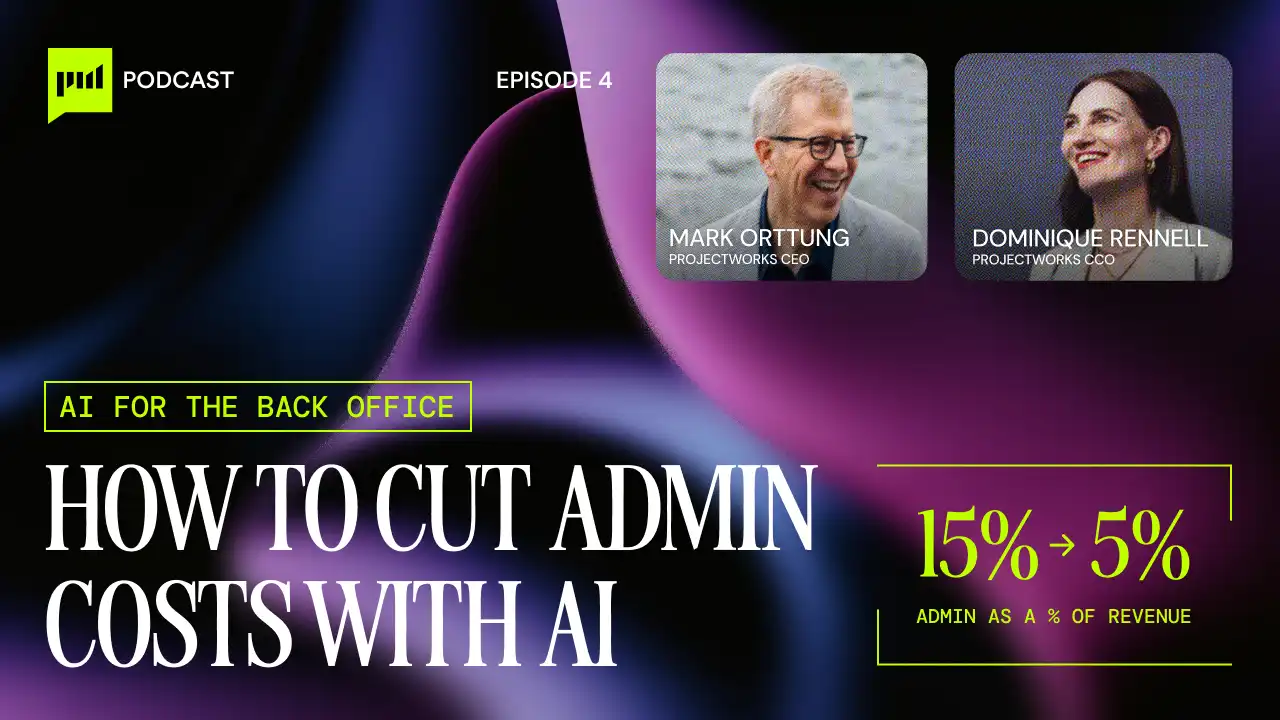
Timesheet chasing, invoicing, month-end, reporting, and the non-billable hours that go with them... its all necessary work in a consulting firm. Without it, clients don't pay you. It's costly though – for most firms, admin as a % of revenue sits at about 15%. Its a whole lot of cost that otherwise could be sitting in your EBITDA. In the AI era, the best consulting firms will bring this figure into the single digits. Learn how in this episode of the podcast.