

E-invoicing sends invoices straight into your client's finance system via Peppol. Here's what NZ and Australian firms need to know and fix first.
Plenty of consulting firms believe they already send electronic invoices, because each one leaves their accounting software as a PDF and arrives by email. The ATO is clear that an emailed PDF isn't an e-invoice.
E-invoicing (also known as eInvoicing) is the exchange of invoice data in a structured, machine-readable format directly between a supplier's software and a buyer's software. In Australia and New Zealand it runs over the Peppol network, so the invoice lands inside the client's finance system, where software checks it and no one has to retype it. That last detail matters more to a consulting firm than the change of file format, because software is far less forgiving than the person in accounts payable who used to read your PDF.
What is e-invoicing?
The ATO and MBIE write it as eInvoicing and you'll also see einvoicing in vendor material, but every spelling describes the same exchange between two finance systems.
E-invoice vs PDF invoice
Structured is the word doing the work in that definition. A PDF has to be opened and read before anyone can act on it, which is how invoices end up sitting in a shared inbox while the payment terms run down. An e-invoice arrives as data your client's system can match to a purchase order and route for approval the moment it lands, and the comparison below shows what else changes.
What an e-invoice contains
An e-invoice carries the same information as any tax invoice, broken into labeled fields. That includes the supplier's and buyer's business identifiers (an ABN in Australia, an NZBN in New Zealand), the invoice number and dates, each line item, and a GST tax category on every line.
Two further fields matter more than their status suggests, the purchase order reference and the buyer reference. PINT A-NZ, the invoice specification used in both countries, lists both as optional. Large buyers tend to treat them as anything but, because their systems use those references to route an invoice to the right approver and match it to what was ordered. The ATO points suppliers to an industry practice statement written for exactly this gap, which covers data that is optional under the specification but vital for large buyers such as government.
How does e-invoicing work?
What is Peppol?
Peppol is the international framework and network that e-invoices travel over, developed by the non-profit OpenPeppol. More than 3.5 million businesses across over 100 countries are registered on it, according to the ATO. Countries that adopt Peppol appoint a Peppol Authority to set local rules, which is the ATO in Australia and MBIE in New Zealand.
The four-corner model
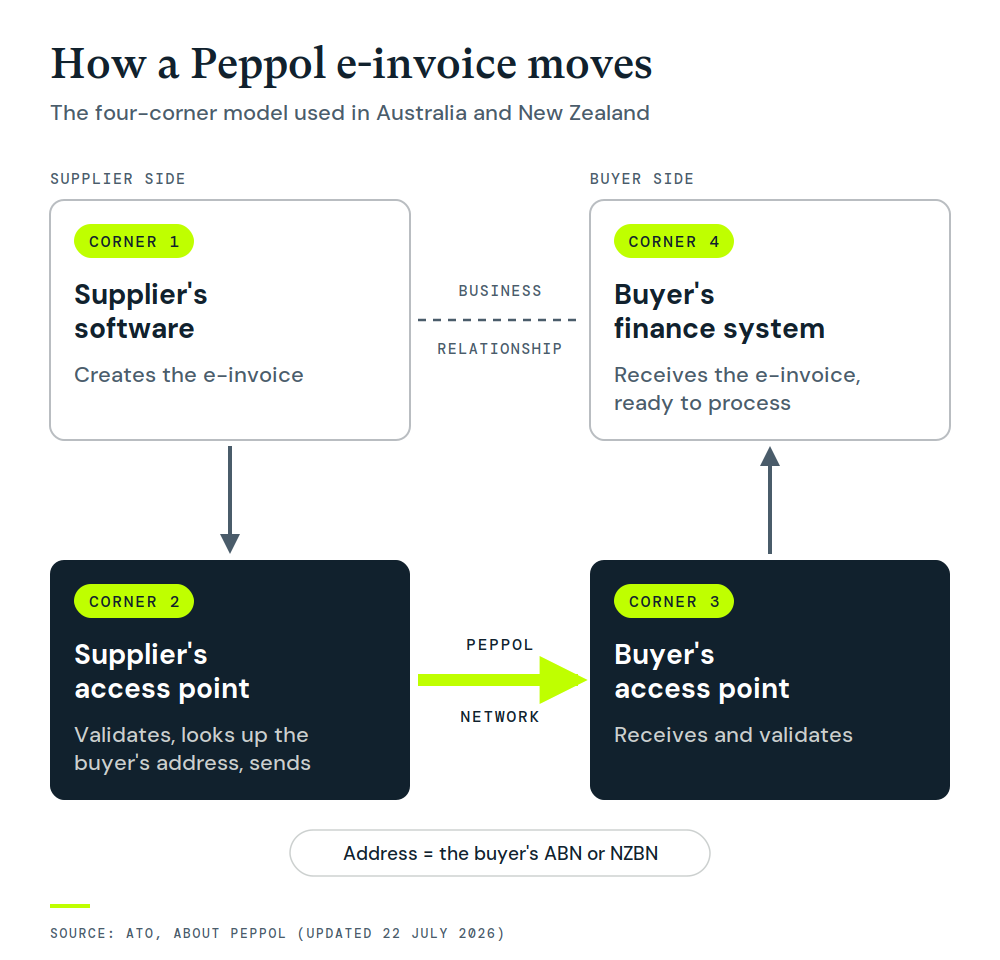
Every Peppol invoice passes through four corners. Your software creates the e-invoice (corner one) and hands it to your access point (corner two), an accredited service provider that validates the invoice, looks up the buyer's address on the network using their ABN or NZBN, and sends it. The buyer's access point (corner three) receives and validates it, then delivers it into the buyer's finance system (corner four).
You'll rarely deal with your access point directly, since it usually sits behind your accounting software. The ATO, which administers access point accreditation in Australia, doesn't receive a copy of any e-invoice and can't view its contents.
Is e-invoicing mandatory in Australia and New Zealand?
Not for invoices between private businesses. In both countries the obligations sit with government agencies, which are in turn pushing their suppliers to switch. That is a lighter touch than much of the world is taking. The EU's VAT in the Digital Age package makes e-invoicing mandatory for cross-border B2B trade within the EU from 1 July 2030, the UK has announced mandatory e-invoicing for VAT invoices from April 2029, and ICAEW counts more than 80 countries with e-invoicing mandates.
Australia
Non-corporate Commonwealth entities (NCEs), which include federal government departments, have had to be able to receive e-invoices since 2022. As the government moves to make e-invoicing the default for its procurement, NCEs were set a target of 30% of invoices received as e-invoices by 1 July 2026, and they must enable automated processing and sending of e-invoices by December 2026. The ATO says more than 400,000 businesses are already on the Peppol network, and more than 300 state, territory and local government organizations have also adopted e-invoicing.
New Zealand
New Zealand's requirements sit in the Government Procurement Rules. Under Rule 44, agencies handling more than 2,000 domestic trade invoices a year had to be able to receive e-invoices by 1 January 2026, and to send them if they send more than 2,000. From 1 January 2027 those agencies must require e-invoices from large suppliers, meaning an entity whose revenue, including subsidiaries, exceeded NZ$33 million in each of the two preceding accounting periods. MBIE has said 2027 isn't a hard cut-off, because agencies apply the requirement as contracts are created, renewed or retendered.
What e-invoicing changes for professional services firms
The invoice has to be right before it leaves
With a PDF, a missing purchase order number usually costs you an email, because someone in your client's AP team spots the gap and you send a corrected copy the same afternoon. E-invoicing takes that human safety net away. The ATO notes that invoice data is checked for accuracy and completeness before an e-invoice is sent, and the buyer's system applies its own rules on arrival. Unimarket, a procurement platform handling Peppol invoices in both countries, generates an error for any Peppol invoice without a matching purchase order.
A rejected or held e-invoice can't be edited and slipped back in. The fix is a credit note against the original plus a new invoice, and many of the common invoice mistakes that slow payment today become hard stops.
Billing data starts at project setup
Time-and-materials work makes this sharper. On a fixed fee you know the invoice amount weeks ahead, but on T&M the number doesn't exist until timesheets are approved, and by then everyone wants the invoice out the same day. Everything else on the invoice has to be correct before that moment, from the PO reference to the tax mapping. So capture it at project setup alongside rates and budgets instead of reconstructing it at month-end. That discipline is also what makes a shorter billing cycle possible in the first place.
Faster payment from government clients
The payoff is speed, and it is clearest with government clients.
In Australia the payment clock only starts once the agency has a correctly rendered invoice and has acknowledged delivery, which ties the faster term directly to clean billing data. In New Zealand, MBIE says mandated agencies must pay 95% of e-invoices within 5 business days and other domestic trade invoices within 10. Agencies don't always hit the mark. Australia's Department of Education paid 71% of its e-invoices within 5 days in 2025–26, compared with 94% of invoices paid within 20 days, so the work of removing invoicing friction with each client doesn't stop once you're on Peppol.
How to get your firm ready for e-invoicing
Start with the Peppol Directory, which shows which of your clients can already receive e-invoices, and confirm your own ABN or NZBN details are current. Then make a PO or buyer reference a standard field on every new project, even for clients who have never asked for one, because the first client who does will ask at month-end. Finally, check whether your accounting software appears on the ATO's eInvoicing Ready product register or MBIE's e-invoicing software register, which tells you whether you can join the network from the tools you already use.
Fix the data and the invoice follows
Most firms will come to e-invoicing because a client asks for it, often a government agency or a large buyer whose system won't take anything else. The firms that handle that request calmly will be the ones whose billing data was already clean at the source, a habit that pays off well before the first Peppol invoice goes out. Firms have billed 35 million hours through Projectworks since 2020, and project invoicing works on that principle by pulling approved time and expense data into pre-filled invoices.

Read similar resources from Projectworks

Most pipeline coverage advice is written for SaaS. Here's how a consulting firm sets coverage by deal stage and plans for the clients it will lose.

Let’s say a consulting firm signs a $30,000 engagement in July and invoices the full fee upfront. The client pays quickly and the cash lands, but the work runs from July through September. By the end of July the firm has completed about one-third of the engagement - the project’s on track but the finance team have some work to do to match revenue with the costs incurred (the “matching principle” of having costs and revenue in the same period is a key accounting concept). Only a third of the project’s fee has been earned (because only a third of the work has been done), and the remaining $20k of revenue is deferred to a future period.
It's the end of September and expenses got a lot of love this month, with a couple of big changes you can start using today and more on the way! We've also made updates across financial reporting, resourcing, HubSpot, and invoicing, dive in to see what's new.