


Deltek is steering Vision users to Vantagepoint, as they reach end-of-life in 2026. Here are 5 reasons not to make the move, and start evaluating your options instead.
Deltek is sunsetting Vision, with its final update released in January 2026, and the message to every customer is the same: Move to Vantagepoint.
Deltek frames it as the natural next step, the path that asks the least of you. For a small or mid-sized professional services or engineering firm, it's often the wrong choice, and the pressure of a deadline is a bad reason to make a decision this big.
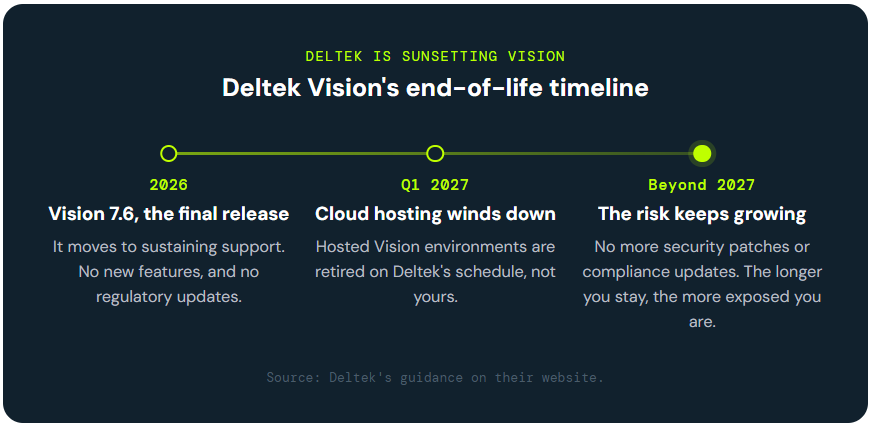
Here are five reasons not to migrate to Deltek Vantagepoint, and why you should be looking at Deltek Vision alternatives instead.
1. You'll pay rebuild prices to land on the same product
Vantagepoint is the next release of Vision, built on the same legacy architecture, and Deltek sells that shared foundation as continuity.
In practice, the move plays out like a full re-implementation. Even the firms Deltek pays to run these migrations describe a rebuild, not an update. Your data has to be cleaned and remapped and your team retrained from scratch, usually with consulting fees on top and a rollout that runs longer than anyone quotes. You fund all of it to arrive on a newer-looking version of the software you were already trying to leave, and the limits that made you look up from Vision tend to follow you straight across. None of that shows up in the upgrade pitch.

2. You'll still be fighting your reports
Reporting is the reason a lot of firms start looking past Vision in the first place, and Vantagepoint doesn't fix it out of the box. There's no projected margin or burn view without building one yourself, and firms that have made the switch describe a long stretch of development work before the numbers come out in a shape they can use. If prying a straight answer out of your own system is part of why you're here, this migration keeps you prying. For a firm without a full-time analyst on staff, that gap gets expensive fast.
3. It won't talk to Xero or QuickBooks
If you run your books in Xero or QuickBooks, Vantagepoint won't sync with them natively. That means exporting and re-keying the same figures between two systems every month, or paying to bridge a gap that shouldn't be there. For a lean finance team, it's hours you never get back and a fresh chance for numbers to drift apart between platforms. By the time you reconcile it, half the month is gone. It's also the exact double-entry grind that pushes firms off Deltek to begin with, so migrating into more of it is a strange way to solve the problem.
4. You can't see the price, and you can't try it
There's no public pricing and no free trial, so you commit to a consulting-led sales process, and then implementation fees, before you ever see the real number. Contracts tend to run multi-year, which locks the decision in long after the sales team has moved on. For a firm watching every dollar, buying software you can't test at a price you can't see is a rough way to start a relationship that's supposed to last.
5. It's ERP built for firms bigger than yours
Vantagepoint is project-based ERP, and its customer base skews mid-market and enterprise. Drop a forty-person firm into it and you feel the mismatch quickly. You end up paying for modules you'll never open and administering a system heavier than your operation needs, and changing something as ordinary as a report often means booking time with a consultant instead of clicking a setting. Every workaround becomes a ticket, and every ticket becomes a bill. The software should fit your firm; your firm shouldn’t have to fit the software.
You're re-evaluating anyway. Here's the smarter move.
A forced migration is the one moment when switching costs about the same wherever you land, because you're doing the migration work either way. The deadline is to Deltek's advantage as most firms will just roll onto the default, but why not put to your advantage instead? You can spend that effort moving onto a newer version of Vision, or spend it on a platform built for a firm your size, with real-time margins and accounting that syncs both ways.
So before you sign anything, weigh your options properly. See the full head-to-head comparison, and book a short walkthrough of what a Vision exit actually looks like for a team like yours.

Read similar resources from Projectworks
Most CRM features are built for sales teams that consulting firms don't have. See which CRM features consulting firms actually need, and which ones they’re paying for and never use.
You've heard AI is turning systems of record into systems of action. Here's what that shift actually means for CRMs and consulting firms.
![Best AI Resourcing Software for Consulting Firms 2026 [Compared]](https://cdn.prod.website-files.com/66e7bd6e836e6762f85a0c45/6a5d9aa3e2fc5acdc5fd4fb8_best-ai-resourcing-tools-1.webp)
The 8 best AI resourcing tools for SMB consulting firms in 2026, compared on AI depth, G2 ratings, and fit for professional services.