


Deltek Vision is ending in 2026. Before you migrate to Vantagepoint by default, here's how to weigh your Deltek Vision alternatives.
Deltek Vision Is Ending.
Vantagepoint Isn't Your Only Move.
Deltek Vision reached its final year-end update in January 2026. After that it moved to what Deltek calls “sustaining support”, and cloud-hosted instances begin winding down in the first quarter of 2027.
If your firm runs on Vision, you already know the message underneath that timeline.
You have to move.
The real question is which way, and Deltek will naturally steer you toward Vantagepoint. But if you’re already having to pay to re-implement, retrain, and clean up your data, then a forced migration is also the ideal time to weigh up Deltek Vision alternatives, and make sure you're investing that time and cost into the right platform. Not just the one Deltek is pushing you to next.
What's actually happening to Deltek Vision?
Here are the facts, stated plainly, because most of what is written about the Vision sunset comes from people who want to sell you a migration to Vantagepoint as your only option.
Vision 7.6 got its last update in January 2026.
From there it sits in “sustaining support”, which in Deltek's own terms means:
- no new features,
- no hot fixes,
- and no regulatory updates.
For firms that run payroll or file against changing tax rules, that last part bites. Cloud-hosted Vision environments wind down through the first quarter of 2027. On-premise firms can hold out longer, but they're running software that has stopped moving.
Vendors retire products all the time, and Vision has had a long life, with Deltek open about the direction for years.
Do I have to move to Vantagepoint?
No. Vantagepoint is Deltek's official upgrade path, not your only option.
Deltek sells it as the next release of Vision, built on the same architecture. That sounds like a smooth upgrade, but it isn't. Even the firms Deltek pays to run these migrations describe a full rebuild, not an update. Your data has to be cleaned and remapped, and your team retrained from scratch. And because the foundation underneath is the same, you carry Vision's limits across with you. You pay the full cost of switching platforms to land on a reskinned version of the one you're leaving.
Which is the point. That bill lands whether you move to Vantagepoint or somewhere else, so the real question isn't how to migrate but what to migrate to. Spend a rebuild to end up where you started, or spend it once on a platform built for a firm your size. That's the case for Projectworks, and a forced migration is the cheapest chance you'll get to make it.
You’re paying to re-implement either way.
Is Deltek Vantagepoint an upgrade from Vision?
The narrative treats Deltek Vantagepoint as the natural conclusion, as if the sunset and the successor were one event. They're two separate things. Retiring a product is a plain fact; asking you to buy the next one is a sales motion, and you can treat it like one.
So look at how it performs. Firms that made the move tend to describe a rough onboarding and a long road to reports that use their data.
The satisfaction scores back them up. On G2, users rate Vantagepoint below Projectworks on every dimension they score, from ease of use to setup to support. The interface was the one thing the upgrade was supposed to fix.
If the interface were a genuine leap forward, the retraining cost might justify itself on its own. When it is a refresh on a legacy base, the cost of migration gets harder to defend.
The question to ask before you migrate anything
So here's the question that matters. If the effort of moving is about the same whether you go to Vantagepoint or elsewhere, the real decision isn't how to migrate but what to migrate to.
You're not choosing between stay and switch, because staying is off the table. You're choosing what your firm runs on for the next decade, in the one window where changing your mind is cheap. The firm you were when you bought Vision isn't the firm you are now. This is the moment to check whether the tool still fits, not re-commit to it by reflex. The sunset ended a product and handed you a decision you would otherwise keep deferring.
When a modern PSA like Projectworks is the better fit
Projectworks is built for the firm on the other side of that line. It's the small or mid-sized professional services or engineering firm, 20-200 people, that bought Vision when it was one of the only serious options and now runs a fraction of what it pays for. For a firm that size, the sunset is doing you a favor. It's the push to do the thing you have probably been putting off.
Start with the move itself. Going to Vantagepoint is a full re-implementation, and it's as costly, complex, and disruptive as that sounds. Getting started on Projectworks is quick, and it stays easy to use once you're in, the opposite of the rough onboarding firms describe with Vantagepoint.
Underneath, Projectworks pulls resourcing, time, invoicing, forecasting, and reporting into one connected system. Margins show up in real time instead of at month-end, and resourcing reads at a glance. Invoicing syncs both ways with Xero or QuickBooks, so nobody re-keys data between systems.
It's the kind of platform your team will actually open, with pricing that flexes to your firm's size rather than locking you into modules you'll never use. It's built for the way professional services firms work, not scaled down from an ERP made for firms ten times your size.
If you're going to spend a migration either way, Projectworks is the safest of the Deltek Vision alternatives on the table.

Pressure-test before you commit
You don't have to take anyone's word for this, ours included. Run every option through the same short list and let the answers decide. The same tests should apply to Vantagepoint and to any modern PSA or ERP you're considering.
- Start with total cost across three years, not the license line.
- Add the consulting fees and reconfiguration, plus the internal hours the migration eats.
- Look at implementation time and how much lands on your team during billable weeks.
- Test day-to-day usability, because a tool your consultants avoid costs more than any subscription.
- Ask whether you get real-time margin and resourcing visibility, or reports you wait weeks and pay thousands to build.
- Check whether it syncs natively with the accounting system you already run, Xero or QuickBooks.
- And be honest about fit for a firm your size, not one ten times larger.
You're facing a migration either way
The strongest reason to stay put is usually fear of the switch. It pays to be clear-eyed about that, because the comparison is not what it first appears.
Staying on Vision is not an option, so the honest choice is not "switch versus stay."
Choose it. Don't get defaulted into it.
The Vision sunset took the easy option off the table, so do not replace it with the automatic one. You are already doing the hard part. Spend it on the platform that fits the firm you have become, not the one you bought a decade ago.
If you want to see what a Vision exit could look like for a firm your size, book a walkthrough with our team. We will walk you through the move and the timeline, including our consultative onboarding services.

Read similar resources from Projectworks

Projectworks has spent 25 years inside consulting firms. Here’s why we built a Consulting CRM around the proposal, and where it goes next.
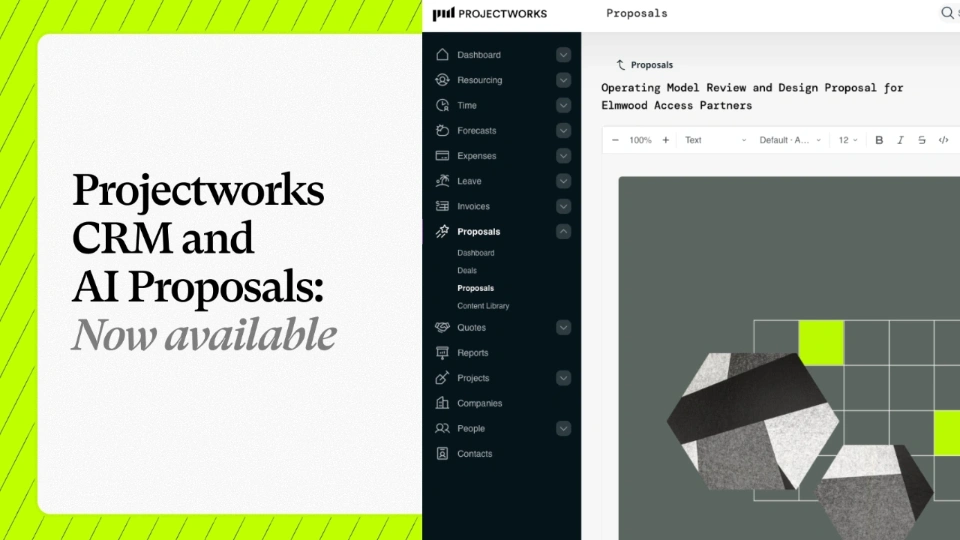
We're excited to announce that our Consulting CRM and Proposals are now available for anyone to use or try out. In just three months, a fast-growing group of firms have been running their pipeline and proposals in Projectworks as part of our early access group, and the results have blown us away.
-card.webp)
Projectworks has been named to the 2026 Inc. 5000, the annual ranking of fastest-growing private companies in the United States, for the second time. Building a global software business is not an easy thing to do. So when our growth shows up on a stage as competitive as the US market, it means a lot.