Standing Out: How To Differentiate & Grow Faster
Mark Orttung (Projectworks CEO) and Dominique Rennell (Projectworks CCO) are joined by Christophe Delaire, the CEO of Marshall Day Acoustics, to discuss what good differentiation looks like at different stages. Marshall Day Acoustics is a one-of-a-kind acoustics consultancy with a global team of experts working everywhere from concert halls to wind farms.


Most small consulting firms grow fast early on, and it’s easy to take that momentum as proof of differentiation. But, more often than not, the market is just giving you a free run. Then somewhere around 30 or 40 people, growth stalls and the realization starts to set in that either the differentiation was never really there, or the market has caught up.
Smaller firms can sustain 40%+ annual revenue growth year after year. They are never going to out-hire or out-spend their largest competitors, so they compete on something else entirely. They have defined sharply what they do better than anyone in their segment, and they back that position in every decision they make.
This is what separates them.
You probably think you are more differentiated than you are
"Good people" is not a differentiator. Neither is "competitive pricing." Every firm says those things, and most founders believe them.
But if you really want to be humbled then get an outside advisor to ask your clients why they actually buy from you, without you present, and then just keep your mind open to whatever comes back. The insights usually reveal that clients see something far more generic than the story you tell internally, and that gap is usually where growth starts to stall.
Real differentiation is narrower than most firms want it to be.
It is when the market mentally associates your firm with a specific problem and its best solution.
"You want to become synonymous with that type of problem and the best answer to it. That's what I would call real differentiation."
- Mark Orttung
Not broadly good, not well-rounded, but the answer to a particular question.
It seems simple, but it actually takes a lot to figure out what you even want that question to be.
Saying no is the key to your differentiation strategy
Most firms say yes to everything in the early years. Every win is a celebration. The instinct is to stay flexible, keep the pipeline full, take the work that is there.
The firms that sustain growth do the opposite. They get specific about the work that fits, and they turn down, or refer out, work that does not.
Once you know your differentiation or specialization, it makes it easier to say no to the things that just don’t fit.
This is not just about margin or team fit. It is a signal the market reads. When a firm tells a prospective client they would get better value elsewhere on a routine project, that honesty compounds over time. Clients start to trust that when you do take the work, you mean it. Referrals come in pre-qualified. Your reputation builds in the segment where you actually win.
"If you want something that's just cookie cutter, we might not be the firm to go to. But when there is a problem, when there is a challenging project, our reputation precedes us, and usually clients come to us directly because they know we can solve their problem."
- Christophe Delaire
The practical test for whether your position is real is to just go out and pitch it. If your conversion rate on a well-defined target list is high and referrals arrive without much chasing, you likely have it. If meetings are hard to get and pitches are not landing, the position is not clear enough yet.
Your edge has a shorter shelf life than you think
How long a differentiation lasts depends heavily on your sector. In deep specialist professional services, expertise built across decades, proprietary tools, and a reputation on complex projects compounds over time and is hard for a competitor to replicate quickly. In fast-moving areas like software or AI-enabled services, the window is much shorter. The cycle that used to take a few years in software now takes six months to a year.
The clearest signal that you are no longer differentiated is that the large firms in your space start offering the same thing. At that point, you either get acquired or you reinvent.
AI is accelerating this in every sector. It is compressing the time and cost of research, first drafts, and early analysis, and clients know this.
“AI creates more things you can do than it takes away. The real challenge is you gotta move fast, you gotta keep reinventing, and you gotta add to the differentiation you have, and keep moving up that value chain, because it's moving fast, and the market moves really quickly now." - Mark Orttung
When the founder is the brand
In the early stages, the founder is the differentiator. They are often what wins the work. Everything from their network, to their way of showing up in client conversations, to their reputation in the market.
"A founder can be the brand right up until they can't be in every room."
- Christophe Delaire
When clients know and trust one or two people but not the rest of the team, growth is limited by how many rooms those people can be in.
“It's so critical to develop a methodology, or a playbook. It comes from the founder, it’s developed by them, but then over time is developed by the company. I think how all great, scalable franchises, they may not have it explicit, but they have at their core a methodology or a playbook that they use to give that consistent experience over hundreds or thousands of brand interaction points, and a consultancy has to do the same thing. You've got to figure out what is your playbook.”
- Mark Orttung
When adopted across the team, this is what turns a founder-dependent firm into a differentiated brand of its own merit.
Differentiation is not a marketing exercise. It is a set of decisions made and remade over time about what your firm is for, what it turns down, and how it delivers. The firms that keep asking those questions are the ones that keep growing.


Listen to moments from similar podcasts

For many consulting firms, the one-project client is the norm and the long-term partnership is the exception, which is backwards given how much cheaper repeat work is to win. This episode is about making that step deliberate rather than accidental. We'll share the play-by-play breakdown of how fast growing firms identify the right client accounts it invest in, how they grow them, who's involved in the relationship, and where AI makes it all easier.
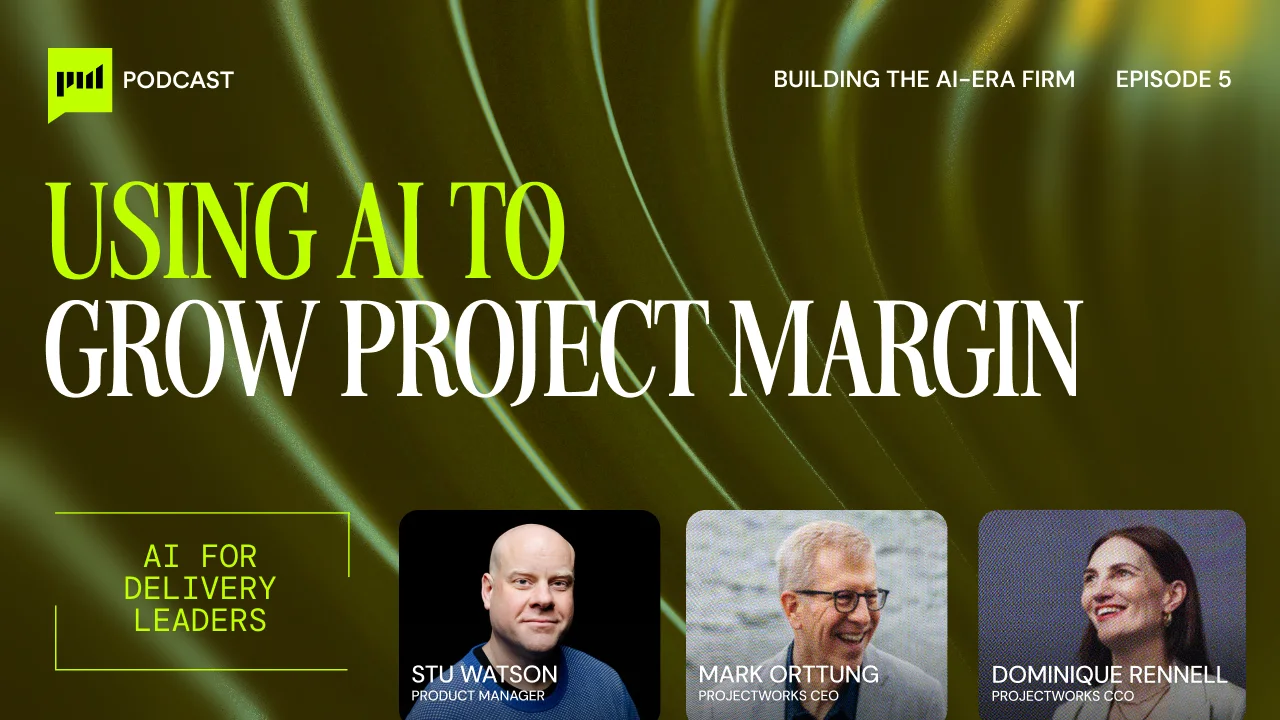
In a small firm, delivery quality holds because everyone works side by side and the founder touches every project. Then the firm grows, the founder runs out of hours, and work gets delivered by people who never learned your delivery method firsthand. Project margins turn inconsistent, and it's rarely the same reason twice. Most AI you've used so far waits for you to ask it something. Agents are different: they work in the background and tell you what needs attention before you'd have caught it yourself. This episode is about what that shift means for delivery, and we'll introduce Kea, the AI agent we're building inside Projectworks, and where we're taking it.
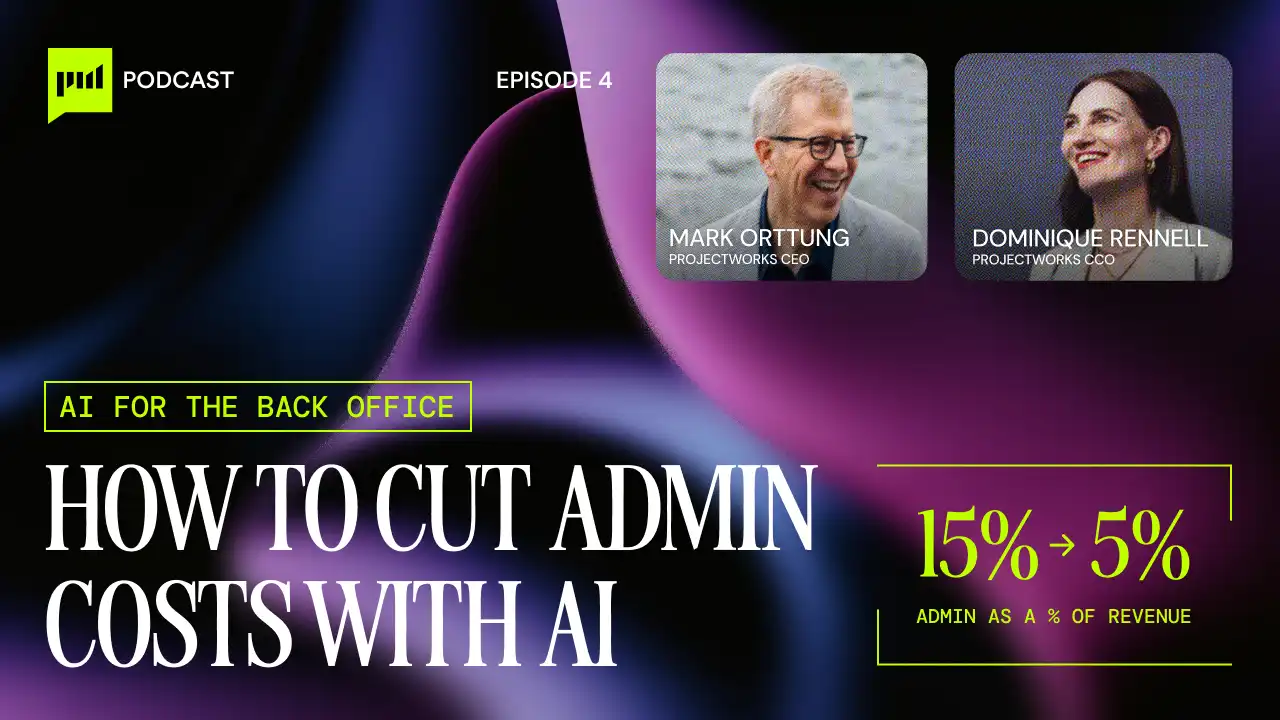
Timesheet chasing, invoicing, month-end, reporting, and the non-billable hours that go with them... its all necessary work in a consulting firm. Without it, clients don't pay you. It's costly though – for most firms, admin as a % of revenue sits at about 15%. Its a whole lot of cost that otherwise could be sitting in your EBITDA. In the AI era, the best consulting firms will bring this figure into the single digits. Learn how in this episode of the podcast.