Building the AI-Era Consulting Firm
Every firm is being told AI changes everything. Few can tell you what it's actually worth to them. We benchmark over 700 consulting firms, and our data puts revenue per employee near $160K today. Over the next couple of years, we expect the leading firms to double it, by turning the tools and data they already run on into an intelligent ecosystem that drives action across the firm. Season 3 opens on the question that defines the rest of it: what does healthy growth and profitability actually look like in the AI era?
%20(1).avif)


Season 3 of the Projectworks Podcast opened with a live poll:
How confident are you that AI is making your firm grow faster or more profitably?
Just 43% of consulting leaders on the call said "slightly confident."
Almost nobody said very.
That result is the reason this season of the Projectworks Podcast exists. Every firm has heard AI changes everything. Very few can point to the line on the P&L where it shows up.
The maturity model hasn't changed. The tools have.
The episode starts where every season starts, with the consulting maturity model AKA the Projectworks MethodTM.
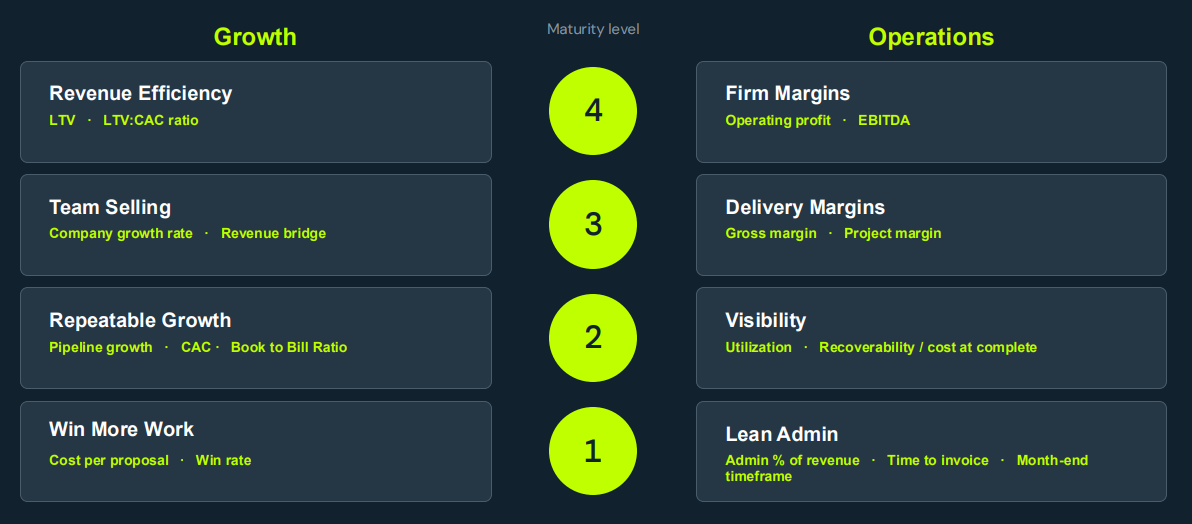
AI doesn't retire this model. A firm still has to sell work, deliver it at margin, and keep admin from eating the week. What changes is how fast a firm can climb, and firms that were already strong in one column will likely compound that strength faster than they can patch a weak one.
AI is reshaping productivity
Productivity leap cycles are compressing. Each leap arrives faster than the last. The cycle is collapsing toward years, not decades.
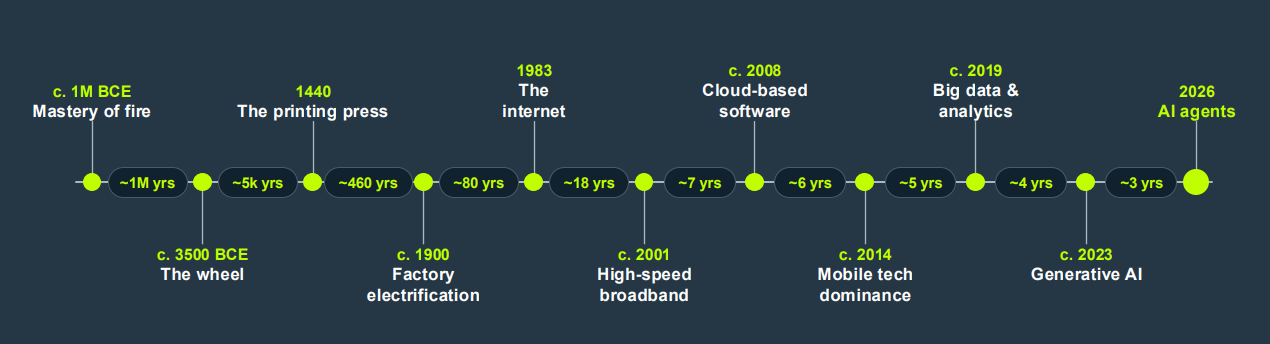
What factory electrification teaches consulting firms about AI
Electrification reshaped the factory the same way AI is reshaping the firm.
When electricity reached factories in the 1880s, it arrived in three stages:
- The lightbulb lit workstations and changed nothing about how work flowed.
- The group drive put one motor on a shared shaft, faster, but the same layout.
- Real productivity gains waited until 1913, when Ford's Highland Park plant put a motor on every machine and rebuilt the floor around the flow of work.
Consulting firms in 2026 are mostly at stage two.
Teams share tools, chat with assistants, and move a bit quicker. But, for many firms, AI is still sitting at the lightbulb stage. It's bolted onto old workflows, drafting emails and summarizing notes at the edges. The firms about to pull ahead are the ones rebuilding the workflow itself.
The unit-drive moment for a firm means mapping its actual business processes, deciding which steps AI can run fully or partially, and putting people on the judgment work only they can do.
(Source: Azeem Azhar and Nathan Warren, 'Why AI isn't showing up on your bottom line', Exponential View, 2026.)
Revenue per employee is the metric that matters
If AI is genuinely making your firm more productive, one number should move: Revenue per employee.
Revenue per employee is the cleanest read on whether your experts are producing more value, or just producing the same value slightly faster.
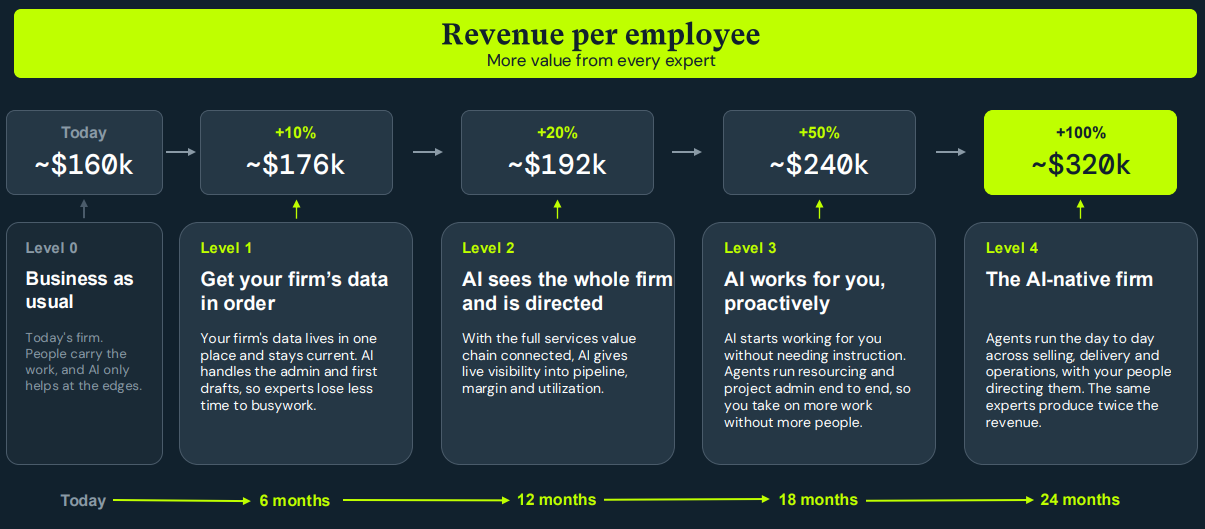
As revenue per employee climbs, the same people generate more revenue.
Consulting Growth StackTM
None of this works without knowing what to measure. The Consulting Growth Stack is the metric set underneath the maturity model, nine growth metrics and nine profitability metrics, from cost per proposal through to EBITDA, drawn from the Projectworks Method and 150+ years of building and scaling firms. Most firms already track a handful. Few know which one AI will move first.
That's the work of the season. Each episode takes a metric from the stack and pulls it apart. What good looks like, where AI shifts it, and what to ignore. First up, cost per proposal, and how AI wins new clients with less non-billable time.


Listen to moments from similar podcasts
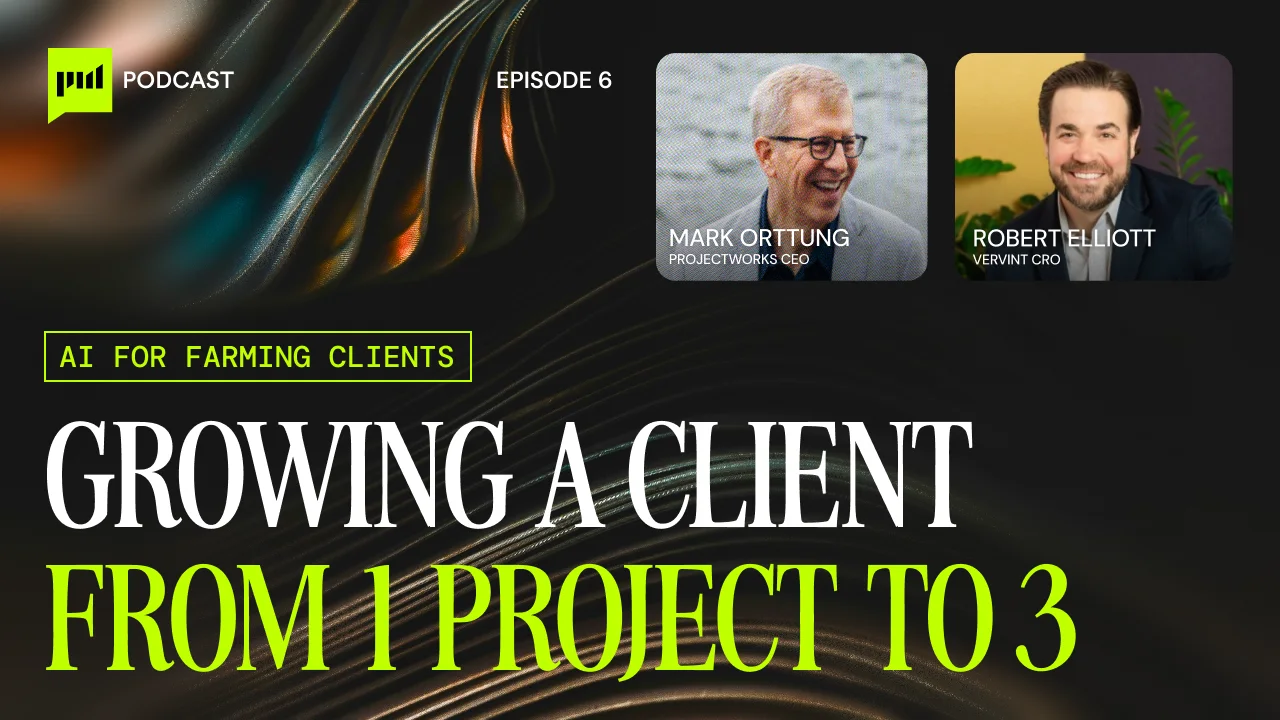
For many consulting firms, the one-project client is the norm and the long-term partnership is the exception, which is backwards given how much cheaper repeat work is to win. This episode is about making that step deliberate rather than accidental. We'll share the play-by-play breakdown of how fast growing firms identify the right client accounts it invest in, how they grow them, who's involved in the relationship, and where AI makes it all easier.
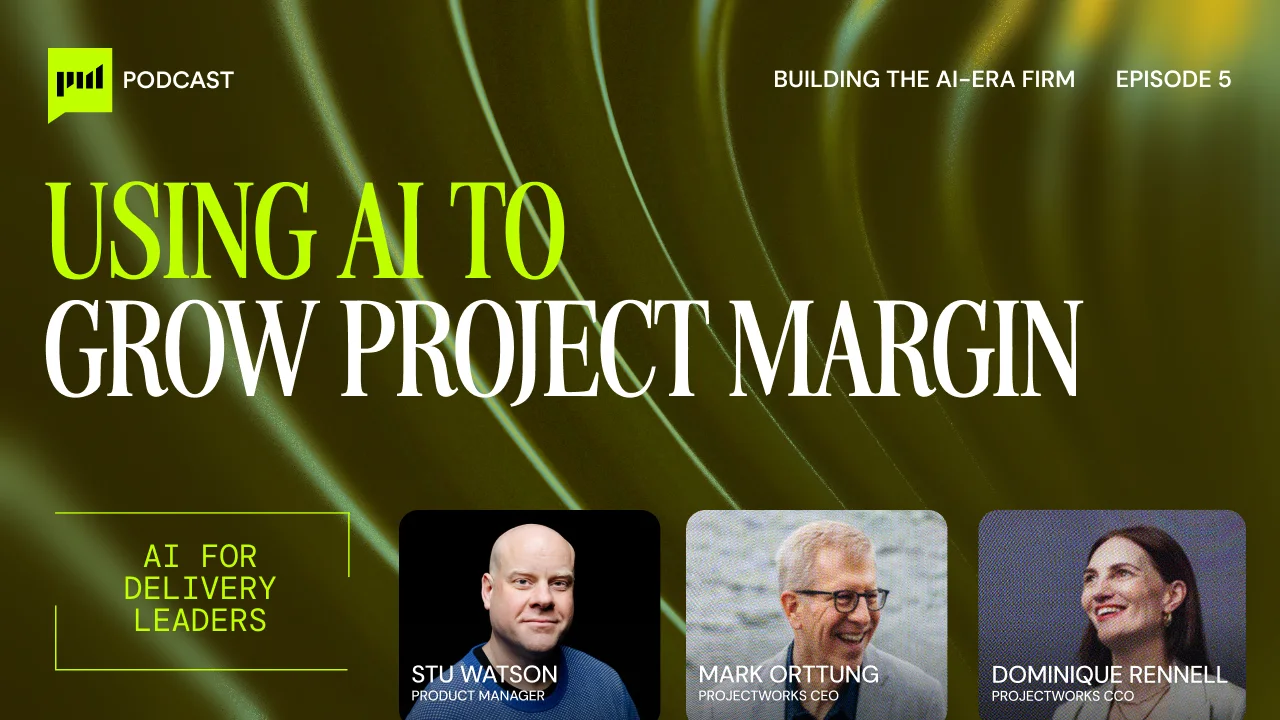
In a small firm, delivery quality holds because everyone works side by side and the founder touches every project. Then the firm grows, the founder runs out of hours, and work gets delivered by people who never learned your delivery method firsthand. Project margins turn inconsistent, and it's rarely the same reason twice. Most AI you've used so far waits for you to ask it something. Agents are different: they work in the background and tell you what needs attention before you'd have caught it yourself. This episode is about what that shift means for delivery, and we'll introduce Kea, the AI agent we're building inside Projectworks, and where we're taking it.

Timesheet chasing, invoicing, month-end, reporting, and the non-billable hours that go with them... its all necessary work in a consulting firm. Without it, clients don't pay you. It's costly though – for most firms, admin as a % of revenue sits at about 15%. Its a whole lot of cost that otherwise could be sitting in your EBITDA. In the AI era, the best consulting firms will bring this figure into the single digits. Learn how in this episode of the podcast.