The New Rules To Win More Work
Winning work is getting harder for a simple reason: the shape of demand has changed. In the episode, we unpack what we’re seeing in Projectworks data, and what it means for proposals, margins, and your delivery team’s sanity.


Smaller budgets, more projects, more proposal load
Projectworks platform data shows the average project budget has halved over the past two years, while the average number of in-flight projects has doubled. That shift changes everything. You need more wins to hit the same revenue, which means proposals become a throughput problem, not just a sales problem.
Proposals are a hidden utilization leak
One of the sharpest stats in the episode: an average firm produces 91 proposals a year and spends roughly 24 hours on each... that's over a year's worth of someone's time. Even if those numbers feel conservative, the point stands. Proposal effort quietly eats a huge chunk of your best people’s time, often pulling delivery leaders into pre-sales, then pushing that work into nights and weekends.
If you want to win more work without burning people out, you have to manage proposal effort like you manage delivery effort.
“Personalized” means relevant proof, not swapped names
A proposal has one job: give the customer confidence you can do what you say you’re going to do.
That confidence comes from relevance:
- Proof that matches their industry and problem (not generic case studies)
- Clear understanding of their constraints and stakes
- A believable plan for what happens first, and what “good” looks like
If your proposal is packed with impressive work that is not similar to their situation, it does the opposite of what you want.
The new differentiator is showing, not telling
Words are cheap now. What cuts through is evidence that you understand the problem and have a real approach to solving it.
In the episode we talk about creating a simple “movie trailer” for the engagement. Not a full solution, just something tangible that makes the buyer think, “They get it”.
That could be:
- A short walkthrough video
- A quick prototype or workflow sketch
- A first-week plan with risks called out
AI will make proposals faster, but the advantage is where you spend the saved time
LLMs are great at large blocks of language, which is most of a proposal. So speed alone will not differentiate you for long.
The edge is using AI to remove admin, then reinvesting human time into the parts that actually win deals and protect margin:
- Qualification and positioning
- Scope clarity and risk control
- Commercial shape and pricing discipline
- Relevant proof and a confident delivery plan
A simple “do this next” checklist
If you want to improve proposal outcomes in the next 30 days:
- Set qualification gates before you pull delivery leaders into pre-sales
- Cap pre-sales hours per opportunity and track it
- Build a proof library tagged by industry, problem, and outcome
- Add one “show it” asset to every serious proposal
- Run a proposal retro: what we under-scoped, what we over-promised, what we’d price differently
Join the Projectworks Proposals waitlist
We’re building new proposals capability in Projectworks to help firms move faster, lift quality, and connect proposals to delivery and financial reality.


Listen to moments from similar podcasts

Losing your biggest client is one of the few things every founder worries about and almost nobody prepares for. In this episode, Mark and Dominique will walk through what actually happens in the 90 days after it hits, then zoom out to the harder question: how you avoid ending up there again. That means carrying enough pipeline to hit your growth number even without your biggest account, and treating client concentration as something you manage on purpose instead of something a crisis forces on you.
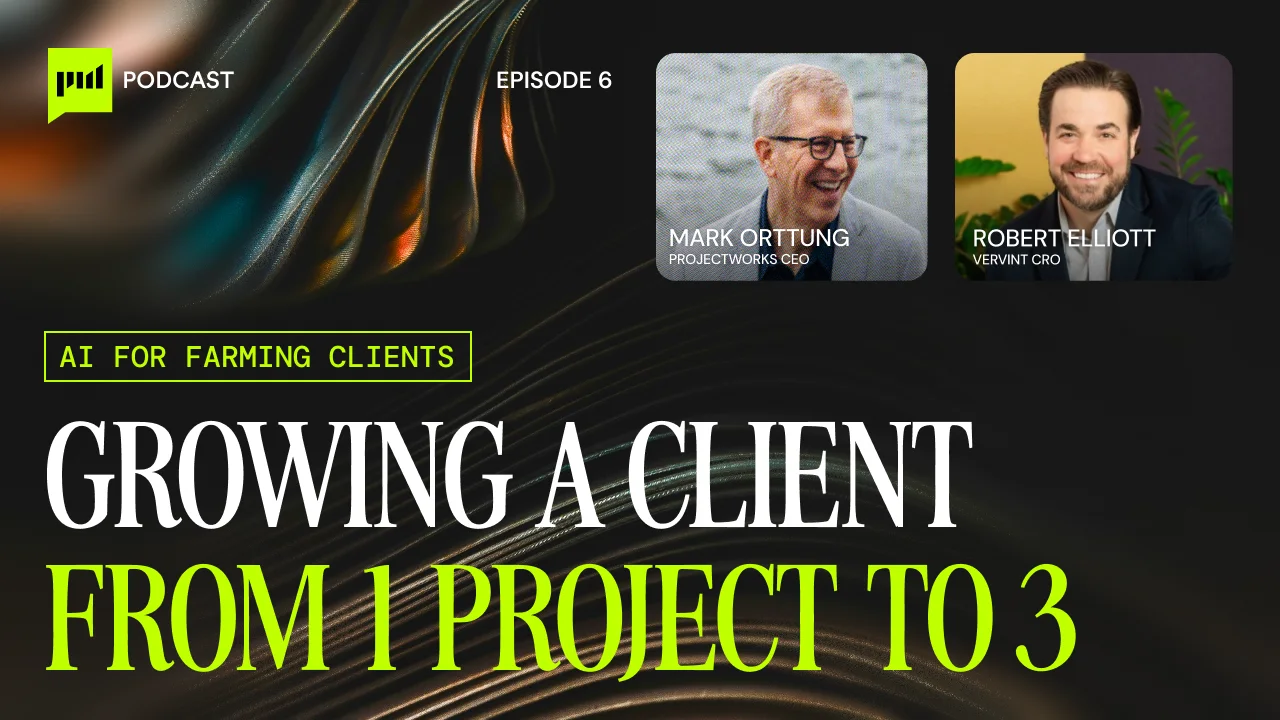
For many consulting firms, the one-project client is the norm and the long-term partnership is the exception, which is backwards given how much cheaper repeat work is to win. This episode is about making that step deliberate rather than accidental. We'll share the play-by-play breakdown of how fast growing firms identify the right client accounts it invest in, how they grow them, who's involved in the relationship, and where AI makes it all easier.
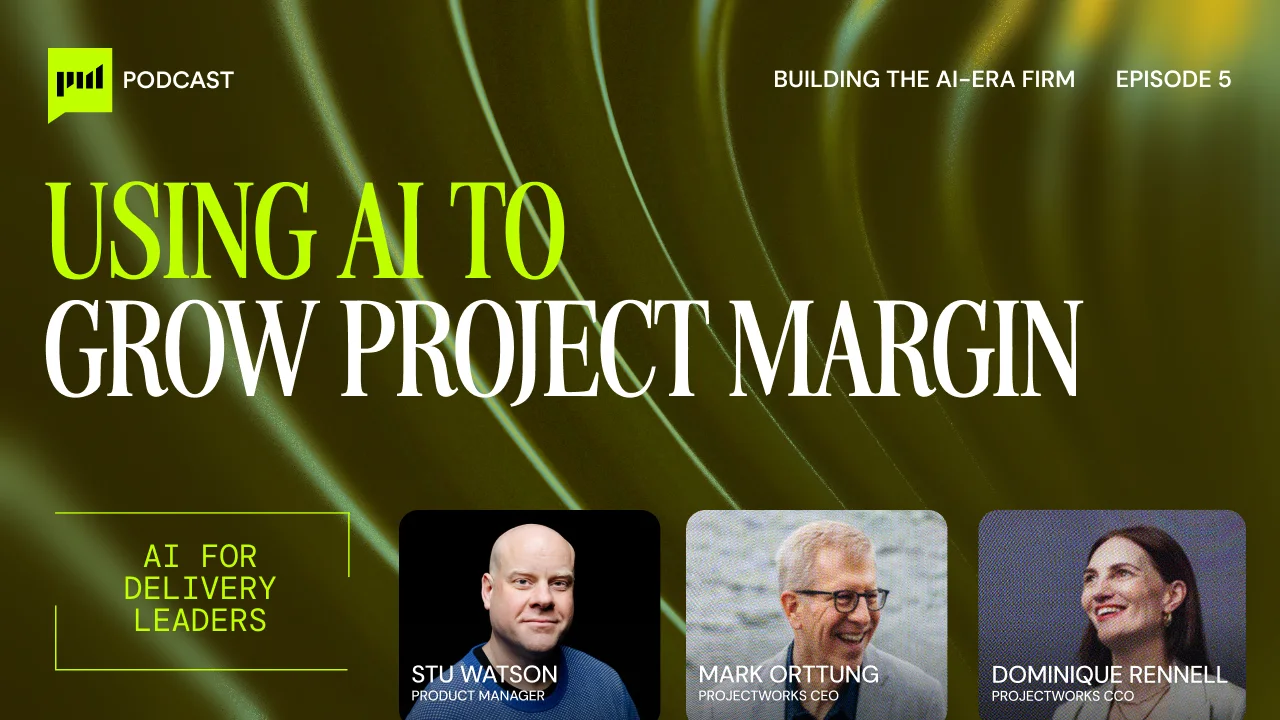
In a small firm, delivery quality holds because everyone works side by side and the founder touches every project. Then the firm grows, the founder runs out of hours, and work gets delivered by people who never learned your delivery method firsthand. Project margins turn inconsistent, and it's rarely the same reason twice. Most AI you've used so far waits for you to ask it something. Agents are different: they work in the background and tell you what needs attention before you'd have caught it yourself. This episode is about what that shift means for delivery, and we'll introduce Kea, the AI agent we're building inside Projectworks, and where we're taking it.