Even A Slight Mismatch In Skills Can Cost Your Consulting Firm Money




Learn how assigning work to whoever is available rather than who is best suited to the work hurts your margins, and how resource planning software addresses this issue.
At a basic level, managing your resources is about putting available consultants to work on projects, and keeping them busy. But effective resource planning is much more than just scheduling. You must find the match between consultant and project that makes financial sense AND is an appropriate use of their skills. If you don’t schedule the right consultants to work on the right projects, you are costing your firm money, and possibly hurting your client relationships.
The Right Person On The Wrong Work
Assigning a senior person to a junior-level task is an unnecessary waste of money. An extreme example would be scheduling a $150/hour consultant to do work that a junior level consultant ($50/hour) could have done for 20 hours. This mistake would have wasted $2000 simply because the senior-level person was available and you didn’t have accurate visibility into the junior-level resources availability. Typically, mismatching higher level consultants on lower level work is less extreme, but more frequent if you do not have the right view into availability and costs when you are planning.
The Wrong Person On The Right Work
On the other hand, assigning work to a consultant who lacks the skill needed for the project can cause delays and rework, hurting or even eliminating project profitability. In addition, rework and delays cause client frustration, which can lead to more difficult renewals and upsells. If you see rework cropping up, it might not be an underperforming consultant - it may be a skill mismatch caused by inefficient planning.
Find The Right Match With Skill Mapping
Resource planning software like Projectworks enables you to match project requirements with consultant’s skills, rate and availability. In addition to seniority level/rate, you can tag each consultant on your staff with specific skills and talents. And when a new project needs to be assigned, you can use the matching feature to find the best available fit. This not only saves time during the resource planning process, it guards your profitability by automatically optimizing the match for the most cost effective, qualified consultant for that work. Your projects will be completed more efficiently, your clients will be happier, and your consulting staff will be less stressed.
If you are ready to go from basic project scheduling to resource planning and save your margins, you can start with a free trial of Projectworks, or let us demo Projectworks for you, and you will see how switching from spreadsheets to software can help your projects become more profitable and your clients happier.

Read similar resources from Projectworks

Projectworks has spent 25 years inside consulting firms. Here’s why we built a Consulting CRM around the proposal, and where it goes next.
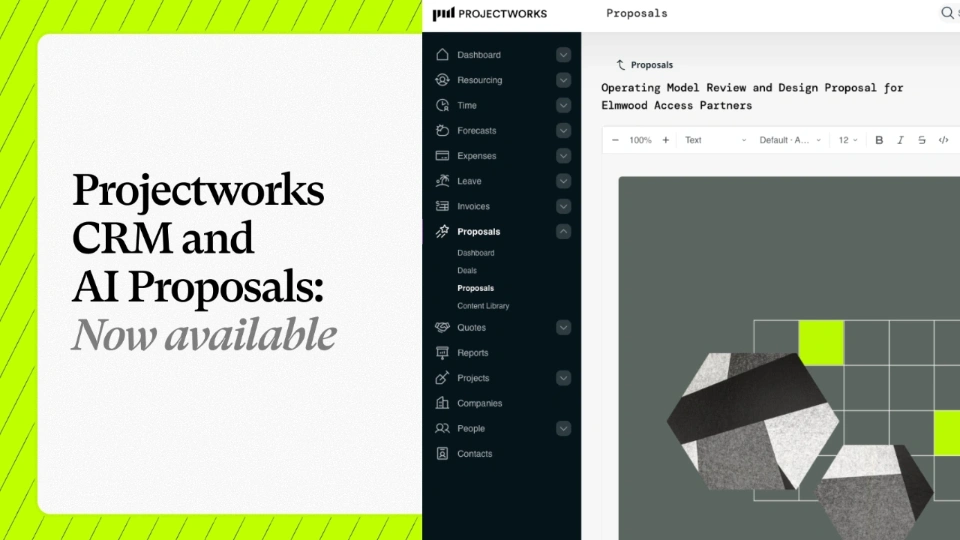
We're excited to announce that our Consulting CRM and Proposals are now available for anyone to use or try out. In just three months, a fast-growing group of firms have been running their pipeline and proposals in Projectworks as part of our early access group, and the results have blown us away.
-card.webp)
Projectworks has been named to the 2026 Inc. 5000, the annual ranking of fastest-growing private companies in the United States, for the second time. Building a global software business is not an easy thing to do. So when our growth shows up on a stage as competitive as the US market, it means a lot.