Free gross margin calculator: Instantly understand your project portfolio




Most professional services leaders make a critical mistake: treating gross margin as a backward-looking accounting metric rather than the forward-looking decision engine it should be.
What is gross margin in professional services?
In contrast to account margin, which calculates margin per account, gross margin calculates the margin across all accounts in your client portfolio.
Gross margin is a good indicator of the overall health of your client work. If your gross margin is strong, then scaling your business is worth investment in sales and marketing (which would come out of operating margin).
To determine gross margin for your company, simply add together your account margins across all accounts, then subtract the costs to deliver the work. These include the costs that are part of your cost of goods sold (COGS). This typically includes practice leadership, bench (team members not on a billable project), and any other non-billable time.
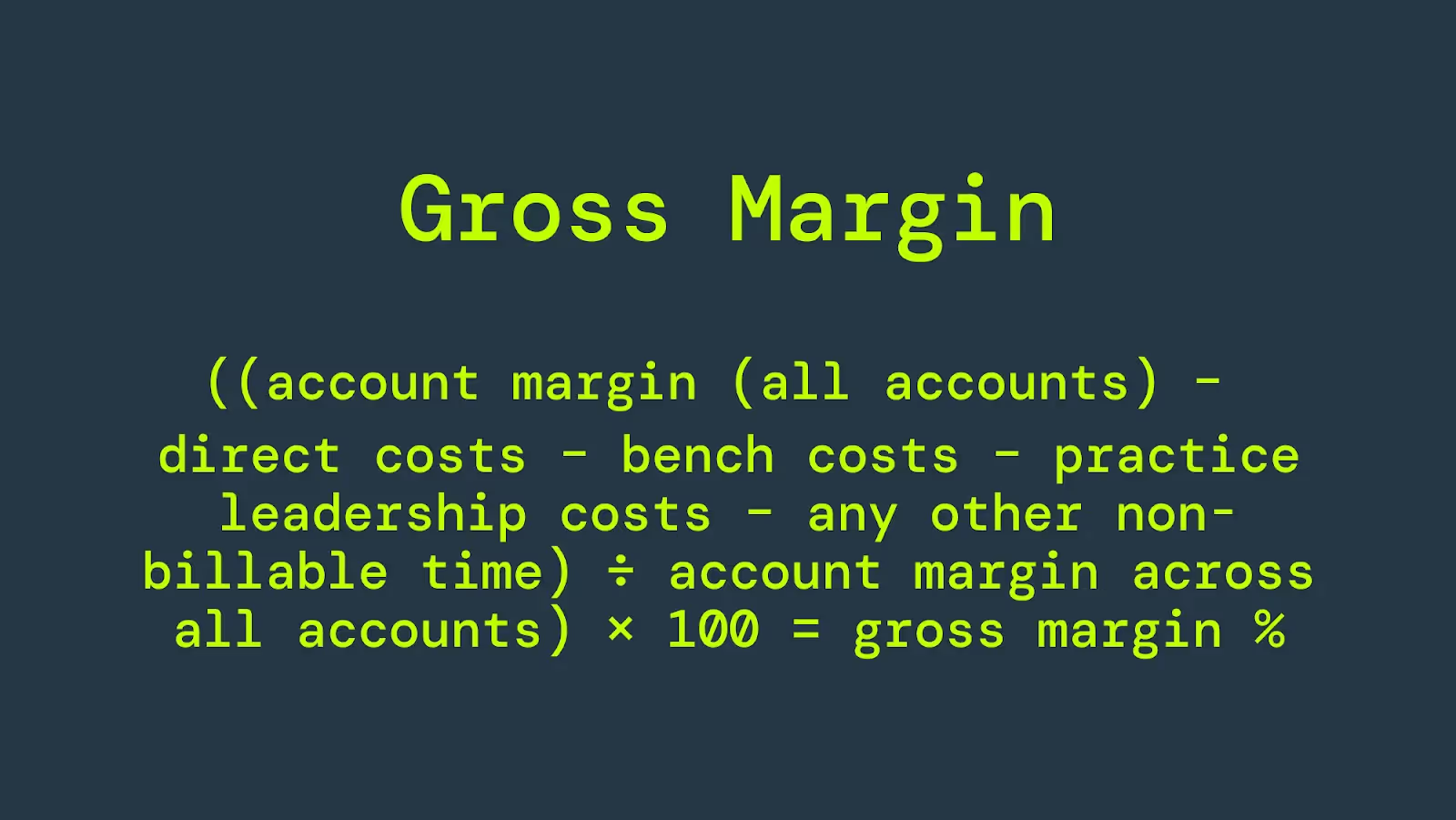
Calculation: ((account margin across all accounts – direct costs to deliver the work – bench costs – practice leadership costs – any other non-billable time) ÷ account margin across all accounts) × 100 = gross margin %
Learn how to calculate your account margin
What to include in your gross margin calculation
Note: There is an important distinction between the direct costs used in the account margin calculation compared to the direct costs used in the gross margin calculation. The account margin calculation includes direct costs to deliver the work (e.g. a specific tool needed for the specific client project). The gross margin calculation includes direct costs that are not specific to one client (e.g. a tool that helps the whole team learn a new technology to generally sharpen their skills).
Gross margin for your company doesn’t factor in the following costs:
- General and Admin operating costs
- Marketing and Sales costs
Including practice leadership time in gross margin calculations
Because practice leadership staff are often working at a strategic level, it can be difficult to know whether to include their hours in certain margin calculations. In the example provided here, you should factor practice leadership time (and therefore costs) into your gross margin calculation across all accounts.
This is because bench costs, practice leadership costs, and non-billable time are for different people than those working directly on the account (or different hours for some people if they are partially assigned to the client project and partially doing something non-billable). In this case, their salary cost plus the same overhead calculation as for account margin would be assigned to this bucket.
The rationale for this is that practice leadership is part of creating the service you provide to the customer, or part of your cost of what you sell.
Why gross margin makes or breaks consulting firms
Gross margin is a powerful indicator of your firm's ability to scale profitably. When your client work generates healthy gross margins, you create the financial foundation needed to invest in business growth through sales and marketing activities.
Does this sound familiar? Your team is fully booked, working around the clock on a multiple client engagements. Everyone's billing hours. The clients are happy. Then finance reports that you barely broke even this quarter.
For consulting leaders, few things are more demoralizing than discovering that what felt like excellent client work was actually a financial drain. This disconnect exists because most firms lack real-time visibility into gross margins when decisions still matter.
When your gross margin percentage hits target thresholds, you can:
- Maintain a bench of specialized talent ready to deploy on high-value opportunities
- Pay competitive salaries while preserving financial stability
- Invest in developing expertise without constant cash flow stress
- Price strategically rather than desperately chasing any available work
- Weather market fluctuations without painful layoffs or cost-cutting
Strong gross margins don't just reflect successful past projects - they enable future growth by funding both the bench talent and the marketing investments needed to take on the world's most urgent problems. If your firm is going to make a real dent, profitability can't be optional.
Calculate your gross margin now: Free interactive calculator
Enough theory. Ready to see where your firm stands?
Our professional services gross margin calculator gives you immediate clarity without spreadsheet hell:
Gross margin vs. operating margin vs. net profit margin: What's the difference?
Stop confusing these metrics. While related, they answer fundamentally different questions:
Account margin answers: "Is this specific client relationship financially viable?"
Gross margin answers: "Are we delivering our services (across all accounts) efficiently enough to cover our overhead, grow sustainably, and remain profitable?"
Operating margin answers: "Are we efficiently managing our business operations and overhead?"
Net margin answers: "Is our overall business model sustainable after all expenses?"
The calculation differences are straightforward (see complete definitions in our margin calculation guide).
How to automate gross margin calculation
The most difficult part of calculating your gross margin is gathering all the relevant information. Using PSA software, you'll be inputting all the data you need in one place through timesheets and invoices. That data is then gathered in real-time to show you your current gross margin, expressed as a percentage. No manual calculations needed!
For a predicted gross margin, you'll also want to use PSA software, as it can be a confusing process to manually calculate all the components. Using Projectworks, you can predict the gross margin you will make on a project before you even start working on it. By entering the financial forecasts (revenue expected) and the resourcing expected to complete it (cost to deliver) you can verify whether the project will deliver the financial results expected.
Transform margins from mystery to management tool
The difference between successful consulting firms and struggling ones is operational clarity. When partners and project managers understand margins in real-time, they make radically different decisions about:
- Which clients deliver the best returns after accounting for costs
- How to structure projects to maximize efficiency while maintaining delivery excellence
- When to bring in specialists versus leveraging internal resources and junior staff
- Which service offerings generate sustainable profits and which drain resources
- How to establish pricing strategies that reflect true operational costs, not just direct expenses
By turning margin insights into actionable intelligence, firms gain the visibility needed to make strategic decisions that drive sustainable growth.
Ready for that level of growth? Book a demo to see how Projectworks helps leading consultancies track and improve their margins without sacrificing client outcomes or team wellbeing.
For an overview of the key margins you'll need to understand in professional services, see our comprehensive guide: How to Calculate Your Margin: Professional Services 101


Read similar resources from Projectworks
You've heard AI is turning systems of record into systems of action. Here's what that shift actually means for CRMs and consulting firms.
![Best AI Resourcing Software for Consulting Firms 2026 [Compared]](https://cdn.prod.website-files.com/66e7bd6e836e6762f85a0c45/6a5d9aa3e2fc5acdc5fd4fb8_best-ai-resourcing-tools-1.webp)
The 8 best AI resourcing tools for SMB consulting firms in 2026, compared on AI depth, G2 ratings, and fit for professional services.

Choosing a CRM for your consulting firm? Here's what actually matters. From tracking the bids you have out to what happens once a job is won.