

Most founders think about consulting M&A backwards – they think the game starts when a buyer turns up, when in fact it actually starts years earlier, in how you build the firm.
Because buyers of professional services firms aren't just buying revenue. They’re buying leadership depth, delivery that doesn't fall apart without the founder, and a firm they can understand, trust, and grow with predictability.
Today’s professional services M&A market is heating up. Thanks to private equity, more capital has entered the category than ever before. We see it all around us in local dentists, accounting firms, lawyers and others being rolled up into national chains. Up next is Engineering, Software and IT, Architecture and other consulting industries too. Why? Because any industry with a predictable supply and demand dynamic is an attractive one to buy and scale. This means founders of consulting firms have more options than ever, but they only matter if your business is built in a way that makes a deal possible and attractive.
The thing is, if you can't show where your growth comes from, how profitable your projects really are, and whether your performance is repeatable, you aren't really planning an exit. You are just hoping one turns up.
If you’re interested in our Consulting M&A Cheat Sheet, grab your copy here.
Why do most Consulting M&A conversations start too late?
Because founders wait until they are ready to sell before they ask the questions they should have asked while building:
Why this firm?
Why now?
What exactly is someone buying?
Is it a puzzle piece that fits neatly into a larger business, or is it a real platform with multiple services, leadership depth, repeatable processes, and the ability to stand on its own?
These questions really matter – because they shape value, leverage, and the kind of buyer you attract. Unfortunately, they’re often questions founders and leaders of professional services firms tend to ignore, because they’re uncomfortable. That, or they tell themselves a false answer and believe it.
Our advice is to get outside perspective early. Experts who aren’t invested in your firm’s success pressure-test your weaknesses. The right person will tell what you don’t want to hear, but absolutely need to if you’re serious about an exit strategy. They’ll help do your pre-mortem before a potential buyer does it instead.
What matters most in Consulting M&A deals?
People. It might sound obvious, but its easy to forget when M&A gets talked about as if its purely a financial exercise. In any consulting industry, you are not buying machinery. You are buying leaders, teams, expertise, relationships, and a scalable way of working.
That's why rushing straight to the numbers is often the first mistake. Good consulting M&A starts with CEO-to-CEO trust, and honest conversations. This is what will help you get ahead of the internal blockers which can quietly kill a deal.
Also, if you’re serious about making a deal happen, be prepared to hand over much more of your day job than feels comfortable, because a potential consulting firm sale process will consume far more time and attention than you might expect.
How to tell the difference between a good professional services M&A deal and a bad one
Usually, it isn’t the headline numbers – it's the structure. Earn-outs are an classic example:
If your earn-outs are too fast, and they can suffocate the business.
If your earn-outs are too slow, and they drain motivation.
If the post-merger structure does not match the earn-out logic, you have a problem.
If key stakeholders are not fully bought in, you have a problem.
If the selling firm has no leverage because it needs the deal too badly, you have a problem.
The lesson here is simple: in professional services M&A, your deal structure has to match reality. You need to know what changes are material, what would cause either side to rethink the deal, and what your credible alternative is if the buyer you’re in conversation with isn’t the one. Don’t have more than one buyer? Ask yourself or someone you trust why not.
What are buyers really looking for during diligence?
Risk hiding in plain sight. Be it client concentration, founder dependence, a weak go-to-market, fragile delivery processes, or a service line that looks healthy until one person leaves or the market changes. Buyers are looking for your weakest link, which means you should be too.
This is where good PSA software comes in – firms that progress well in consulting M&A diligence can already see their own business clearly. They know their margins. They know utilization. They know which work is profitable and which isn’t. They know whether revenue is genuinely scalable or if its being held together by one person’s heroics.
Why do so many Consulting M&A deals disappoint after close?
Because everyone relaxes after the signature, but thats actually when the hardest part starts.
Integration is where deals live or die. If the acquired leaders lose all autonomy on day one, if culture mismatches get glossed over, or if the founder has not been honest about whether they want to stay, lead, transition, or leave, things break fast. The best integrations often give the acquired business room to breathe first, then merge with eyes wide open.
If you want the full Consulting M&A framework we've developed, get the cheat sheet here.


Read similar resources from Projectworks
It's the end of September and expenses got a lot of love this month, with a couple of big changes you can start using today and more on the way! We've also made updates across financial reporting, resourcing, HubSpot, and invoicing, dive in to see what's new.
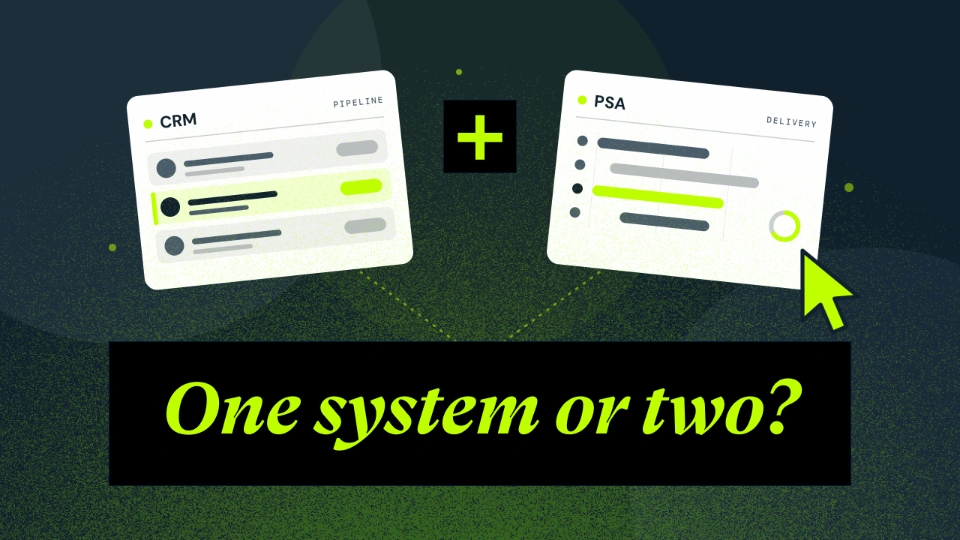
PSA software with built-in CRM, or a separate CRM? For consulting firms, one system usually wins. Here's why.
.png)
This is your guide to all the updates across Projectworks in the month of August. There's new and updated integrations, upgraded resourcing and the opportunity to join early access to Kea, our AI Agent - something for everyone!