resources
BLOG
Consulting Advice

Leading through growth

Communications
Growth
Go deeper
Download our professional services ‘cheat sheet’ now

It’s no secret that business growth is bloody hard work. It’s sought by many of us and achieved by only a few. With it comes a series of challenges that until you’ve been through them it’s hard to have the foresight to plan for or avoid.

For those of us that are up for the challenge though, growth is incredibly rewarding to work through and achieve. It’s addictive too – in fact, I heard a quote recently from Jerry Seinfeld which resonated with me and the relationship many of us have with growth. He was talking about writing comedy, but the insight is brilliant:

"It's like going to the gym every day. You know how you walk in every day and you go oh jeez I gotta do this again. It's a tortured life. But you know what, your blessing in life is finding the torture you're comfortable with. Find the torture you're comfortable with and you'll do well" – Jerry Seinfeld

In my time leading through growth, I’ve learnt a few lessons (usually the hard way). These have had a transformative experience on my experience as a leader, the mindset of the people I’ve led, and the business growth we’ve delivered together.

1. Know your strengths & lean into them

Self-awareness in leadership is foundational to your success. It allows you to be more purposeful in the application of your strengths, as well as build a better understanding of how to work well with people who think or operate differently from you.

In the early stages of high-growth consulting firms, founding team members have a significant hands-on impact across all aspects of their business. As your firm scales, however, it’s essential that you empower others to take ownership of areas you no longer have the capacity for. This can be a difficult transition, so it’s important you take the time to consider what type of leader you want to be, and what areas you want to have greater influence over. Some leaders apply themselves equally across the full breadth of their business, while others remain heavily involved in new business development, technical leadership, operations or finance. Whatever your approach is, be purposeful about it as well as realistic about the capacity it takes to do well.

2. Surround yourself with people who think differently

Understanding yourself well then enables you to know your gaps and surround yourself with a diverse range of people who challenge you openly, as well as expand your collective capability and perspective. People bring a broad range of unique experiences and insight to problem-solving, and when we collaborate well we're capable of achieving phenomenal outcomes for our customers and businesses.

Growing professional services firms is challenging, however with the right strategy and awareness of your team’s capabilities, you can focus on bringing the people onboard that will build your company for scale, and enable you as a leader to have an even greater impact.

3. Invest in your people

As you personally become significantly less hands-on across your business, your reliance on your people hugely increases. With the right people and the right level of investment in them & their tools, your firm will thrive.

As leaders, we have a responsibility to see potential in our teams that they don’t yet see in themselves and to motivate and push them to find new ways of solving problems. This can mean challenging them to grow and be accountable for the outcomes they produce commercially, relationally, or in other ways. At times, these can be hard conversations, yet out of a consistent place of caring for them personally and pursuing their potential, your team will embrace the challenge.

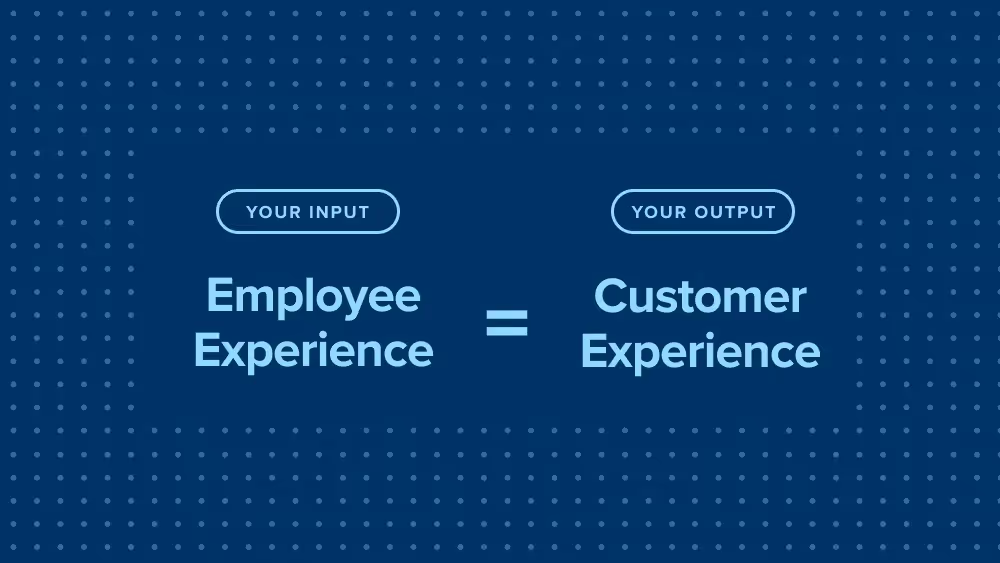
A simple way of thinking about this is that your employee experience is your input and your customer experience is your output. One version of this is all too common: 💩 in equals 💩 out. On the other hand, you can experience an extraordinary multiplier effect when you consistently demonstrate your genuine care and investment in each of your people, they will repay that with a far greater level of care for your customers and business success.
4. Make yourself (operationally) redundant and systemise for scale

In order to grow a business, you have to enable yourself to think proactively about the problems and opportunities of the future, and that means making yourself operationally redundant over and over again. You may retain the same title but your role will be fluid, adapting to the challenges of scaling and accelerating towards your vision.

Operationalising your growth strategy means ensuring that your team's processes and tools for managing project and business performance are easy to use, connected as an ecosystem, and ultimately enable better decision-making. Build in regular operational reviews and feedback loops to ensure your systems are fit for purpose for tomorrow’s challenges. This empowers your people to focus on the real work of making great decisions aligned with the direction you provide and removes the risk of high dependency on you or your fellow leaders for the detailed tactical execution of your strategy.

For consulting firms that might mean setting up a transparent and scalable resourcing system that doesn’t require your personal time to manage, or ensuring your senior leaders don’t have to touch a thing for invoices to go out. Modern PSA software is essential for your business to scale.
5. Culture is the key

Change can be hard for people, yet for a growing business, it's consistent. To truly build momentum, a healthy culture of growth means your team run head-first at it rather than shying away from it.

Growth needs to be embedded in the DNA of your organisation. This could mean celebrating or incentivising professional achievements, investing in the development of your people through courses & coaching, communicating clearer success measures and progress against them, greater emphasis on a growth mindset in your hiring decisions, retrospectives or feedback loops with your team, or any variety of other ideas.

Consulting firms should consider what key measures of success are communicated transparently and celebrated because this is at the core of your culture. Examples might be celebrating utilization rates, or project margins, consistently staying on budget, or satisfied clients. It’s important for everyone to know what success means in your organisation, so make the decisions you need to in line with your business strategy around what metrics you communicate about and celebrate.

Our Founder and Chief Exec here at Projectworks, Matt Hayter, recently said to me that the role of CEO in a fast-growing business like ours really is a Chief Culture Officer. It’s the area he’s focused on influencing the most because it helps to shape every decision made across our business.

If you’re interested in chatting more about what I’ve shared then I’d love to hear from you! Message me on Linkedin or email me at [email protected]
Share:
learn more

Download our professional services ‘cheat sheet’.

Whether you’re at $5M, $15M, or $50M, this cheat sheet maps the moves that separate firms who stall from firms who scale.

UP next:
By subscribing you agree with our Privacy Policy.
Thank you! Your submission has been received!
Oops! Something went wrong while submitting the form.
Keep reading

Read similar resources from Projectworks

resource type

Novigi has an impressive story. Since launching in 2016, they’ve scaled to 550 staff across six offices and two countries, while becoming the fastest-growing professional services firm on the AFR Fast 100 - their story is worth studying.

Bernadette Keating
April 9, 2026
resource type
resource type

Happy New Year! To kick things off, we're sharing our new, smoother connection between Schedule, Resourcing, and Forecasting. Plus, do you use our QuickBooks Online or HubSpot integrations? We've added new QBO classes and enabled HubSpot Line Items to create Budgets in Projectworks, saving you valuable billable time.

Charlotte Steel
January 27, 2026
resource type
resource type

”When new work comes in, we have the right people, ready to go. Winning work and protecting the team, we never have to choose just one.” How often can you confidently say the same? Facing resourcing questions about upcoming projects can sound simple, but if your schedules are built on assumptions and capacity is only estimated, face it, your resource planning is under-engineered!

Bernadette Keating
April 12, 2026
resource type
Consulting Advice
Communications
,
Growth

Leading through growth

By
Jacob Lawrie
Leading through growth

Projectworks' new Head of Marketing Jacob Lawrie has built his career in high-growth organizations. Now he brings his leadership advice to our latest blog post.

It’s no secret that business growth is bloody hard work. It’s sought by many of us and achieved by only a few. With it comes a series of challenges that until you’ve been through them it’s hard to have the foresight to plan for or avoid.

For those of us that are up for the challenge though, growth is incredibly rewarding to work through and achieve. It’s addictive too – in fact, I heard a quote recently from Jerry Seinfeld which resonated with me and the relationship many of us have with growth. He was talking about writing comedy, but the insight is brilliant:

"It's like going to the gym every day. You know how you walk in every day and you go oh jeez I gotta do this again. It's a tortured life. But you know what, your blessing in life is finding the torture you're comfortable with. Find the torture you're comfortable with and you'll do well" – Jerry Seinfeld

In my time leading through growth, I’ve learnt a few lessons (usually the hard way). These have had a transformative experience on my experience as a leader, the mindset of the people I’ve led, and the business growth we’ve delivered together.

1. Know your strengths & lean into them

Self-awareness in leadership is foundational to your success. It allows you to be more purposeful in the application of your strengths, as well as build a better understanding of how to work well with people who think or operate differently from you.

In the early stages of high-growth consulting firms, founding team members have a significant hands-on impact across all aspects of their business. As your firm scales, however, it’s essential that you empower others to take ownership of areas you no longer have the capacity for. This can be a difficult transition, so it’s important you take the time to consider what type of leader you want to be, and what areas you want to have greater influence over. Some leaders apply themselves equally across the full breadth of their business, while others remain heavily involved in new business development, technical leadership, operations or finance. Whatever your approach is, be purposeful about it as well as realistic about the capacity it takes to do well.

2. Surround yourself with people who think differently

Understanding yourself well then enables you to know your gaps and surround yourself with a diverse range of people who challenge you openly, as well as expand your collective capability and perspective. People bring a broad range of unique experiences and insight to problem-solving, and when we collaborate well we're capable of achieving phenomenal outcomes for our customers and businesses.

Growing professional services firms is challenging, however with the right strategy and awareness of your team’s capabilities, you can focus on bringing the people onboard that will build your company for scale, and enable you as a leader to have an even greater impact.

3. Invest in your people

As you personally become significantly less hands-on across your business, your reliance on your people hugely increases. With the right people and the right level of investment in them & their tools, your firm will thrive.

As leaders, we have a responsibility to see potential in our teams that they don’t yet see in themselves and to motivate and push them to find new ways of solving problems. This can mean challenging them to grow and be accountable for the outcomes they produce commercially, relationally, or in other ways. At times, these can be hard conversations, yet out of a consistent place of caring for them personally and pursuing their potential, your team will embrace the challenge.

A simple way of thinking about this is that your employee experience is your input and your customer experience is your output. One version of this is all too common: 💩 in equals 💩 out. On the other hand, you can experience an extraordinary multiplier effect when you consistently demonstrate your genuine care and investment in each of your people, they will repay that with a far greater level of care for your customers and business success.

4. Make yourself (operationally) redundant and systemise for scale

In order to grow a business, you have to enable yourself to think proactively about the problems and opportunities of the future, and that means making yourself operationally redundant over and over again. You may retain the same title but your role will be fluid, adapting to the challenges of scaling and accelerating towards your vision.

Operationalising your growth strategy means ensuring that your team's processes and tools for managing project and business performance are easy to use, connected as an ecosystem, and ultimately enable better decision-making. Build in regular operational reviews and feedback loops to ensure your systems are fit for purpose for tomorrow’s challenges. This empowers your people to focus on the real work of making great decisions aligned with the direction you provide and removes the risk of high dependency on you or your fellow leaders for the detailed tactical execution of your strategy.

For consulting firms that might mean setting up a transparent and scalable resourcing system that doesn’t require your personal time to manage, or ensuring your senior leaders don’t have to touch a thing for invoices to go out. Modern PSA software is essential for your business to scale.

5. Culture is the key

Change can be hard for people, yet for a growing business, it's consistent. To truly build momentum, a healthy culture of growth means your team run head-first at it rather than shying away from it.

Growth needs to be embedded in the DNA of your organisation. This could mean celebrating or incentivising professional achievements, investing in the development of your people through courses & coaching, communicating clearer success measures and progress against them, greater emphasis on a growth mindset in your hiring decisions, retrospectives or feedback loops with your team, or any variety of other ideas.

Consulting firms should consider what key measures of success are communicated transparently and celebrated because this is at the core of your culture. Examples might be celebrating utilization rates, or project margins, consistently staying on budget, or satisfied clients. It’s important for everyone to know what success means in your organisation, so make the decisions you need to in line with your business strategy around what metrics you communicate about and celebrate.

Our Founder and Chief Exec here at Projectworks, Matt Hayter, recently said to me that the role of CEO in a fast-growing business like ours really is a Chief Culture Officer. It’s the area he’s focused on influencing the most because it helps to shape every decision made across our business.

If you’re interested in chatting more about what I’ve shared then I’d love to hear from you! Message me on Linkedin or email me at [email protected]

Join our professional services community

Subscribe for the latest updates delivered straight to your inbox.

By subscribing you agree with our Privacy Policy.
Enjoying this article?
Share it with the world!

Related Articles

Turning an Operational Discipline Into a Growth Engine
Consulting Advice
Z Suite

Turning an Operational Discipline Into a Growth Engine

Novigi has an impressive story. Since launching in 2016, they’ve scaled to 550 staff across six offices and two countries, while becoming the fastest-growing professional services firm on the AFR Fast 100 - their story is worth studying.

Double Your Revenue Growth With Effective Resource Planning
Resource Management
Revenue
,
Growth

Double Your Revenue Growth With Effective Resource Planning

Your sales pipeline and marketing funnel are important as a source of leads and revenue, but the real driver of growth for your consulting firm may be from an unexpected source: effective resource planning. Building an efficient lead-to-close system will drive revenue, but if you can’t deliver the work efficiently and profitably, your firm isn’t actually growing; it’s just getting more busy.

Projectworks Product Update: March 2026
Product Updates
Product Update

Projectworks Product Update: March 2026

It’s hard to tell if March felt too short or too long but we’ve squeezed an impactful update into the final weeks of Q1 for you! From improvements to time logging, subscription details and sync history, here’s what’s new in the Projectworks platform - your all-in-one PSA software for project intelligence.