How Small to Mid-Sized Consulting Firms Win Bigger Deals - Without Being A Global Giant
When I first became CEO of consulting firm Nexient, things felt stuck. We were doing a lot of $100k, $200k, $500k projects, and were just stuck at a wall between $30M and $40M in revenue.
Here’s one of the ways we broke through that wall - we started winning bigger work. Not across the board - first we spent four years convincing a handful of our best clients to go over $10M a year each. By the end of my tenure we were regularly selling $1-2M projects.
If you are leading an ambitious consulting firm and hungry for bigger projects in the year ahead, know this - bigger deals aren’t just bigger invoices. They unlock critical mass:
- Larger, more stable teams
- Deeper, more strategic client relationships
- The ability to invest in IP, leadership, and growth
The hard part is not wanting bigger projects. It is knowing how to credibly win them when you’re not the biggest - or safest- name competing for the work.
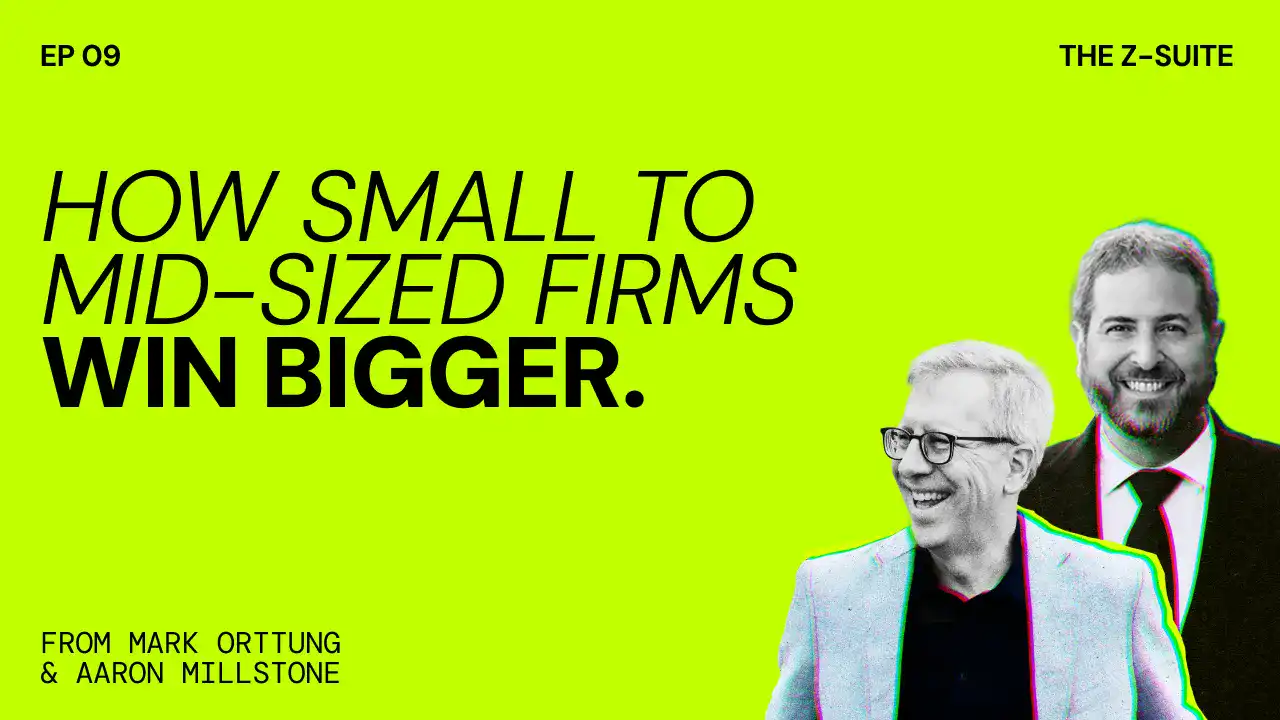
In a recent Z Suite conversation, I chatted with a consulting leader who’s built a reputation from winning big. NTT DATA Chief Growth Officer Aaron Millstone just landed his first $1.5B project, and regardless of the size of the prize your firm is after, there are five things our conversation taught me about winning bigger work.
Watch the full conversation below, or keep scrolling for the 5-minute playbook.
1. The Bigger The Deal, The More Comfortable You Need To Get Just Outside Your Comfort Zone
Bigger deals always force you into new territory. New scale. New complexity. New visibility. That is the point.
Aaron has found the same pattern in his own career.
“All my big career progressions have been when I have been most uncomfortable. From a business and team perspective, getting just outside your comfort zone is when teams really shine. It is when you have the best growth moments as a company, as a team, and as an individual.”
The winning zone is not “no way we can do this.”
The winning zone is “this is scary but believable.”
Do it now: Define your credible edge
For your next big opportunity, answer these three questions with your leadership team:
- What is the largest deal size or scale of work we can credibly deliver today?
- What is the next step up that would make us slightly nervous but still believable with a clear plan?
- What would be so big that we could not credibly explain how we would deliver it?
Draw a line. Focus your energy on opportunities in that “slightly uncomfortable but believable” band. If you stretch too far, you will lose credibility. If you stay too small, you will never break through.
2. The Bigger The Deal, The More Trust You Have to Build With The Smaller Wins
Small firms absolutely can win big. But almost nobody gives a boutique firm a $10M project out of nowhere.
It’s a long game if you are a boutique firm and you do not have that global safe pair of hands reputation. But it is doable.
At Nexient we started by doing a pilot project, usually something someone else had failed at. We had to succeed at it before they would let us in the door. Then we had to do two or three medium projects well before they would even think about giving us a bigger project.
Big deals are the result of a trust ladder:
- A painful problem no one else is solving well
- A small, high stakes pilot where you prove you are different
- A series of medium projects that show you are consistent
- A strategic, multi-million dollar engagement that feels obvious in hindsight
Do it now: Design your trust ladder
Pick one strategic account you want to grow into a $5M or $10M client over the next few years. Then:
- Identify one painful, “failed before” problem you could fix as a pilot for a client
- Map the next two or three medium projects that would logically follow if the pilot works
Treat big deals as the end of a path, not the starting point.
3. The Bigger The Deal, The More Contagious Your Confidence Needs To Be
You cannot sell a $10M project from a place of hesitation.
Aaron puts it simply: “Confidence is contagious. Losing is also contagious. If you have to pick one of those two things, pick winning. Be strong with your confidence both internally and externally.”
Bigger deals put your firm under a microscope:
- Your team will question whether you can really do this
- Your client will wonder if they are betting their career on the wrong horse
- Your partners and board will be nervous about risk
If you do not look and sound sure of yourselves, everyone else’s doubts will win.
Confidence is not bravado. It is a clear, grounded story about:
- Why this problem sits squarely in your firm’s wheelhouse
- Why now is the right moment for the client to act
- Why your team, specifically, is the safest bet
Do it now: Run the confidence test
Before you commit to pursuing a big opportunity, sit with your core deal team and answer:
- On a scale of 1 to 10, how confident are we we can deliver this if we win?
- What would need to be true to move that number up by 2 points?
- What proof points, case studies, or people do we need in the room to make that confidence visible to the client?
If you cannot get to a believable story internally, you will not be able to sell it externally.
4. The Bigger The Deal, The More You Need To Make Relationships Your Unfair Advantage
You are not going to beat a global firm on brand. You can absolutely beat them on the quality and depth of relationship.
Just remember what is actually at stake for your buyer: their career.
Aaron has lived both sides of this:
“If you do not have the relationship, and you do not have the brand, you can show up with a great solution, great proposal, great commercials, great pricing, everything. But it is usually not enough for a client to go bet their career on for a larger deal. I have had deals we thought we had won, we went and celebrated the win prematurely, then found out we had lost because we did not actually have the relationships we thought we had. A competitor that did have the relationships just took the deal away.”
Relationships trump perfect proposals. Every time.
Do it now: Build “career bet” relationships
For each stretch project you’re chasing right now, ask:
- Who, specifically, would be betting their career if they chose us for a $5M or $10M deal?
- When was the last time we had a frank, off-the-record conversation with them about what is really at stake?
- Do they see us as a vendor, a preferred supplier, or someone they would personally fight for?
If the answer is “vendor,” you are not ready for a big deal yet. Start acting like a long-term partner long before an RFP appears.
5. The Bigger The Deal, The Tougher - And The More Important - The Internal Sell Becomes
Big deals are not just hard to sell to clients. They are hard to sell inside your own firm.
Aaron has seen it be “harder to sell internally than externally”:
“You have to convince all the people who are worried about risk and deliverability. The sales people are trying to convince everyone it is all doable. Delivery and finance are trying to figure out the ways it will not be doable. In large corporations, once you hit certain dollar thresholds, you need different levels of approvals. Sometimes it has to go all the way up to the board.”
Without internal buy-in, Aaron would have never got his most recent $1.5B win across the line - his firm’s business unit leader was adamant there was no way they could win it, because an influential stakeholder openly disliked the firm.
But Aaron was convinced they could win, and he sold that internally, one stakeholder at a time. It wasn’t smooth sailing - right up to the RFP drop, there were heavy debates about whether to even bid. At one point Aaron had to go to the CEO and asked him to override the P&L owner.
Sometimes leading a firm means taking political risk on the deals you believe in.
Do it now: Pre-wire the internal yes
Before you chase a big deal, map your own internal stakeholders:
- Who is worried about risk, reputation, or margin?
- Who has formal approval power at each dollar threshold?
- What would they need to see in the plan to say yes?
Bring them in early. Let delivery and finance shape the approach, not just review it at the end. The bigger the deal, the more you need one story the entire leadership team can stand behind.
6. The Bigger The Deal, The More You Have To Weave Many Perspectives Into A Single Vision
Multi-million dollar deals are almost never decided by a single person. They are a messy web of decision makers, influencers, blockers, and quiet power brokers.
Aaron’s approach starts with a people map, not a solution:
“You start by mapping the various decision makers, stakeholders, and influencers. What is the actual map of people involved in how this will be sold and delivered? Then you do the deep listening rounds. What are the pain points keeping them up at night? Where are the opportunities to deliver lasting impact?”
The job is not to force your solution into that complexity. It is to listen your way into a shared vision.
“You are trying to get to: what is the problem, what is the opportunity, over and over, across many stakeholders who can have very different opinions. You keep playing back what you are hearing, and you start to show up with points of view and narratives about how you could get them to a different place. You do not go in and talk about technology solutions. You do some of that to credentialize yourselves. But really it is the vision you are trying to paint. A vision that is aligned with what they wish they had. Then you paint yourselves into that story.”
Do it now: Map the Stakeholders. Then build the future narrative
For your largest live opportunity:
- Map every stakeholder: economic buyer, decision makers, influencers, potential blockers.
- Capture, in their own words, the problem and opportunity for each of them.
- Draft one narrative that:
- Names the shared problem
- Articulates the shared opportunity
- Shows how your firm gets them from today to that future
- Pressure test that narrative in conversations before you ever put it in a proposal.
If stakeholders cannot see themselves in the story, they will not fight for your deal in the rooms you are not in.
7. The Bigger The Deal, The More You Need To Get Your Back Office In Order
Big deals do not just scale revenue. They scale chaos.
- More people on projects
- More complex invoicing and milestones
- More scrutiny on margin, burn, and delivery risk
- More executives asking for real time data
If you are still running the firm on spreadsheets, email, and one heroic operations leader, the first big deal you win could stretch your team past breaking point.
We talk to firms every day who wish they had got their house in order before the big projects hit. Once you are in the middle of delivery, it is much harder to retrofit new tools and processes.
This is where a Professional Services Automation tool (PSA) like Projectworks matters. Instead of managing each big deal as a one off, you get a single system for:
You cannot control when the next $5M or $10M opportunity appears. You can control whether your firm is operationally ready to deliver it without sleepless nights.
Do it now: Run the “big deal readiness” check
Look at your current operations through the lens of a $5M or $10M engagement:
- Can you see, in real time, where hours and costs are blowing past scope?
- Do you know which work is most profitable so you do not discount in the wrong places?
- Could you credibly walk a CFO through your resourcing, margin, and risk on a single dashboard?
If not, book in a demo with our team.
Aaron’s big deal qualification checklist
The bigger the deal, the more your firm will have to invest in winning it. Here’s the mental checklist Aaron runs, and expects his team to run, to decide how likely a big project is to turn into a big win:
- Relationships
Are there legitimate, trusted relationships with the client well in advance of the RFP? Or are you just a name on a list? - Real “why”
Do you really understand why they want to do this work now? Across the entire complex map of stakeholders, not just the person who called you? - Stakeholder map and risks
Are you confident you understand the full map of decision makers and influencers, why they might object to you, and why they might prefer your competitors? - Brutal self review
Have you interrogated your and your team’s answers to all of the above with real honesty? Or are you letting optimism and revenue pressure blur the reality?
If you cannot answer “yes” to all four, your odds of winning a big deal are much lower than you think.
Make Your Next Big Win Intentional, Not Accidental
Breaking through to larger projects is not about one magic RFP response. It is a long game of:
- Playing at the edge of your comfort zone
- Climbing the trust ladder from small wins to big bets
- Projecting grounded confidence
- Building relationships that people will bet their careers on
- Selling as hard internally as you do externally
- Weaving a shared vision across many stakeholders
- Getting your back office ready before the wave hits
Pick one live or target account right now and run it through this lens. Design a small but meaningful pilot, map the stakeholders, check your confidence, and get your operations ready. Do that consistently, and the shift from many small projects to a few $10M relationships will not be a lucky break. It will be the predictable result of how you have chosen to build your firm.
Related Articles
Five pricing questions every consulting leader should ask in 2026
If you signed a big client tomorrow at your current rates, would you be happy to live with that pricing for the next three years? Most consulting leaders I speak to quietly admit the answer is no. Wage costs have jumped, client expectations have shifted, and yet rate cards still reflect a world from two or three years ago.


The Talent Pipeline Tightrope: Lessons from Scaling with Vicky Papa
Most consulting execs think the biggest challenge in scaling is sales. It isn’t. Or at least, it isn’t only sales. The real challenge is scaling both pipelines at once – revenue and talent. If you grow one without the other, you break. Sales without delivery capacity shatters trust. Talent without sales leaves people on the bench and drains morale.